Screening of diverse Psylloidea species in Taiwan reveals the presence of both known and potentially novel “Candidatus Liberibacter” species in multiple psyllid lineages
Reun-Ping Goh, Yi-Chang Liao, Man-Miao Yang, Chia-Ching Chu

TL;DR
This study found both known and potentially new 'Candidatus Liberibacter' bacteria in various psyllid species in Taiwan, suggesting a wider diversity of these harmful plant disease-causing bacteria than previously known.
Contribution
The study reveals new 'Candidatus Liberibacter' genotypes in underexplored psyllid species, expanding the known diversity of these plant-pathogenic bacteria.
Findings
Five psyllid species in Taiwan were found to carry 'Candidatus Liberibacter' bacteria.
Some detected strains are closely related to known species, while others may represent novel 'Ca. Liberibacter' species.
The study suggests a broader diversity of 'Ca. Liberibacter' exists in underexplored psyllid and plant species.
Abstract
Psyllids (Psylloidea) are host-specific, phloem-feeding insects that are associated with the transmission of destructive plant diseases caused by the bacterial genus “Candidatus Liberibacter”. While psyllid-liberibacter interactions have been studied in great detail, most research mainly focused on species associated with important crop diseases. Therefore, a more general understanding of the associations between these two groups of organisms remains limited. The present study investigated the occurrence of infection by “Ca. Liberibacter” across undercharacterized psyllid lineages in Taiwan. Samples of 46 psyllid species, representing six of the seven known Psylloidea families from host plants spanning 22 families, were obtained. The presence of “Ca. Liberibacter” in adult psyllid DNA samples was determined by PCRs targeting 16S rDNA of “Ca. Liberibacter”. PCR tests amplifying…
Genes, proteins, chemicals, diseases, species, mutations and cell lines named across the full text — each resolved to its canonical identifier and authoritative record.
Click any figure to enlarge with its caption.
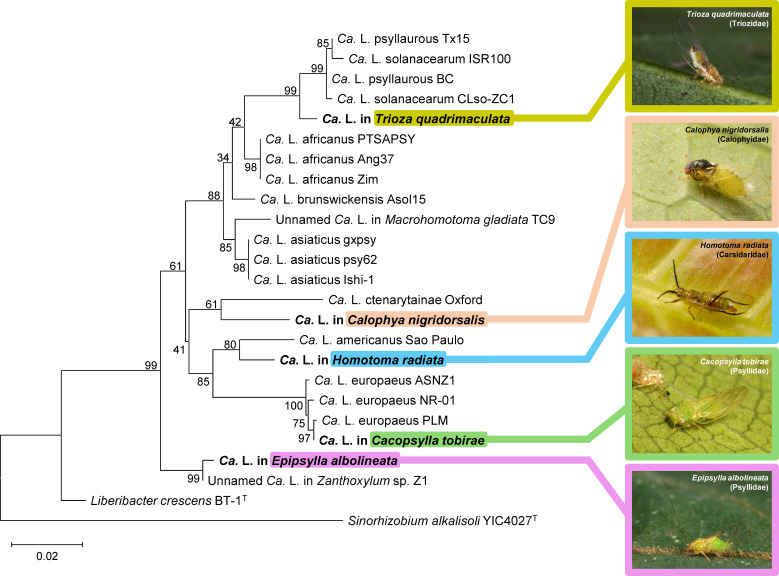 Figure 1
Peer Reviews
No public reviews on file for this paper yet. If you reviewed it on a platform where reviews are public (OpenReview, ICLR, NeurIPS, ICML), you can paste yours below so the community can read it here.
Videos
No videos yet. Explain this paper in a talk, walkthrough, or lecture? Add one.
Taxonomy
TopicsPhytoplasmas and Hemiptera pathogens · Plant Pathogenic Bacteria Studies · Nematode management and characterization studies