Bead beating demonstrates enhanced bacterial detection in kidney stone culture compared to traditional mortar-pestle processing
Tyler A. On, Farhan Anwar, Austin L. Chien, Chiu-Hsieh Hsu, Gayatri Vedantam, William D. Lainhart, David T. Tzou

TL;DR
Bead beating improves bacterial detection in kidney stone cultures compared to traditional methods, potentially leading to better infection diagnosis.
Contribution
Bead beating is introduced as a novel, standardized method for kidney stone culture processing.
Findings
Bead beating detected microbial growth in all 25 positive stones, while mortar-pestle missed seven.
Both methods identified the same microbes in 17 stones, but bead beating uniquely detected organisms in seven.
Bead beating showed higher sensitivity and could improve diagnostic accuracy for kidney stone infections.
Abstract
Percutaneous nephrolithotomy (PCNL) is a standard operation for treating large kidney stones but carries a risk of postoperative infection. Recent guidelines recommend obtaining a stone culture or kidney stone culture, yet no standardized protocol exists for processing kidney stones. Bead beating (BB) is a standardizable method of specimen preparation technique, which has been utilized for bacterial culture in other fields, but its application to kidney stone cultures is novel. Sixty kidney stone specimens were collected prospectively from patients undergoing PCNL, and each specimen was processed by either BB or mortar and pestle (MP). Following homogenization, samples were cultured with the standard procedure for a high-quality urine culture. Microorganisms were identified using matrix-assisted laser desorption/ionization time-of-flight mass spectrometry and quantified following…
Genes, proteins, chemicals, diseases, species, mutations and cell lines named across the full text — each resolved to its canonical identifier and authoritative record.
Click any figure to enlarge with its caption.
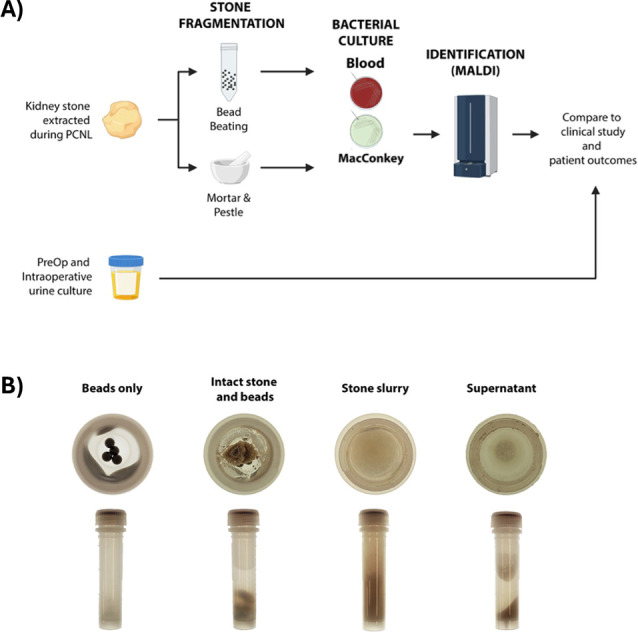 Figure 1
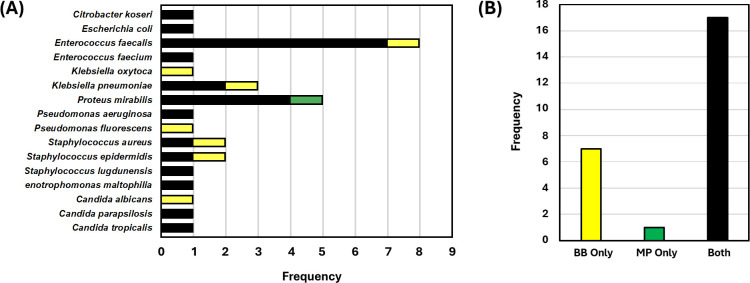 Figure 2
Peer Reviews
No public reviews on file for this paper yet. If you reviewed it on a platform where reviews are public (OpenReview, ICLR, NeurIPS, ICML), you can paste yours below so the community can read it here.
Videos
No videos yet. Explain this paper in a talk, walkthrough, or lecture? Add one.
Taxonomy
TopicsKidney Stones and Urolithiasis Treatments · Bacterial Identification and Susceptibility Testing · Urinary Tract Infections Management