A randomized controlled trial on the effect of hydroxychloroquine in mild Graves’ orbitopathy (GO-HCQ): study protocol
Chia-Hung Lin, Yi-Hsuan Wei, Jin-Ying Lu, Hung-Yuan Li, Chung-Wei Lee, Chung-Yi Yang, Chin-Hao Chang, Wan-Chen Wu, Chih-Yuan Wang, Shyang-Rong Shih

TL;DR
This study will test if hydroxychloroquine helps treat mild Graves’ orbitopathy by measuring eye-related outcomes and quality of life in patients.
Contribution
This is the first randomized controlled trial to evaluate hydroxychloroquine's efficacy in mild Graves’ orbitopathy.
Findings
The trial will assess ophthalmic parameters like eyelid aperture and exophthalmos as primary outcomes.
Orbital CT scans will provide objective data on changes in fat and muscle volumes.
Quality of life and disease activity will be evaluated as secondary endpoints.
Abstract
Graves’ orbitopathy (GO) is a prevalent manifestation of Graves’ disease (GD), characterized by proptosis, eyelid retraction, soft tissue swelling, diplopia, and potential visual acuity impairment. Furthermore, even mild GO can significantly impact mental health and overall quality of life for patients with GD. Despite its severity, available medical treatments for mild GO are limited. Recent basic studies on orbital fibroblasts suggest hydroxychloroquine (HCQ) as a promising therapeutic agent for GO patients. This randomized controlled trial (RCT) was designed to assess the efficacy of HCQ in treating mild GO. This multi-center open-label RCT will be conducted in Taiwan with a total of 108 participants randomized into HCQ and control groups at 2:1 allocation ratio. The primary endpoint of this study is a composite outcome of ophthalmic parameters including eyelid aperture, soft tissue…
Genes, proteins, chemicals, diseases, species, mutations and cell lines named across the full text — each resolved to its canonical identifier and authoritative record.
Click any figure to enlarge with its caption.
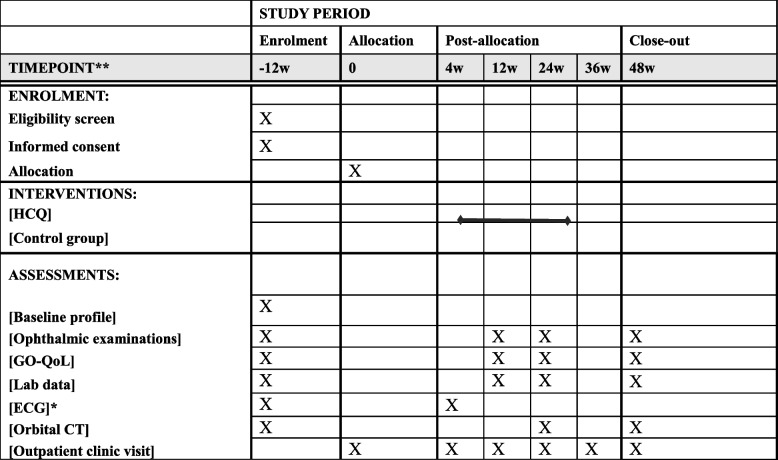 Figure 1
Peer Reviews
No public reviews on file for this paper yet. If you reviewed it on a platform where reviews are public (OpenReview, ICLR, NeurIPS, ICML), you can paste yours below so the community can read it here.
Videos
No videos yet. Explain this paper in a talk, walkthrough, or lecture? Add one.
Taxonomy
TopicsOphthalmology and Eye Disorders · Pituitary Gland Disorders and Treatments · Drug-Induced Ocular Toxicity