Two-Dimensional Metals Over, Inside, or Beneath Templates
Jinbo Pang, Shuye Zhang, Yufeng Hao, Hong Liu, Mark H. Rummeli, Weijia Zhou, Rafael G. Mendes

TL;DR
This paper reviews methods for creating 2D metals and highlights challenges in their growth and stability.
Contribution
The paper systematically discusses five approaches for 2D metal synthesis and outlines future research directions.
Findings
Five common methods for 2D metal fabrication are reviewed.
Thermodynamic stability and scalability remain major challenges.
Future opportunities for 2D metal development are proposed.
Abstract
Two-dimensional (2D) metals have drawn great attention because of their extraordinary properties, especially in applications that favor van der Waals interaction. The development of advanced characterization tools has facilitated the understanding of formation or growth mechanisms of 2D metals. In this perspective, we discuss 5 common approaches to obtaining 2D metals, including, (top down) van der Waals squeezing and selective extraction, and (bottom up) electron beam-induced growth, self-assembly, and graphene-templated wet chemistry growth. The future opportunities are proposed in the summary section. Furthermore, challenges and problems such as thermodynamic stability and scalability in 2D material growth are proposed for the community to tackle.
Genes, proteins, chemicals, diseases, species, mutations and cell lines named across the full text — each resolved to its canonical identifier and authoritative record.
Click any figure to enlarge with its caption.
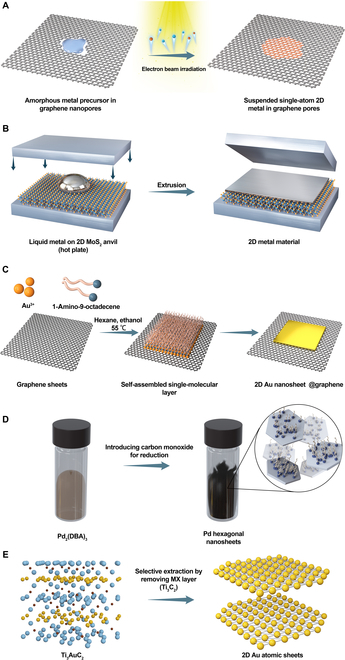 Figure 1
Peer Reviews
No public reviews on file for this paper yet. If you reviewed it on a platform where reviews are public (OpenReview, ICLR, NeurIPS, ICML), you can paste yours below so the community can read it here.
Videos
No videos yet. Explain this paper in a talk, walkthrough, or lecture? Add one.
Taxonomy
TopicsSurface and Thin Film Phenomena · Graphene research and applications · Semiconductor materials and devices