Host–Guest Engineering of MOF-808 for Random Lasing and Solid-State Emission
Giuseppe Ficarra, Ashim Pramanik, Ludovico G. Barbata, Marco Cannas, Romy L. Ettlinger, Russel E. Morris, Gianpiero Buscarino, Fabrizio Messina, Alice Sciortino

TL;DR
This paper shows how embedding fluorescent dyes in MOF-808 improves their stability and enables efficient random lasing and solid-state emission.
Contribution
The novel contribution is demonstrating MOF-808's dual role in preventing dye quenching and enhancing random lasing performance.
Findings
MOF-808 prevents aggregation-caused quenching in dyes, enabling solid-state emission.
MOF-808 nanoparticles act as efficient scatterers, enhancing random lasing with reduced thresholds.
MOF-808-dye thin films are suitable for portable lasing applications with halved lasing thresholds.
Abstract
Fluorescent organic dyes have a broad range of applications across various fields. However, their use is threatened by stability issues such as photobleaching and aggregation-caused quenching that prevent them from showing solid-state luminescence and being used in high-power photonics applications for a long period. One possibility to overcome these problems is to embed dye molecules within a hosting platform. Metal–organic frameworks (MOFs) are among the best candidates to overcome these problems due to their porous nature, which provides excellent sorption capacities while ensuring stability for potential guest molecules, even in extreme environments. In this work, we investigate the optical performance of rhodamine B and coumarin 343 when interacting with Zr-based MOF-808. On one hand, we demonstrate that inclusion of dye molecules in MOF-808 cavities prevents aggregation-induced…
Genes, proteins, chemicals, diseases, species, mutations and cell lines named across the full text — each resolved to its canonical identifier and authoritative record.
Click any figure to enlarge with its caption.
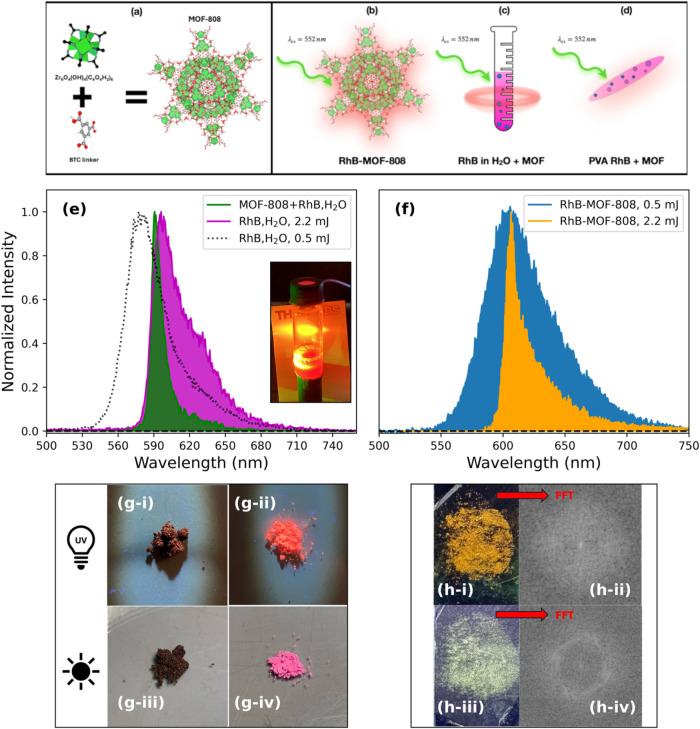 Figure 1
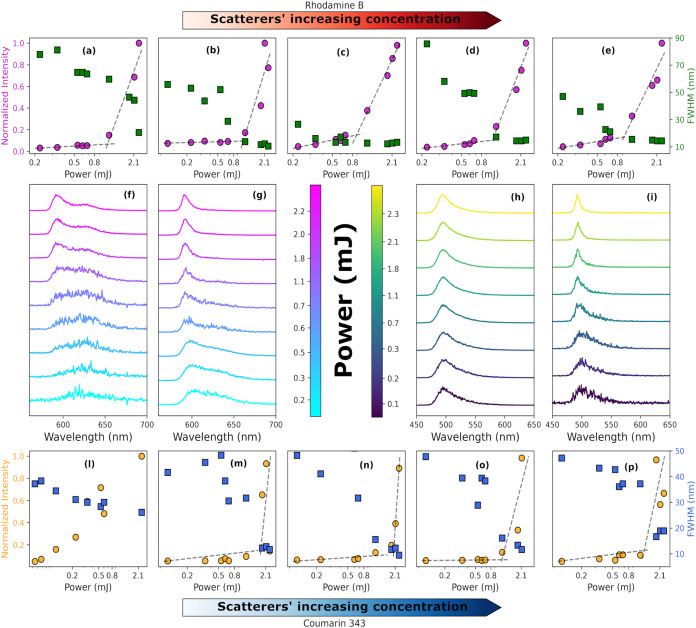 Figure 2
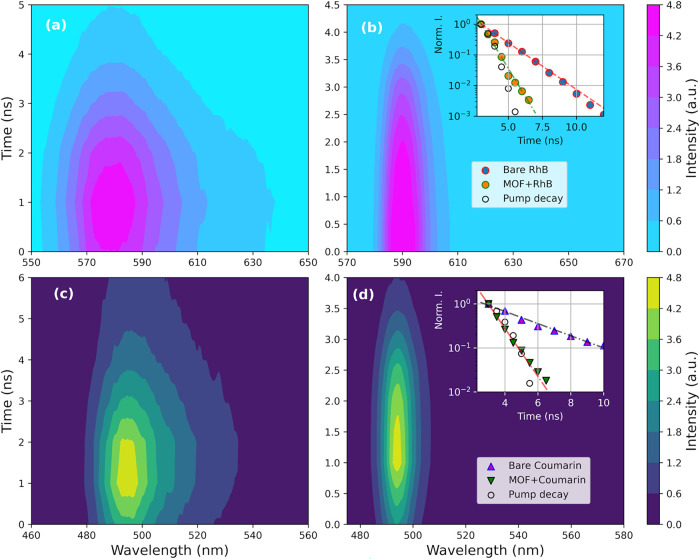 Figure 3
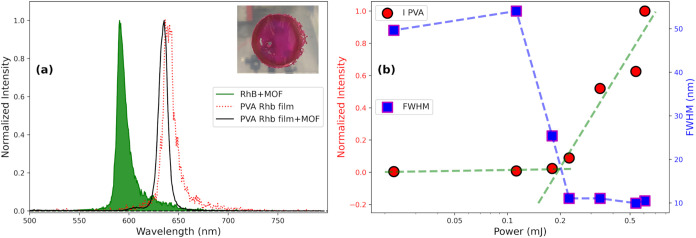 Figure 4
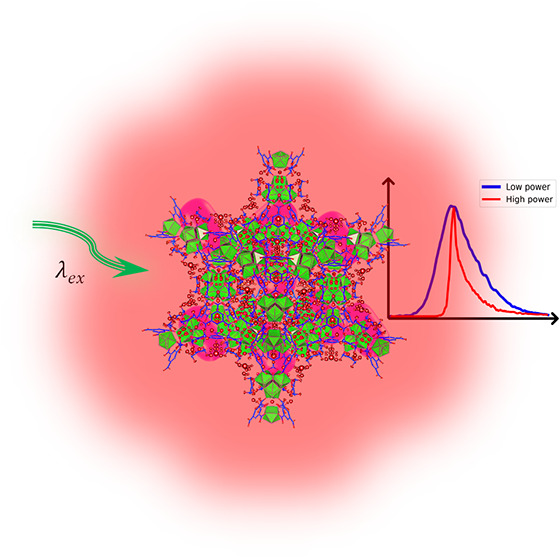 Figure 5
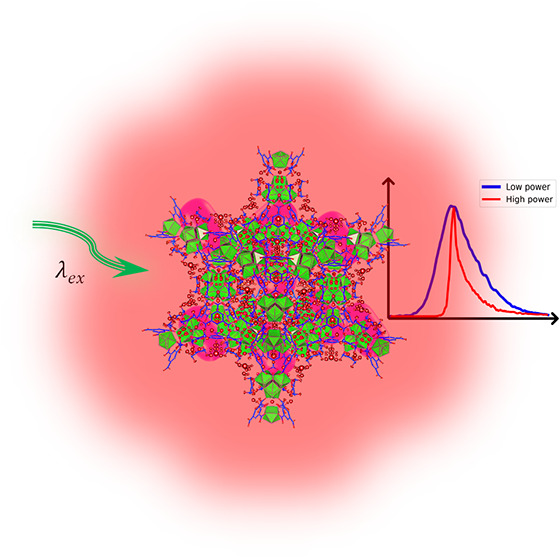 Figure 6
 Figure 7
Peer Reviews
No public reviews on file for this paper yet. If you reviewed it on a platform where reviews are public (OpenReview, ICLR, NeurIPS, ICML), you can paste yours below so the community can read it here.
Videos
No videos yet. Explain this paper in a talk, walkthrough, or lecture? Add one.
Taxonomy
TopicsRandom lasers and scattering media · Nonlinear Optical Materials Studies · Luminescence Properties of Advanced Materials