Cultural adaptation and psychometric properties of the 8-item Patient Health Questionnaire (PHQ-8) to screen for depression in southwestern Madagascar
Hervet J. Randriamady, Manasi Sharma, Rocky E. Stroud, Aroniaina M. Falinirina, Romario, Madeleine Rasoanirina, Nadège V. Volasoa, Frédéric Déclerque, Marc Y. Solofoarimanana, Jean C. Mahefa, Hanitra O. Randriatsara, Karestan C. Koenen, Christopher D. Golden

TL;DR
This paper adapts and validates a depression screening tool for use in southwestern Madagascar, showing it works well across different groups.
Contribution
The PHQ-8 was culturally adapted and validated for depression screening in Madagascar, with evidence of measurement invariance across demographic groups.
Findings
The one-factor depression model showed better fit (RMSEA=0.046, CFI=0.993) than the two-factor model.
The adapted PHQ-8 demonstrated good internal consistency (omega=0.81, alpha=0.87).
Measurement invariance was achieved across sex, ethnicity, education, and age groups.
Abstract
There have been no culturally validated measures to screen for depression in Madagascar. In 2022–2023, we conducted qualitative studies in the Bay of Ranobe area in southwestern Madagascar to understand local mental health syndromes specific to this region. We found that the 8-item Patient Health Questionnaire (PHQ-8) shares symptoms with the general distress-like, depressive-like and grief-like syndromes elicited locally. We adapted the PHQ-8 to align with the unique symptoms found in the region that were missing from the measure. We administered the adapted PHQ-8 to 809 participants aged 16 and above. We found that the one-factor (Depression) model (root mean square error of approximation [RMSEA] = 0.046, standardized root mean square residual [SRMR] = 0.053, Comparative Fit Index [CFI] = 0.993 and Tucker–Lewis Index [TLI] = 0.991) had a better fit to our data than the two-factor…
Genes, proteins, chemicals, diseases, species, mutations and cell lines named across the full text — each resolved to its canonical identifier and authoritative record.
Click any figure to enlarge with its caption.
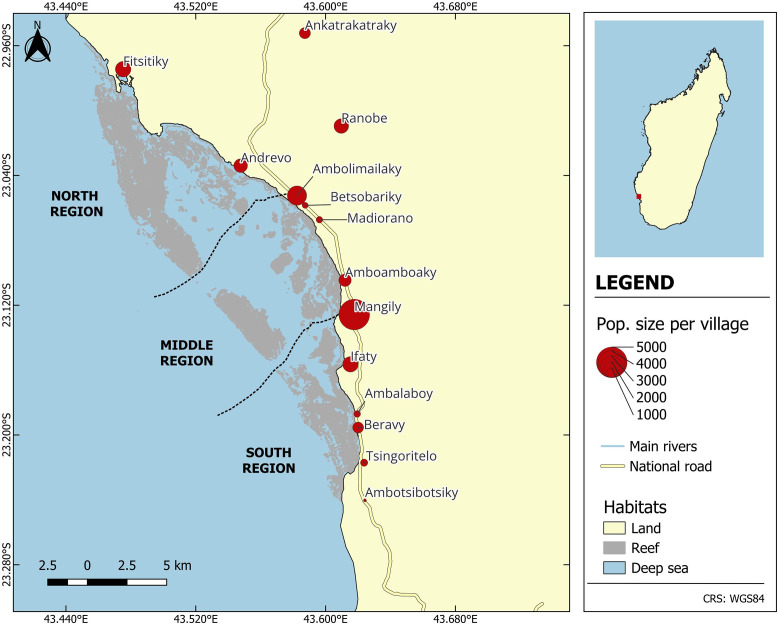 Figure 1
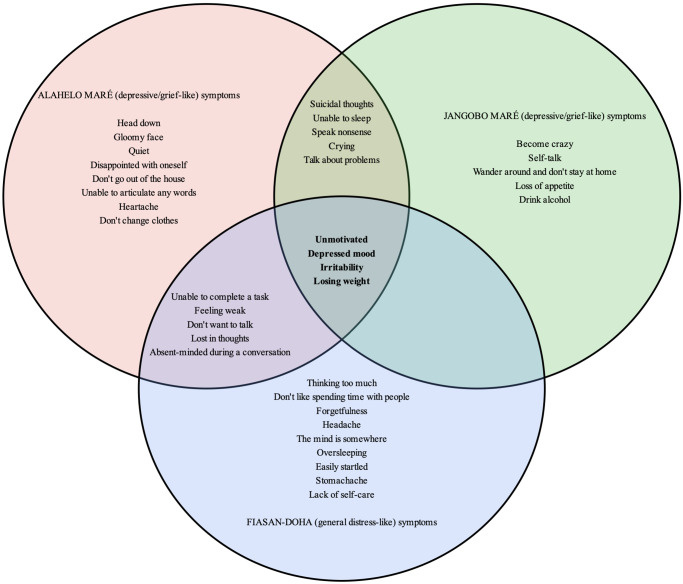 Figure 2
 Figure 3
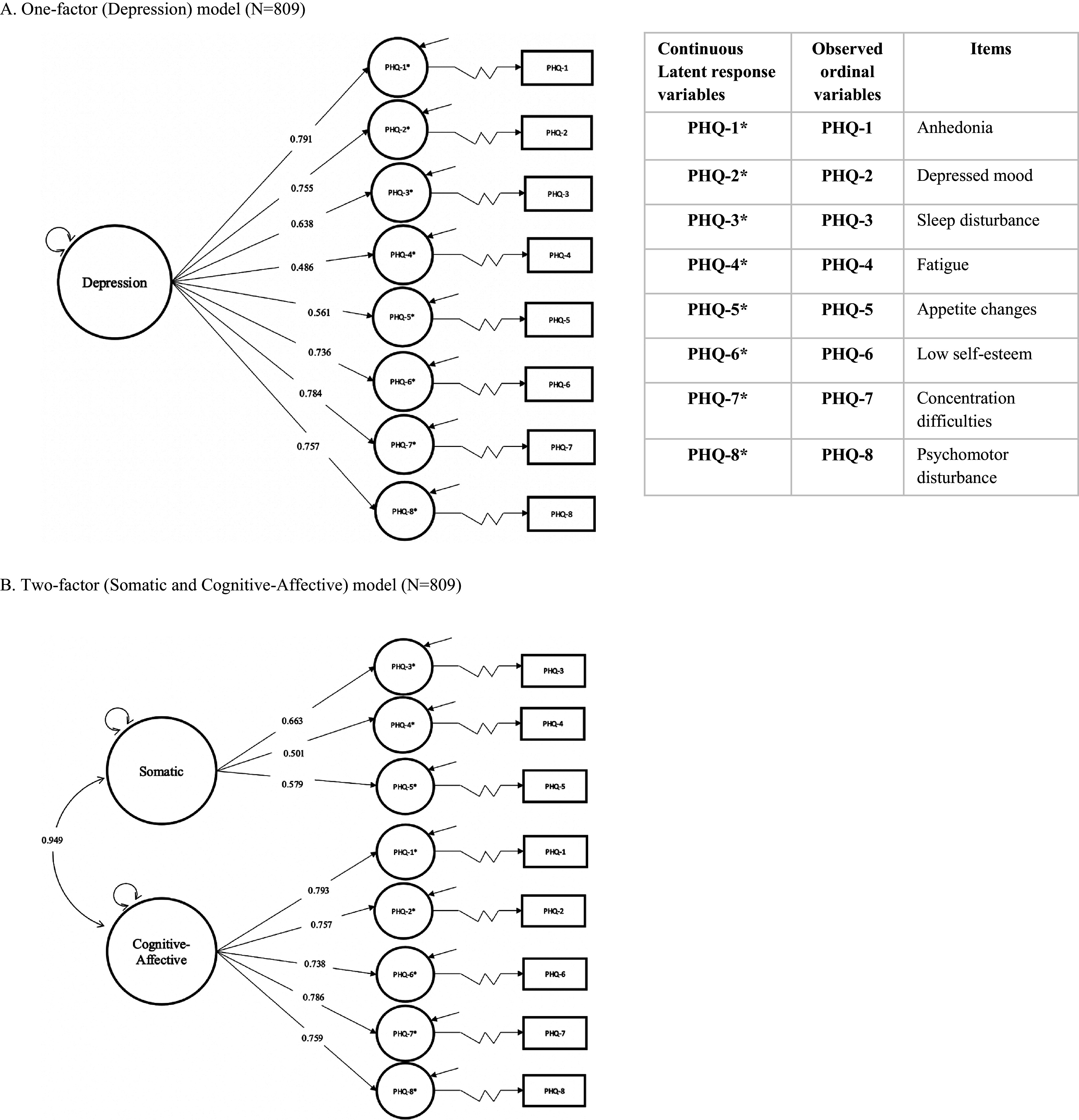 Figure 4
 Figure 5
 Figure 6
 Figure 7
 Figure 8
 Figure 9
 Figure 10
 Figure 11
 Figure 12
 Figure 13
 Figure 14
 Figure 15
 Figure 16
 Figure 17
 Figure 18
 Figure 19
 Figure 20
 Figure 21
 Figure 22
 Figure 23
 Figure 24
 Figure 25
 Figure 26
 Figure 27
 Figure 28
 Figure 29
 Figure 30
 Figure 31
 Figure 32
 Figure 33
 Figure 34
 Figure 35
 Figure 36
 Figure 37
 Figure 38
 Figure 39
 Figure 40
 Figure 41
 Figure 42
 Figure 43
 Figure 44
 Figure 45
 Figure 46
 Figure 47
 Figure 48
 Figure 49
 Figure 50
Peer Reviews
No public reviews on file for this paper yet. If you reviewed it on a platform where reviews are public (OpenReview, ICLR, NeurIPS, ICML), you can paste yours below so the community can read it here.
Videos
No videos yet. Explain this paper in a talk, walkthrough, or lecture? Add one.
Taxonomy
TopicsMental Health Treatment and Access