Arterial tortuosity syndrome in a newborn
Pietro G. Lacaita, Gudrun M. Feuchtner

Abstract
Genes, proteins, chemicals, diseases, species, mutations and cell lines named across the full text — each resolved to its canonical identifier and authoritative record.
Click any figure to enlarge with its caption.
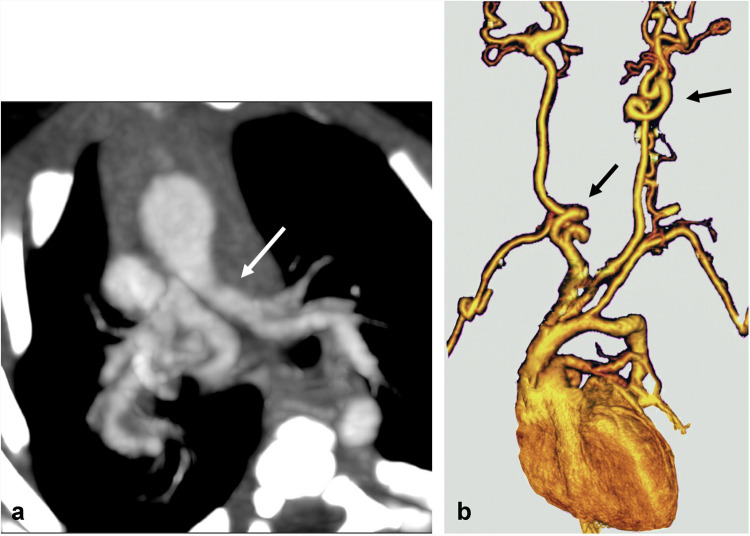 Figure 1
- —University of Innsbruck and Medical University of Innsbruck
Peer Reviews
No public reviews on file for this paper yet. If you reviewed it on a platform where reviews are public (OpenReview, ICLR, NeurIPS, ICML), you can paste yours below so the community can read it here.
Videos
No videos yet. Explain this paper in a talk, walkthrough, or lecture? Add one.
Taxonomy
TopicsConnective tissue disorders research · Shoulder Injury and Treatment · Hip disorders and treatments
A 2-day-old girl presented with cutis laxa, frequent vomiting, and infant respiratory distress syndrome, necessitating neonatal intensive care. Echocardiography showed aortic elongation. An anteroposterior chest radiograph demonstrated an enlarged cardiomediastinal silhouette and a retrocardiac lucency due to a large diaphragmatic hernia, which was confirmed by computed tomography angiography (CTA).
Axial CTA (a) showed an inverted V-shaped configuration of the pulmonary artery bifurcation (arrow), along with tortuosity and narrowing of the left main pulmonary artery (arrow). Three-dimensional reconstructions of the vertebral arteries (b) showed significant arterial twisting (arrows in** b**).
Genetic profiling confirmed arterial tortuosity syndrome, a rare connective tissue disorder caused by a mutation in the SLC2A10 gene. Radiological features were vascular twisting and pulmonary stenosis. Additional associated abnormalities with the syndrome include kyphoscoliosis, chest wall deformities, hernias (inguinal and/or diaphragmatic), vascular aneurysms, and skin laxity.