Schrödinger's Doctrine of Identity: On the Role of Advaita Vedānta in Erwin Schrödinger's Thought
Thijs M. K. Latten

TL;DR
This paper explores how Indian philosophy, particularly Advaita Vedānta, influenced Erwin Schrödinger's scientific and philosophical thinking.
Contribution
The paper identifies Schrödinger's adoption of the 'doctrine of identity' from Advaita Vedānta as a key philosophical influence.
Findings
Schrödinger's engagement with Advaita Vedānta is evident in his personal notebooks and published works.
The doctrine of identity provided Schrödinger both religious comfort and a framework for metaphysical inquiry.
This Indian philosophical concept resonated with Schrödinger's views on the nature of reality and science.
Abstract
Ever since Erwin Schrödinger learned about Indian thought through Arthur Schopenhauer, it occupied a visible role in both his published writings and personal books. Schrödinger called for a “blood transfusion” of Indian thought into the West and, in one notebook, construed the Upaniṣadic slogan “Brahman = Atman” as the “closest thing to the truth.” However, the historical and philosophical literature on his engagement with Indian ideas remains limited and often confused. Two questions should be addressed for a more comprehensive account of Schrödinger's philosophical views: which Indian insights did he embrace, and what was their role in his thought? I argue that examining what he termed the Indian “doctrine of identity” illuminates answers to these questions and can correct some historical misinterpretations. First, situating Schrödinger's reading of Indian works in his time and…
Genes, proteins, chemicals, diseases, species, mutations and cell lines named across the full text — each resolved to its canonical identifier and authoritative record.
Click any figure to enlarge with its caption.
 Figure 1
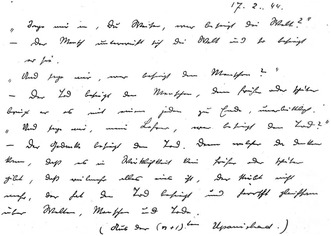 Figure 2
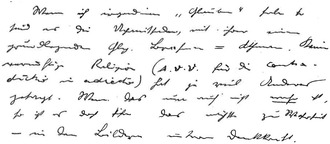 Figure 3
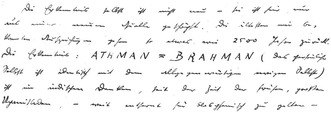 Figure 4
Peer Reviews
No public reviews on file for this paper yet. If you reviewed it on a platform where reviews are public (OpenReview, ICLR, NeurIPS, ICML), you can paste yours below so the community can read it here.
Videos
No videos yet. Explain this paper in a talk, walkthrough, or lecture? Add one.
Taxonomy
TopicsSpanish Philosophy and Literature · Educational Philosophies and Pedagogies
Introduction
1
Although Erwin Schrödinger is famous for his contributions to quantum physics, he wrote in his book My View of the World about a long‐cherished wish to become a philosopher—indicating he considered to “devote” himself to philosophy in 1918, before his 1925 breakthrough in wave mechanics.1 This same year, Schrödinger read the work of various philosophers and was introduced to Indian philosophy through Arthur Schopenhauer's writings. In the rest of Schrödinger's writings throughout his life, both published and unpublished, Indian concepts and ideas played a visible role. Most notably, his book My View of the World culminated in a chapter called “The Vedantic Vision,”2 where he elaborated his answer to what he saw as the “real difficulty” for philosophy, namely: how to make sense of the spatial and temporal multiplicity of observing and thinking individuals.3 His answer: “The plurality that we perceive is only an appearance; it is not real.”4 Schrödinger laid out that ultimately there is a unity of individual selves and a unity between this self and the world:[…] inconceivable as it seems to ordinary reason, you—and all other conscious beings as such—are all in all. Hence this life of yours which you are living is not merely a piece of the entire existence but is in a certain sense the whole; […]. This, as we know, is what the Brahmins express in that sacred, mystic formula which is yet really so simple and so clear: Tat tvam asi, this is you. Or, again, in such words as ‘I am in the east and in the west, I am below and above, I am this whole world.’5
Schrödinger described this insight of ultimate unity as the “profound rightness of the basic conviction of Vedanta”6—essentially captured in what he called the “doctrine of identity.”7
The main aim of this paper is to zoom in on Schrödinger's doctrine of identity to assess the relation between Indian philosophy and Schrödinger's thought in a twofold manner: I aim to assess 1) which Indian insights Schrödinger specifically embraced; and 2) what role these Indian ideas played in his life and thought.
A more comprehensive understanding of Indian insights in the worldview of this pivotal physicist is particularly relevant in light of Schrödinger's own comments on the matter. Schrödinger adamantly believed that metaphysics was and should be the basis for science,8 that this basis was defunct,9 and that it was “Eastern thought” that should aid in the rethinking of this basis.10 To better understand what Schrödinger could have meant and potentially to better understand the role of Schrödinger's philosophical views in his physics, we first need to reach a better understanding of Schrödinger's thought in general, specifically about the origin and role of the Indian ideas in it.
Previous literature on Schrödinger and Indian thought remains rather limited and often confused. In Lisa Wessels’ 1975 dissertation on Schrödinger's interpretation of quantum mechanics, she centrally assessed his philosophical views through Ernst Mach and Ludwig Boltzmann.11 In 1989, Walter Moore published his biography on Schrödinger, addressing Schrödinger's fascination with Indian philosophy more thoroughly. Moore emphasized how Schrödinger adopted Indian concepts as religious truths12 and indicated, furthermore, that Schrödinger “found in the philosophy of Vedānta his understanding of the nature of scientific research,”13 but Moore did little to elaborate on how exactly this is the case. In 1998, Michel Bitbol then delivered the most philosophically rich account of Schrödinger and Indian thought to date, discussing in quite some detail Schrödinger's thoughts on the duality of mind and matter and the observed plurality of minds and bodies.14 Bitbol concluded Schrödinger's philosophy “relied extensively on Indian concepts of mind and matter”15 and that “Schrödinger was so deeply immersed in a non‐dualist Vedântic‐like view that this served as a broad framework, and as a subliminal inspiration, in all parts of his work, including in theoretical physics.”16
A point of confusion throughout this literature resides in the Indian traditions from which Schrödinger distilled his doctrine of identity. Both Wessels and Moore equated the message of the Upaniṣads (widely regarded as one of the most important foundational collections of Sanskrit texts based on which numerous Indian philosophical traditions arose) with Vedānta (one particular school of interpretations of, among others, the Upaniṣadic texts).17 Furthermore, Bitbol referred to Schrödinger's position as Vedānta,18 but then also referred to Schrödinger's position as Advaita Vedānta (a further subschool within the school of Vedānta), and makes no attempt to address the historical confusion. The first aim of this paper, discussed in Section 2, is to target this confusion surrounding the origin of Schrödinger's doctrine of identity. I show it is specifically the notion of Advaita Vedānta by eighth century CE Indian thinker Śrī Śaṅkarācārya (hereafter referred to as Śaṅkara) that Schrödinger embraced in his reading of the Upaniṣads and consequently in his doctrine of identity. By historically contextualizing Schrödinger's reading of Indian thought—currently absent from the literature—through nineteenth‐century philosopher Arthur Schopenhauer, we can see exactly why it is this Advaita Vedānta reading that has been embraced in various Western references to the Upaniṣads.
The second and final aim of this paper is to indicate the role of these Advaita Vedānta insights in Schrödinger's life and thought, as discussed in Section 3 and 4. This second aim of the paper contributes to the literature by expanding upon Bitbol's work and by offering a new look into some of Schrödinger's notebooks in Section 3.1. I argue, in this paper, that Schrödinger's published and unpublished writings indicate that this doctrine of identity seems to have offered Schrödinger both a way of dealing with the finitude of existence while also informing his views on the nature of reality and some of his reflections in the philosophy of science. I indicate the philosophical significance of two notions present in the doctrine of identity in Schrödinger's thought (the notion of non‐dualism and of a perceived‐ultimate distinction). I use these notions to analyze the relation between Schrödinger's embrace of this doctrine of identity and Schrödinger's reading of Mach's neutral monism and highlight resemblances with his thoughts on the subject–object relation in quantum mechanics19 and his views on scientific realism.
Some notes on methodology and scope are in order. In this paper, I investigate both Schrödinger's published philosophical books and essays as well as his unpublished personal notebooks and diaries (cited as this paper progresses). I closely read selected parts of the Erwin Schrödinger Archive in Vienna relevant to the topic of this paper—selected through database searches and complemented by selections of Christof Capellaro (administrator of the Erwin Schrödinger Archive). Concerning the scope of this paper, I cannot aim to do justice to all philosophers and physicists who have exerted an influence on Schrödinger's thought.20 I specifically zoom in on those influences necessary to understand Schrödinger's doctrine of identity, most notably nineteenth‐century philosopher Arthur Schopenhauer and eighth‐century Indian thinker Śaṅkara. One can observe possible parallels particularly with the topics discussed and insights presented by Immanuel Kant and Ernst Mach. Although I will address some of these, a comprehensive study of the relation between these European ideas and possible resemblances in India is beyond the scope of this paper. How exactly the deeper relations between these influences converge in Schrödinger's thought is a topic for future studies—this paper aims to contribute to first laying out what Indian insights Schrödinger so visibly embraced, where they came from, and what role they played in his thinking.
Śaṅkara and Schrödinger's Reading of the Upaniṣads
2
Schopenhauer and Persistent Misconceptions
2.1
Schrödinger's notebooks around 1918, near the end of the First World War, display a preoccupation with Indian philosophy.21 In Schrödinger's own recollection, he became familiar with the “doctrine of unity” (usually referred to as “doctrine of identity”)—which he attributes to the Upaniṣads—in 1918 through Arthur Schopenhauer.22 This is not surprising, as Schopenhauer is one of the most famous (or infamous) and widely read philosophers who introduced Indian thought to the West. Although he did not specify his source, Walter Moore noted multiple times that Schrödinger “read every word” of Schopenhauer,23 and concluded Schopenhauer's “direct influence on Schrödinger was considerable, but equally important was the introduction he provided to Indian philosophy.”24 This informs an essential but currently overlooked way in which Schrödinger's reading of Indian thought should be contextualized.
Schopenhauer read the Upaniṣads—widely regarded as one of the most important foundational collections of Sanskrit texts in orthodox Indian traditions—through the first translation of the work into Latin, translated by Abraham Hyacinthe Anquetil‐Duperron in 1801.25 Schopenhauer reportedly read this book every night before going to bed.26 Anquetil‐Duperron's translation of the Upaniṣads, however, was no clear rendering of the Sanskrit text into Latin. Rather, Duperron translated the work based on the Persian translations, dated 1657, commissioned by Prince Dārā Shukōh (great‐grandson of the Mogul emperor Akbar). As historian Wilhelm Halbfass showed, within this Persian translation, various cases of commentaries can be found that can be traced back to eighth‐century Indian thinker Śaṅkara.27 This particular reading, as I will illustrate, seems to have informed Anquetil‐Duperron, Schopenhauer, and eventually Schrödinger's readings of the Upaniṣadic texts.
I should first address why rendering Śaṅkara's commentary as a clear reading of the Upaniṣads is historically problematic. This becomes clear once we understand the lineage of Indian scholarship. Vedic texts (or: Vedas)—a large body of early Sanskrit texts—date back to the second millennium BCE. The Upaniṣads is the collection of texts that (partly) complete the Vedas and are dated around the eighth century BCE. The Upaniṣads centrally address various questions (regarding, e.g., the nature of the self, or the epistemology of liberation) and contain verses on key concepts in Indian philosophy, such as ātman (the self), brahman (ultimate reality), karma, saṃsāra (worldly existence), mokṣa (enlightenment), puruṣa (persons) and prakṛti (nature), which come to constitute the vocabulary of later traditions. Various philosophical schools arose that accepted the authority of the Vedas in the following centuries, such as Vaiśeṣika, Nyāya, Mīmāṃsā, Vedānta, Sāṃkhya, and Yoga. As the number of interpretative schools suggests, the meaning and significance of the terms and topics discussed in (among others) the Upaniṣads, are widely controversial throughout later traditions. These traditions developed distinct epistemologies, metaphysics, ethics, soteriology, and logical frameworks. To give an example of the variety already within the metaphysical outlook, Vaiśeṣika traditions can be characterized as pluralistic realism where the ontology is organized in categories (padārtha), while Samkhya traditions chiefly emphasize the significance of the metaphysical duality between prakṛti (nature) and puruṣa (persons). The school of Vedānta—often mentioned by Schrödinger and scholars of Schrödinger—places particular emphasis on those passages concerning the relation between brahman and ātman. Moreover, the school of Vedānta,28 as one of the six major interpretive schools of the Vedas listed above, is itself not a unitary school. It can be subdivided into the six main interpretive schools of Bhedābheda, Advaita, Viśiṣṭādvaita, Dvaita, Śuddhādvaita, and more recently Neo‐Advaita—all with a distinct focus. While the subschool of Dvaita Vedānta, for example, teaches the complete difference between the individual self and brahman, Advaita Vedānta emphasizes the non‐dualism, or rather, complete monism, of brahman and ātman (this can be recognized in the name of the school: a meaning non and dvaita meaning dualism in Sanskrit). As the Indian philosophical traditions are much too rich and diverse to do justice to here, what is important to observe in the context of this paper is that Śaṅkara and his school of Advaita Vedānta is distinctly promoting a radical form of metaphysical monism.29 Brahman, for Advaitins, is the monist unity that transcends individuality and plurality. Śaṅkara's Advaita Vedāntin commentary, the reading included in Anquetil‐Duperron's translation, thus delivered a specific eighth‐century CE interpretation, within a distinct school of interpretations, on the foundational texts of the Upaniṣads—sixteen centuries (!) after the Upaniṣads came into existence. Hence it would be historically problematic to unequivocally render this reading as a clear reading of the original texts. What Schopenhauer understands to be the Upaniṣads is, thus, influenced by an interpretation (Śaṅkara's reading) within a school of interpretations (Advaita Vedānta) that sits within a further distinct school of interpretations (the school of Vedānta) of the original Upaniṣads.
This intermingling of Śaṅkara's Advaita Vedānta and the original Upaniṣads has affected this line of scholarship philosophically—from the earliest Persian translations into Schopenhauer. Halbfass elaborated that Dārā Shukōh (who commissioned the translations of the Upaniṣads including some of Śaṅkara's commentary into Persian) took it for granted that Hinduism is monotheistic, and saw the Upaniṣads as the “most original testimony of the oneness of God or the Absolute”30—resonating with the philosophical tenets of ultimate monism that identified Śaṅkara's Advaita Vedānta in the Indian philosophical landscape. Resemblances between Schopenhauer and Śaṅkara's systems of thought have often been remarked.31 Perhaps most importantly, Śaṅkara's notion of the illusory character of the plurality we perceive around us (as ultimately there is only brahman) is present in both Anquetil‐Duperron and Schopenhauer.32 In a hermeneutical study on Schopenhauer's philosophy and Indian thought, Douglas Berger showed that māyā is one of the central terms Schopenhauer used in his philosophical system that he adopted from Indian thought, affecting Schopenhauer's epistemology, metaphysics, and ethics.33 Berger showed Schopenhauer incorporated a notion of māyā (as ignorance) in his “falsification thesis”34—the existence of the world as it presents itself to us is falsified in the sense that it is illusory—construing this notion of māyā as a “veil of deception.”35 Berger showed, furthermore, that the definition of māyā Schopenhauer used is one that was not introduced in Indian traditions until Advaita Vedānta thinkers such as Śaṅkara altered the conception of māyā by equating māyā with avidyā (ignorance).36 So, it was this understanding of māyā introduced by Advaita Vedānta scholars that influenced Schopenhauer's philosophy.
Despite widespread criticism of Schopenhauer's grasp of Indian philosophy, spanning various misappropriations and generalizations of Indian concepts,37 there have been numerous scholars who have accepted Schopenhauer as an authority on Indian philosophy and who have consequently adopted much of Schopenhauer's representations of it—including adopting this reading influenced by Śaṅkara's Advaita Vedānta comments as a faithful reading of the original Upaniṣads. Berger identified two camps of scholars: those who critique Schopenhauer's appropriations and those who naïvely assume the correctness of Schopenhauer's musings on Indian philosophy.38 This second, naïve camp includes philosopher Friedrich Nietzsche and Indologist (and Nietzsche's classmate) Paul Deussen.
Schrödinger's Reading of Indian Thought
2.2
Now, turning to Schrödinger, there are both historical and philosophical reasons that indicate he might be placed in what Berger called the naïve camp regarding the misconceptions present in Schopenhauer's rendering of Indian thought, both in his first encounters with Indian thought and in the later stages of his life. Let us start with Schrödinger's initial engagement with Indian thought, particularly assessing the sources Schrödinger embraced in his early reading of Indian philosophy.
Although Schrödinger was critical of Schopenhauer as a person,39 he nowhere adopted a critical attitude to Schopenhauer's use or understanding of Indian thought—neither in his published writings nor in his personal notebooks. Schrödinger listed in one of his notebooks the sources he read on various Indian traditions. Although this notebook is not dated, there is strong reason to believe it was written around 1918.40 Interestingly, the list shows Schrödinger read the work of Max Müller (in original English), who was, according to Berger, critical of Anquetil‐Duperron's translations of the Upaniṣads (the translations Schopenhauer used).41 However, the work where Müller expresses this criticism of Anquetil‐Duperron is not referred to by Schrödinger.42 Moreover, while Schrödinger listed various authors on Buddhism, and Müller is mentioned in the list of “general” Indian thought, Schrödinger mentions only Paul Deussen's Das System des Vedânta when it comes to the sources he read on “Brahmanism.”43 In his encounters with Indian thought around 1918, Schrödinger thus appeared to be, in his first reading of Vedāntic traditions, particularly exposed to the work of Deussen, a notoriously naïve scholar regarding Schopenhauer's misconceptions. Deussen is known to have privileged Śaṅkara's Advaita Vedānta reading, which is particularly evident in the book by Deussen that Schrödinger quoted to have read around 1918.44
Assessing Schrödinger's philosophical ruminations in these early years of his readings of Indian thought confirms the suspicion of Schrödinger as naïvely regarding Schopenhauer's musings as accurate. In the 1925 parts of My View of the World, an Advaita Vedānta notion of māyā, where māyā is this “veil of deception” that Schopenhauer and Deussen adopted, underlies Schrödinger's reasoning when he writes about the fundamental dogma of “Vedantic philosophy” as the idea that the plurality we perceive is only an appearance.45 But even more importantly, Schrödinger's doctrine of identity, which entailed radical unity of all individuals and a further unity between this universal self and the world, centrally formulated in 1925 as Schrödinger's answer to the “real difficulty” for philosophy,46 precisely captured the central idea Śaṅkara's Advaita Vedānta aimed to convey. Although unity was a theme present in the original Upaniṣadic texts, it was precisely the Advaita Vedānta school (including Śaṅkara), as elaborated earlier, that centrally emphasized the illusory character of perceived appearances and embraced the idea of ultimate non‐duality, that is, unity, of ātman and brahman. Śaṅkara and his school of thought distinctly underscored this idea as the message of the Upaniṣads—just like Schrödinger centrally did in his formulation of the doctrine of identity. Schrödinger called this emphasis on non‐plurality the “orthodox dogma of the Upanishads” in 1925, displaying he adopted an Advaita Vedānta reading.47 The main idea Schrödinger takes away is Śaṅkara's emphasis, just like Schopenhauer and Deussen.
A natural question to ask is whether Schrödinger was exposed to or searched for other sources that may have been critical of Schopenhauer's presentations at a later stage of his life, for example, when Schrödinger moved to Berlin in 1927 or to Dublin in 1938. Unfortunately, not a lot is known about exactly what sources on Indian thought were available to Schrödinger throughout his life. Schrödinger often wrote on Indian philosophy in his published works and in his personal notebooks but only sporadically referred to the interpreters or authors he read on the matter. To my knowledge, the only name Schrödinger refers to later in his life regarding his reading of Vedāntic traditions is that of Deussen. In the year before his death, in the 1960 part of My View of the World, Schrödinger wrote about the doctrine of identity and referred to two works of Deussen as the “best sources available in German,” and Schrödinger continues in the book to quote from Deussen's translations.48 In one of these works that Schrödinger labeled the best works on Indian thought, several parts of Deussen's translation of the Upaniṣads were based on Anquetil‐Duperron's Latin translation, which, as elaborated earlier, was precisely the work that intermingled Śaṅkara's commentaries with the original texts (based on the Persian translations of Dārā Shukōh).49 Hence Schrödinger appeared to rely on translations by Deussen, while Deussen utilized the very same work responsible for the prevalence of Śaṅkara in Schopenhauer.50 As such, despite the lack of comprehensive insight into what sources were available to Schrödinger at different stages of his life, Schrödinger's strong endorsement of Deussen's work near the end of his life in 1960, and Deussen being known for privileging Śaṅkara's reading and adopting Schopenhauer's misunderstandings, displays historical reasons suggesting a certain continuity of the prevalence of Śaṅkara's thought in Schrödinger's views on Indian philosophy.
This suggested continuity is again supported when we look at the content of Schrödinger's reflections on Indian thought in the later stages of his life. Schrödinger wrote explicitly about the Indian concept of māyā, again through Schopenhauer's and Śaṅkara's use of the term as the perceived deception (e.g., 1944 and 1960). For example, Schrödinger wrote in 1960: “the plurality of sensitive beings is mere appearance (maya); in reality they are all only aspects of the one being.”51 Moreover, the doctrine of identity is possibly even more fanatically embraced in the later stages of his life and centrally echoes the same Advaita Vedānta emphasis on unity throughout his writings (e.g., in 1944, 1958, and 1960).52 For example, Schrödinger wrote in 1960: “‘There is no plurality here whatever.’ This is simply the mystical‐metaphysical doctrine of the Upanishads itself […].”53 Schrödinger perceiving this doctrine of identity as the “doctrine of the Upanishads itself” in 1960, illustrates he, like Schopenhauer and Deussen, followed Śaṅkara's reading of the work, supposedly until the end of his life.54 Even in case Schrödinger had at some point encountered other sources on Indian philosophy that did not adopt Schopenhauer's and Deussen's presentations, the aforementioned historical and philosophical reflections suggest such sources may not have made a significant impact on the central idea of Schrödinger's doctrine of identity.
We see, thus, how Schopenhauer's use of Anquetil‐Duperron's translations resulted in an overemphasis on Śaṅkara's Advaita Vedānta in Western literature on India55—which became particularly visible in Schrödinger's doctrine of identity. This should be addressed as there seems to be a way in which we can speak of a lineage of misconception that perpetuates until today, running through Schopenhauer, Deussen, Schrödinger, and now through Schrödinger scholars such as Wessels and Moore. Outside of Bitbol56—who correctly referred to Schrödinger's reading of the Upaniṣads as an Advaita Vedānta reading but did not elaborate on why this was the case, nor did he address the historical misconceptions—the conceptual mix‐up originating in Anquetil‐Duperron's 1801 translation remained unnoticed in Schrödinger scholarship. Schrödinger scholars such as Lisa Wessels accepted the “one mind thesis” as the message of the Upaniṣads57 (while this emphasis on brahman as the metaphysical unity being equal to the universal self, or universal consciousness, is specifically an Advaita position). Furthermore, Schrödinger's biographer Walter Moore understands māyā as the “principle of illusion,”58 signaling Moore also adopted the Advaita Vedānta definition of māyā. The problem is sketched most tellingly when Moore wrote that Śaṅkara “provides a standard and orthodox view of Vedānta,” which is simply untrue, and then continued to elaborate on the message of the Upaniṣads by quoting Śaṅkara.59 Such remarks not only perpetuate misconceptions but amplify and solidify them—contributing to a widespread misunderstanding of Indian philosophical traditions in the West.
Critiquing the Substantiality of the Personal Self
2.3
Before I discuss this doctrine of identity in Schrödinger's life and thought, I should briefly underline the centrality of this doctrine of identity in Schrödinger's use of Indian thought. Although Schrödinger read widely into Indian thought, reading and writing also about Samkhya, Yoga and Buddhism,60 the role of these other schools—except for Buddhism61—seems relatively limited in the philosophical work they did in his writings. In this section, I briefly comment on Schrödinger's conceptualization of the self in a notebook in 1944, where I argue Schrödinger's comments can be understood through Śaṅkara's writings. My conclusion contrasts that of Michel Bitbol, who argues that Schrödinger incorporated the Buddhist notion of anātman in his conceptualization of the self.
In a diary entry from April 24, 1944, Schrödinger wrote that the ego is transitory, seemingly aligning his ideas with the defining Buddhist tenet of anātman (no‐self).62 However, in the 1944 diary entry, Schrödinger tried to elaborate that the definition of the self has two meanings: one that is immediate but accidental63 and one in which the self is equal to “It,” elaborating this second position by stating that “I am It. […] That is called all in all—and that is true” (Figure 1).64 Śaṅkara wrote in the Brahmasūtrabhāṣya: “The individual soul is not directly the highest Atman […] We may call the jīva [personal self] as a mere reflection of the Atman.”65 This verse (as well as others) is interpreted as arguing that the personal self is a combination of reality and appearance—it is real in so far as ātman is its basis, and it is appearance in so far as it is observed as finite and distinct.66 Schrödinger's postulation of the two definitions of the self in his diary resonates with Śaṅkara's description: Schrödinger's accidental definition resonates with Śaṅkara's appearance (it appears to us as distinct and finite, but is only appearance), and Schrödinger's definition of the I as the “It,” as “all in all” resonates with Śaṅkara's ultimate definition (Śaṅkara's ātman, since ātman is equal to the ultimate monist unity for Śaṅkara). Schrödinger, furthermore, often explicitly calls this ultimate reality (this second definition) “Atman.”67
Excerpt from Schrödinger's diary dated April 24, 1944. 68 Erwin Schrödinger, Diary March−July 1944 [Ephemerides], 1944, Austrian Central Library for Physics, Vienna/Erwin Schrödinger Archive, L33‐557, copy, in parts transcribed by Auguste Dick.
Although Buddhist schools would agree with the illusory nature of the accidental ego/personal self, they would not agree with the idea that there would be a substantial ātman underneath this illusory self: the rejection of the substantial ātman is the primary reason Buddhists reject the authority of the Vedas. Conceptualizing Schrödinger's comments on the self through an Advaita framework allows us to make sense of his two definitions of the self in his diary without running into complications with Buddhist thought rejecting the substantiality of the universal self, which Schrödinger explicitly embraced.
Bitbol concluded Schrödinger incorporated the Buddhist concept of anātman into his Advaita Vedānta perspective, resulting in a philosophy that combined Buddhist critiques of the substantiality of the personal self with an Advaita emphasis on the universal self.69 I argue this is not a necessary conclusion. One could thus construe the transitory and non‐ultimate character of the self as a form of anātman in Schrödinger's comments, as Bitbol did, but only in a very limited sense: this only accounts for one of the two definitions Schrödinger and Śaṅkara have for the self and would thus (in the Buddhist notion of anātman) be inconsistent with the broader metaphysical claims that both Schrödinger and Śaṅkara put forth. I do not dismiss the role of Buddhism in Schrödinger's thinking (including in how he construes the personal self). For example, reading Buddhist works may reasonably have enforced Schrödinger's belief in the transitory and non‐ultimate character of the personal self. I merely argue, contrary to Bitbol, that the Buddhist notion of anātman is not necessary to make sense of Schrödinger's criticism of the substantiality of the personal self, and thereby highlight a way in which we can construe Schrödinger's comments on the personal self through his over‐arching conviction of the doctrine of identity.
Dealing with Death and Finitude
3
A further question to ask regarding this doctrine of identity is how to make sense of this position in the larger context of Schrödinger's life. In this chapter, I argue that a closer study of Schrödinger's published and unpublished writings shows how this idea of Indian origin offered Schrödinger a form of consolation—a way of dealing with death and the finitude of existence.
In his book, My View of the World, Schrödinger explicitly mentioned that the doctrine of identity offered religious consolation.70 A look into Schrödinger's personal notebooks sheds light on what he may have meant.
Schrödinger wrote many notebooks dedicated to physics and a decent amount dedicated to Indian thought. Moreover, he kept collections of notebooks throughout his life writing on his love life, (the politics of) war, and all types of day‐to‐day things. One of the themes that can be identified running through these diaries concerns his thoughts on death and the finitude of existence, especially around the time of the Second World War. In 1940, for example, Schrödinger wrote about how “Individuals have to escape death […] they have to fear it,”71 as fear of death is a prop that is introduced to secure the survival of the species.72 What is more, his musings on death and existence were often interlaced with references to the doctrine of identity. For example, on February 17, 1944, Schrödinger wrote his own Upaniṣad in his notebook (Figure 2). After a couple of iterations in German, he added an English translation of his own Upaniṣad:Tell me, enlightened one, who overpowers the world?– Man subjects all this world to his command.and thus he acquires power over it.And tell me, who has power over man.– Death has. For sooner or later he puts an end to it with every man, inexorably.And tell me, my teacher, who conquers death?– Thought conquers death. For he who is able to think, that in reality there is no sooner or later, that rather all that is one, he dies not, he has conquered death and, as it were, reigns over worlds, men and death.–E.S.73
Excerpt from Schrödinger's diary dated 17 February 1944. 74 This is the original German version of his self‐written Upaniṣad, before he translated it to English. Erwin Schrödinger, Diary 1942–1944 [Ephemerides], 1944, Austrian Central Library for Physics, Vienna/Erwin Schrödinger Archive, L33‐557, copy, in parts transcribed by Auguste Dick.
Schrödinger, here, captured aspects of the Upaniṣads in both thematic and style. Death, for Schrödinger, can be conquered by realizing (or knowing) the underlying unity of past, present, and future.75 This idea seems more than something he merely conceptually accepted, it seems to bear some personal meaning to him. When his dog—Burschi—died on May 8, 1946, for example, Schrödinger wrote that through friendship with the dog, we transcend our own sphere and bind ourselves to eternity.76 In reality, he elaborated, both the dog and humans are already eternal.77 It is again this underlying unity in which people, animals, and the world are united that Schrödinger referred to when dealing with the death of his dog.78 Schrödinger thus found in this Advaitin emphasis on ultimate unity an answer to the perceived finitude of existence. The doctrine of identity, Schrödinger seems to have maintained, provided insight into the liberation from death through the universal and eternal character of the self, and the unity of this universal self with the world.
The Doctrine of Identity in Schrödinger's Philosophical Views
4
In a diary entry dated the first of June 1941, Schrödinger wrote that if he had any belief, he believed in the Upaniṣadic message that ātman (universal self) equals brahman (ultimate totality of reality) (Figure 3).79 Concerning this insight, he reasoned that even if this statement is also not true, it is “certainly the closest thing to the truth […].”80 One might then wonder whether Schrödinger expressed here his belief in the doctrine of identity as a religious belief or a philosophical conviction. The exact status of religion in Schrödinger's thought remains rather puzzling, as he often used religious symbolism in his philosophical texts but claimed to be an atheist, as other scholars have noted.81 In the remainder of this paper, I do not attempt to spell out the role of religious versus philosophical convictions in Schrödinger's thinking (and whether such a distinction should be maintained at all in Schrödinger's thought). However, I will argue in the remainder of this section that Schrödinger seemed to view this doctrine of identity as a key philosophical notion, adopting it in metaphysical reflections on the nature of reality.82 Schrödinger categorized this doctrine of identity explicitly as a “mystical” and “metaphysical” thesis83—in the same way as, according to him, a position such as materialism is a mystical and metaphysical thesis.84 I will address, for Schrödinger, the philosophical significance of two notions that are present in this doctrine of identity, particularly the notion of non‐dualism and a conventional‐ultimate distinction, and highlight instances where these notions find resemblances in his philosophy of science.
Excerpt from Schrödinger's diary dated June 1, 1941, where he wrote about his belief in the Upaniṣadic message. 85 Erwin Schrödinger, Diary 1940–1941 [Ephemerides], 1941, Austrian Central Library for Physics, Vienna/Erwin Schrödinger Archive, L33‐557, copy, in parts transcribed by Auguste Dick.
The Role of Non‐Dualism
4.1
In another noteworthy diary entry, dated March 10, 1944, Schrödinger suggested the metaphysical significance of this non‐dualist notion expressed in his doctrine of identity. Schrödinger wrote about how the “I” (the universal self) moves the atoms according to the laws of physics.86 His reasoning can be summarized as follows. Schrödinger, in this entry, starts with two observations concerning his body: 1) the body functions as a pure mechanism, obeying the laws of nature; and 2) Schrödinger notes that “I” (Schrödinger) am directing that body. About 1) he is reasonably certain; and about 2) he is absolutely certain through “irrefutable direct experience.”87 Putting these observations together, Schrödinger argued it follows that “I,” in the broadest metaphysical sense of the word (i.e., all conscious agents to have ever existed, Schrödinger noted), am the one who directs and regulates the motions of atoms.88 Schrödinger elaborated that this thought is not new and attributes it to the Upaniṣads (Figure 4).89 Moreover, Schrödinger noted that although this is blasphemy in Christian circles, he concluded just like he did in his book What Is Life?,90 that not only the Upaniṣads but also “the biggest mystics of all time” arrived at “deus factus sum (I have become god—I have become personally identical with god).”91 We see Schrödinger here utilize religious terminology and symbolism in order to express metaphysical reflections about the nature of reality (on that which is beyond the movement of atoms and the laws of nature)—coupling his insights on the universal self to the movement of atoms. Furthermore, it seems Schrödinger imbued, here, this doctrine of identity with a universal character—the biggest mystics, regardless of time and culture, all arrived at versions of this underlying unity of self and world. This universality of these ideas was underlined in his book Mind and Matter, where Schrödinger wrote that his view “levels with that of Aldous Huxley” in his book The Perennial Philosophy.92
Excerpt from Schrödinger's diary dated March 10, 1944, where he mentioned how his point—about the self being identical to the world—is nothing new, as it is found in the Upaniṣadic slogan ātman = brahman. 93 Erwin Schrödinger, Diary March−July 1944 [Ephemerides], 1944, Austrian Central Library for Physics, Vienna/Erwin Schrödinger Archive, L33‐557, copy, in parts transcribed by Auguste Dick.
Schrödinger discussed the philosophical (and scientific) significance of this non‐dualist notion in the doctrine of identity not only in his personal notes. This theme is easily recognized in his published writings.94 In his book Mind and Matter, where Schrödinger once again discussed the doctrine of identity, he mentioned how this idea of unity of mind and matter is particularly unpalatable in Western thought and science.95 This is because, he reasoned, Western thought—based on Greek “objectivation”—has cut itself off from the mind, the subject.96 He called this the “exclusion principle,”97 elaborated as: “we exclude the Subject of Cognizance from the domain of nature that we endeavor to understand.”98 Schrödinger again then introduced his paradox (how to make sense of the plurality of minds) and stated: “There is obviously only one alternative, namely the unification of minds or consciousnesses. Their multiplicity is only apparent, in truth there is only one mind. This is the doctrine of the Upanishads.”99 Schrödinger then connected the doctrine of identity to his ruminations about the omission of the subject in Western thought and science. He wrote: “I do believe that this is precisely the point where our present way of thinking does need to be amended, perhaps by a bit of blood‐transfusion from Eastern thought.”100 Schrödinger suggested a blood transfusion of Eastern thought into the West aimed specifically at assimilating the doctrine of identity with Western thought: introducing the mind, or “I,” into Western thought and science.101 Schrödinger here makes a prescriptive argument: this doctrine of identity is not just an accurate philosophical thesis, Western thought and science should take note of this doctrine of identity. While in colonial India people such as late nineteenth and early‐twentieth century scientist Jagadish Chandra Bose attempted to assimilate traditions such as Advaita Vedānta with Western science, Schrödinger did not work out in much detail what such a “blood transfusion” would look like.102 However, his arguments display his commitment to take this doctrine of identity seriously in contemporary philosophical and scientific reflections and, furthermore, display a commitment to take some Advaita Vedānta insights seriously more broadly in philosophy and science.
It thus becomes clear from both published and unpublished writings that Schrödinger took this non‐dualist notion seriously in his metaphysical ruminations about the nature of reality. Moreover, I argue there is reason to believe this non‐dualist position situated some reflections in his philosophy of science, particularly his reflections on the subject–object relation in his philosophy of quantum mechanics. In Mind and Matter, Schrödinger replied to a claim of what he called the “prevailing school of thought in quantum physics” at the time, namely that of “Niels Bohr, Werner Heisenberg, Max Born and others.”103 In Schrödinger's construal the abovementioned authors argued that under the impact of our refined methods, quantum mechanics showed us how the boundary between subject and object collapsed—as the object is affected by our observation.104 Schrödinger responds elaborately, arguing that ultimately “subject and object are only one. The barrier between them cannot be said to have broken down as a result of recent experience in the physical sciences, for this barrier does not exist.”105 In the chapter immediately following this reply to Bohr, Heisenberg, and Born, Schrödinger offered his remedy against excluding the subject, or the mind, from nature, namely “Eastern thought.”106 We see, here, how it is precisely this tenet of the unity of subject and object—this position of ultimate non‐duality of subject and object he formulated time and time again by Schrödinger through the Advaita insight of ātman equals *brahman—*which seems to motivate this instance of Schrödinger's response to Bohr, Heisenberg, and Born.
Interestingly, since the postulation by Bohr, Heisenberg, and Born (that Schrödinger rejected) casts doubt on the sharp distinction between subject and object in quantum physics, Schrödinger could have used that postulation precisely as a demonstration of the point he tried to convey, namely that quantum mechanics shows the subject should be included in our thinking. But Schrödinger disagreed with their reasoning more fundamentally. Saying this subject–object relation breaks down in quantum mechanics suggests the original dualist assumption was justified in other settings. Schrödinger critiqued this by employing a more thorough and encompassing reading of the non‐dualist thesis. Only for practical reference, to navigate everyday life, do we act as if there is a distinction between subject and object, Schrödinger proclaims.107 But we should not say the subject–object relation breaks down at the quantum level, as, for Schrödinger, this relation does not make sense at any ultimate level. There is ultimately only non‐duality. Schrödinger's insistence on non‐duality thus situated his reflection on the subject–object relation in quantum mechanics. In this instance, it framed his reply to other physicists at the time.
The Perceived and the Ultimate
4.2
Besides this emphasis on non‐dualism, Schrödinger also seems to have utilized a distinction that resembles one in Śaṅkara's Advaita Vedāntin works: that between conventional, perceived reality (vyāvahārikasattā) and ultimate, non‐dual reality (pāramārthikasattā). For Śaṅkara, conventional reality is the world of everyday, empirical reality, in which we perceive a plurality of objects and people.108 This reality, for Śaṅkara, is illusory, but that is not to say it is totally unreal or non‐existent. Rather, it exists as a convention but is illusory in an ultimate sense.109 The word illusion, thus, refers to the sense in which there is no ultimate metaphysical character to the entities we observe. A frequently cited analogy is Śaṅkara's idea that one can mistake a rope for a snake: the observation of the snake is real in some sense, as it has real effects on us (e.g., can induce a physical reaction), but ultimately there is no snake, so the observation of the snake is illusory in an ultimate sense.110 In the analogy, the observation of the snake is conventionally real but has no ultimate character, as there is no snake. Similarly, the world we observe around us, with its plurality of individual minds and objects, exists conventionally for Śaṅkara but has no ultimate metaphysical character. In the following passages, as well as in various other instances across his published and unpublished writings,111 Schrödinger seems to adopt a similar distinction. The distinction between perceived (but deceptive) plurality and the ultimate reality of monist unity is key to what Schrödinger expressed as “the profound rightness of the basic conviction in Vedanta” in 1925, namely, that “the plurality that we perceive is only an appearance; it is not real” followed by the conclusion that you are “all in all.”112 And in 1960, in the second part of My View of the World:[…] astronomy gives us of myriads of suns with, perhaps, inhabitable planets, and of a multitude of galaxies, each with myriads of such suns, and ultimately of a probably finite universe […], mediated to our senses by the indescribable panorama of the starry heavens on a clear night. To me personally all that is maya, albeit maya of a very interesting form, exhibiting laws of great regularity.113
Central to this comment is the deceptive quality of māyā that Schopenhauer, Deussen and Schrödinger took from Śaṅkara's definition of māyā, as discussed in Section 2. Schrödinger hinted more directly at what this means in his 1944 book What is Life?:The only possible alternative is simply to keep to the immediate experience that consciousness is a singular of which the plural is unknown; that there is only one thing and that what seems to be a plurality is merely a series of different aspects of this one thing, produced by a deception (the Indian MAJA).114
Schrödinger here seems to have utilized a similar distinction Śaṅkara maintained. For Schrödinger, we perceive a plurality of things and beings, but this is deceptive or illusory in an ultimate sense, as there is ultimately only the singular consciousness. Note, here, that the distinction between the perceived and the ultimate is, for Schrödinger, not a metaphysical distinction in the sense that these are two metaphysically distinct worlds (see also the discussion on scientific realism later in this section). Schrödinger explicitly used the English word “illusion” in some instances.115 Note, furthermore, that Schrödinger's two definitions of the self discussed in Section 2.3 follow a similar perceived‐ultimate structure. Moreover, also his views on the subject–object relation discussed in Section 4.1 can be understood through this perceived‐ultimate distinction: the subject–object distinction can be expressed precisely as a conventional distinction in Śaṅkara's terms, one that can be used for reference in daily life, but should be rejected in an ultimate account of reality—as subject and object are ultimately one.
The perceived‐ultimate distinction,116 I would argue, helps clarify certain ways in which Schrödinger's philosophical views can be construed, particularly the relation between his reading of Mach's neutral monism and his embrace of Advaita monism. Some contemporary historians of Mach stress that Mach's neutral monism should not be read as a form of atomism, as these neutral elements for Mach are not atomistic logically independent simples but are rather “always bound up in functions that supervene on their causal powers to affect each other.”117 Insofar as I can tell, Schrödinger read Mach's neutral elements not as atomistic in the material sense (as he stresses these neutral elements can constitute either mind or matter). However, there seems to be a sense in which Schrödinger construes these elements as independent simples. Schrödinger referred to these elements as “primitive elements” constituting “the external world and consciousness.”118 Moreover, in his book Nature and the Greeks, Schrödinger describes how the “real world around us” and “we ourselves” are constituted “of the same bricks” and argues that we can think of these neutral elements either as constituting mind or the material world, but not both—similar to how a child can build various things with a box of bricks, such as a house or a tower, but it cannot build both a house and a tower with these objects at the same time.119 In Chapter VII of My View of the World, Schrödinger argues that such notions of Mach (and Avenarius and Schuppe) come “as near to the orthodox dogma of the Upanishads as it could possibly do without stating it expressis verbis.”120 A potential problem in Schrödinger's thinking now presents itself: how can Schrödinger maintain there is ultimately only a unitary brahman (which for Śaṅkara means there is no way one can ultimately make sense of plurality, which Schrödinger explicitly adopts with his emphasis on non‐plurality in his “Vedantic Vision”)121 while also maintaining there is a collection (i.e. plurality) of primitive elements? I argue that looking at Śaṅkara's conventional‐ultimate distinction, which Schrödinger seemed to adopt in his distinction between the perceived and the ultimate, allows for a reading that reconciles these two ideas in Schrödinger's philosophy.
Schrödinger construing the “real world around us” and “we ourselves” through primitive elements can be understood as him using neutral monism to conceptualize conventional, perceived reality. When Schrödinger introduced this notion of the “real world around us,” he did so in a rather ironic fashion—as he was critiquing, in the chapter, our tendency to understand the world around us as if it were something distinct from ourselves, which is mistaken according to Schrödinger.122 Consider again Schrödinger's claim in the aforementioned passage: “[…] what seems to be a plurality is merely a series of different aspects of this one thing.”123 In this assertion, the neutral elements can now be understood as the aspects (i.e., the perceived distinct phenomena, conventional reality, the “real world around us”), while that which they are aspects of, “this one thing,” is the ultimate monist unity (brahman, ātman, universal consciousness or the universal self). This aligns with Schrödinger's characterization of neutral elements as “sense perceptions, memory images, imagination, thought,”124—these typifications concern conventional, perceived reality, which is ultimately happening in the unitary consciousness.125 In this way, if we grant Schrödinger the principle of charity and expect he would have noticed that one cannot maintain there is ultimately one thing while there are also a plurality of elements, we can understand Schrödinger's philosophical views as accepting his reading of Mach's neutral monism to make sense of perceived reality (where the elements are the aspects), while the radical unity expressed in Śaṅkara's views is accepted by Schrödinger to describe reality in an ultimate sense (which is that which the elements are aspects of).126
This notion of a distinction between the perceived and the ultimate in the doctrine of identity is thus adopted in Schrödinger's philosophical reflections on the nature of reality and helps make sense of his reading of Mach's neutral monism in his thinking. Important to note is that even if one would disagree with my analysis of the relation between Schrödinger's Advaita beliefs and his use of neutral monism, the very fact that Schrödinger discussed this doctrine of identity in relation to the philosophical views of people such as Mach (one of his major influences in physics and philosophy) further underlines the philosophical significance of this doctrine of identity for Schrödinger.
Lastly, the perceived‐ultimate distinction that Schrödinger often expressed in Indian terminology resonates further with some of Schrödinger's reflections in the philosophy of science, particularly his attitude to scientific realism. In his book, Schrödinger's Philosophy of Quantum Mechanics,127 Michel Bitbol uses Blackburn's notion of quasi‐realism128 to capture the more mature scientific realist position Schrödinger arrived at around the 1950s, developed over the years. A quasi‐realist is “someone who, starting from an anti‐realist position finds himself progressively able to mimic the thoughts and practices supposedly definitive of realism.”129 In essence, Schrödinger's more sophisticated scientific realist position was metaphysically strictly and unambiguously anti‐realist about the “real world around me” (or as Bitbol puts it: “the reality of the physicist”)130 but was methodologically realist.131 In 1954, Schrödinger talked about the “real world around me” as something he constructs.132 In Bitbol's book, one conclusion posed is that when Schrödinger talks about scientific entities as existing in a real sense, he talks about them as existing as constructs.133 Schrödinger thus maintained a rather loose definition of existence—one where a conceptual entity posited by the scientist exists already as this conceptual entity. This allowed Schrödinger to treat scientific entities as objects of study with utter seriousness while not necessarily ascribing a metaphysical character to them. Bitbol emphasized that this scientific anti(‐metaphysical) realist view that Schrödinger holds regarding the “real world around us” includes the way Schrödinger understands conceptual entities in physics.134
Bitbol mentioned Indian thought briefly when discussing Schrödinger's scientific realist position,135 but a resonance with Śaṅkara's philosophy can now be made more explicit. In Schrödinger's scientific realist considerations, the emphasis on having a world picture that Bitbol points out clearly has Viennese roots, particularly with Boltzmann.136 However, I want to highlight that this idea—that scientific entities can be thought of as real in the sense that they are real as constructed entities—resonates with the way Śaṅkara construes distinct entities as existing by convention. Both Śaṅkara's emphasis on conventional versus ultimate existence and Schrödinger's later quasi‐realist position emphasize the reality of (scientific) entities as conceptual constructs, as constructs we can (and should) talk and think about for pragmatic purposes, while they both fanatically deny the ultimate metaphysical character of these constructs in light of ultimate non‐duality.137 Note, lastly, that there is a sense in which both Śaṅkara and Schrödinger emphasize that appearances are constructed and that it is a lack of knowledge, or ignorance, that is involved in the construction of these appearances.138
Despite the influence of Kant on Schrödinger (and his generation of scientists), and a possible resonance between Schrödinger's abovementioned views and Kantian insights (e.g., think of the construction of the phenomenal world),139 a thorough study on the ways Kantian thought converges with Indian thought in Schrödinger is beyond the scope of this paper.140 In this paper, I merely argue that the resemblance between Śaṅkara and Schrödinger should not be left unnoted. It is especially relevant to mention the resemblance with Śaṅkara since Schrödinger chose to express his thoughts on the reality of the world and objects in it often in Advaita Vedānta terms and concepts (such as māyā, brahman, and ātman), in both his published and unpublished documents.
Conclusion
5
In this paper, I have historically contextualized Schrödinger's reading of Indian philosophy and shown that Schrödinger's doctrine of identity essentially captures Śaṅkara's Advaita Vedānta reading of the Upaniṣads. Furthermore, I have indicated that the insights of ultimate unity seem to have offered Schrödinger a form of religious consolation—a way of dealing with death and the finitude of existence. However, I have further shown how these insights offered Schrödinger more than religious comfort; he takes the doctrine of identity seriously in his philosophical views. Schrödinger adopts the doctrine of identity into his metaphysical ruminations about the nature of reality, and it further resonates with some of his reflections in the philosophy of science, such as the subject–object relation (in quantum mechanics) and his views on scientific realism.
Although the generality of the grand insights adopted from India might obscure a possible influence on Schrödinger's physics, the intensity with which Schrödinger embraced these ideas does suggest the relevance of further research on this topic.141 Furthermore, Schrödinger preached that metaphysics should be the basis for science, so it would be interesting to develop a better understanding of whether and to what extent Schrödinger's own metaphysical views served as the basis for his physics. The fanatic embrace of Indian ideas by Schrödinger shown in this paper demonstrates that Indian insights should not be excluded from such an assessment of philosophical ideas in Schrödinger's scientific pursuits.
The reference list from the paper itself. Each links out to its DOI / PubMed record.
- 1Banks, Erik C. , “The Case for Mach's Neutral Monism,” in Interpreting Mach: Critical Essays, ed. John Preston (Cambridge: Cambridge University Press, 2021), 258–279.
- 2Berger, Douglas L. , “Shedding Light on the Matter: Śaṅkara's Dualistic Theory of Cognition,” in Indian and Intercultural Philosophy: Personhood, Consciousness and Causality, ed. Douglas L. Berger (London: Bloomsbury Academic, 2021), 15–23.
- 3Berger, Douglas L. , “The Veil of Māyā: Schopenhauer's Theory of Falsification: The Key to Schopenhauer's Appropriation of Pre-Systematic Indian Philosophical Thought” (Ph D thesis, Temple University, 2000).
- 4Bitbol, Michel , “Schrödinger and Indian Philosophy.” Conference talk, French Embassy, New Delhi, January 1998.
- 5Bitbol, Michel , Schrödinger's Philosophy of Quantum Mechanics (Dordrecht: Kluwer Academic Publishers, 1996).
- 6Blackburn, Simon W. , Essays in Quasi-realism (New York NY: Oxford University Press, 1993).
- 7Brown, C. Mackenzie , “Jagadish Chandra Bose and Vedantic Science,” in Science and Religion: East and West, ed. Yiftach Fehige (New York: Routledge, 2016), 104–122.
- 8Copleston, Frederick , “Schopenhauer,” in The Great Philosophers: An Introduction to Western Philosophy, ed. Bryan Magee (Oxford and New York: Oxford University Press, 1987), 210–231.