Post-fall sacral swelling
Haruka Hikichi

Abstract
Genes, proteins, chemicals, diseases, species, mutations and cell lines named across the full text — each resolved to its canonical identifier and authoritative record.
Click any figure to enlarge with its caption.
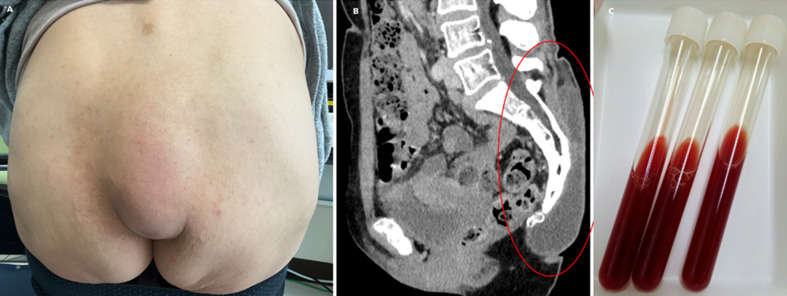 Figure 1
Peer Reviews
No public reviews on file for this paper yet. If you reviewed it on a platform where reviews are public (OpenReview, ICLR, NeurIPS, ICML), you can paste yours below so the community can read it here.
Videos
No videos yet. Explain this paper in a talk, walkthrough, or lecture? Add one.
Taxonomy
TopicsInjury Epidemiology and Prevention
Image in medicine
A 54-year-old woman presented with a progressively enlarging, painless swelling over the sacral region. She reported repeated falls over the preceding several weeks, attributed to the adverse effects of antidepressant medications. Physical examination revealed a 15-cm, soft, non-tender mass with mild erythema over the sacrum (panel A). The patient was afebrile. Laboratory findings, including white blood cell count, erythrocyte sedimentation rate, and C-reactive protein, were within normal limits. Computed tomography revealed a well-circumscribed, homogeneous, low-density fluid collection in the subcutaneous tissue over the sacrum (panel B). Aspiration yielded hemorrhagic, turbid fluid (panel C). Cytology results were negative for malignancy, and cultures were negative for bacterial growth. A diagnosis of sacral bursitis was made. Bursitis is an inflammation of a synovium-lined bursa, typically occurring in large joints such as the shoulder, knee, hip, and elbow. Sacral bursitis is rare and often misdiagnosed as an abscess, hematoma, or soft tissue tumor. In this case, the absence of systemic symptoms, normal inflammatory markers, and negative cultures helped rule out an infectious etiology. Imaging findings also lacked the features suggestive of septic bursitis, such as peribursal fat stranding and wall thickening. Most cases of non-infectious bursitis can be managed conservatively. This patient was treated with rest, analgesics, and aspiration drainage, with gradual resolution of symptoms.
A, B, C) post-fall sacral bursitis presenting as a painless swelling