Genome sequence of Paracoccus sandarakinolimnes ME4, a pigmented, aerobic bacterium isolated from freshwater
Victoria Abramczuk, Virginia Saionz, Maria Estevez, Emily Stowe

TL;DR
This paper reports the genome sequence of a newly discovered freshwater bacterium that produces carotenoids.
Contribution
The study provides the first genome sequence of Paracoccus sandarakinolimnes ME4, a carotenoid-producing freshwater bacterium.
Findings
The genome consists of 4,061,481 bases across five contigs.
It includes 4,028 protein-coding genes, 106 tRNA and rRNA genes, and 35 pseudogenes.
Abstract
Paracoccus is a metabolically diverse genus found in a range of habitats. Here we describe Paracoccus sandarakinolimnes ME4, a carotenoid-producing, aerobic bacterium isolated from freshwater. The genome contains 4,061,481 bases in five contigs with 4,028 protein-coding genes, 106 tRNA and rRNA genes, and 35 pseudogenes.
Genes, proteins, chemicals, diseases, species, mutations and cell lines named across the full text — each resolved to its canonical identifier and authoritative record.
Click any figure to enlarge with its caption.
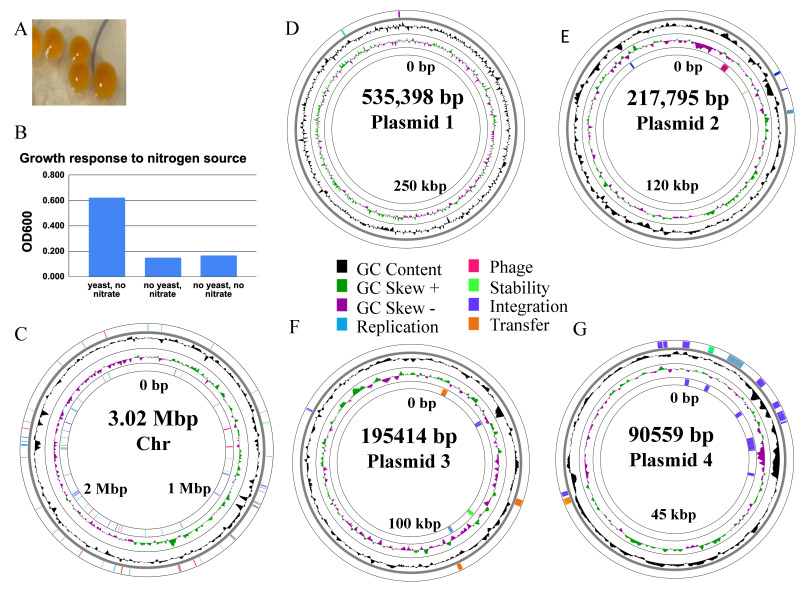 Figure 1
Peer Reviews
No public reviews on file for this paper yet. If you reviewed it on a platform where reviews are public (OpenReview, ICLR, NeurIPS, ICML), you can paste yours below so the community can read it here.
Videos
No videos yet. Explain this paper in a talk, walkthrough, or lecture? Add one.
Taxonomy
TopicsGenomics and Phylogenetic Studies · Microbial Metabolism and Applications · Microbial Natural Products and Biosynthesis
Description
Recent work by Louca et al. (2019) estimates the global diversity of prokaryotes at 0.8 to 1.6 million different OTU (operational taxonomic units). A vanishingly small number of these organisms have been characterized individually. We isolated a novel bacterium (hereafter called ME4) from a freshwater pond on BG11 media (Rippka et al., 1979) supplemented with mannitol while attempting to isolate nitrogen fixing organisms. Though ME4 lacks nitrogen fixation ability, we maintained the organism due to its orange pigmentation, likely a carotenoid ( Figure 1A ). Carotenoids are studied for their potential health benefits and as additives in food, animal feed, and cosmetics (Demmig-Adams et al., 2020, Sereti et al., 2025). Although carotenoids can be synthetically manufactured, interest remains in their biosynthesis by microorganisms (Conradie et al., 2018, Ram et al., 2020, Naik and Gupte, 2024). Many *Paracoccus * species have previously been explored as sources of carotenoids (Conradie et al., 2018, Maj et al., 2020, Naik and Gupte, 2024, Hwang et. al, 2024).
Intrigued by the pigmentation of ME4 and interested in determining if its carotenoid production differed from other known Paracoccus carotenoid producing strains, we carried out additional phenotypic and genetic analyses. ME4 is obligately aerobic and mesophilic, but grows poorly above 30 °C. ME4 requires an organic nitrogen source as indicated by reduced growth when supplied solely with sodium nitrate ( Figure 1B ). Preliminary analysis of growth on BIOLOG GENIII plates indicates ME4 can use a wide range of carbon sources, tolerates mildly acidic conditions (pH6 not pH 5) and increased salinity (1% and 4% NaCl not 8% NaCl). BLAST analysis of the PCR amplified 16S gene product indicates a 99.09% similarity to Paracoccus marcusii MH1(NR044922.1) (Altschul et al, 1990; Weisburg et al., 1991; Harker et al., 1998). Paracoccus is a taxonomically diverse and widespread genus with few characterized freshwater species (Puri et al., 2021; Puri et al., 2022, Hollensteiner et al., 2023).
We sequenced the genome of ME4 using combined Illumina and Oxford Nanopore technologies. The assembled genome is 4,061,481 bases in five contigs ( Figure 1C- G) with a GC content of 68.51%. NCBI Prokaryotic Genome Annotation v6.7 identified 4,169 total genes, 4,028 protein-coding genes, 106 tRNA and rRNA genes, and 35 pseudogenes (Tatusova et al., 2016). Although not shared across the genus, multiple species of Paracoccus such as P. carotinifaciens, P. haeundaensis, and *P. marcusii * can synthesize carotenoids and have been considered for optimization of bacterial carotenoid production for the food, cosmetic and pharmaceutical industries (Conradie et al., 2018, Maj et al., 2020, Ram et al., 2020, Naik and Gupte, 2024, Maharjan and Kim, 2025). ME4 contains a crtWZYIBE operon (accession numbers WP_411837231-WP_411837236) which, given the orange pigmentation of the colonies, indicates the ability to generate a range of carotenoids from geranyl diphosphate (Choi et al., 2007). Contigs 2-5 contain homologs of plasmid replication genes repAB supporting their identification as plasmids (Petersen et al., 2009). Despite 99.09% identity to the 16S rRNA gene for P. marcusii MH1, the highest relationship observed via KBase FastANI v0.1.3 (Arkin et al., 2018, Jain et al., 2018) analysis to 44 Paracoccus complete genomes (Genbank October 2024, Clark et al, 2016) is 88.86% ( P. marcusii MBLB0836 (GCA_028621715)). This value is below the accepted ANI species delimitation threshold (Richter and Rosselló-Móra 2009, Hollensteiner et al., 2023) thus we chose the name Paracoccus sandarakinolimnes for ME4 to reflect both its color and habitat. Sandarakinos is Greek for orange-colored and limnes in Greek refers to a marshy or watery place. Continuing work with ME4 includes identification of carotenoids produced, optimization of carotenoid production and confirmation of plasmid identity.
Methods
We isolated Paracoccus sandarakinolimnes ME4 from a small, spring-fed pond on the Bucknell University Natural Area (41.020402, -76.747581) in 2021. ME4 is an orange pigmented bacterium initially isolated on modified 1.5% agar solidified nitrate-free BG11 media supplemented with 1% mannitol at 22℃ (Rippka et al., 1979). Axenic cultures were obtained by streaking on the same media supplemented with 0.5g/L yeast extract. Growth tests were performed in liquid media from single isolated colonies at 25°C. Cultures were grown for 48 hours, diluted back to OD600 0.1 in nitrate free BG11 + 1% mannitol with either yeast extract (0.5 g/L), sodium nitrate (17.6 mM) or neither as a source of nitrogen. OD600 was subsequently measured at 24 hours. ME4 was streaked onto BUG media (biolog.com) and grown at 25°C for three days. A single isolated colony was resuspended into inoculating fluid A (biolog.com), aliquoted into a GENIII Aerobic Bacteria 2.08.09 plate (biolog.com) and incubated at 22°C for three days. Growth was indicated by color production and was assessed by eye. Anaerobic conditions were created in a Thermo Scientific™ AnaeroPack™ 2.5L Rectangular Jar (R685025) using Thermo Scientific™ AnaeroPack™-Anaero Anaerobic Gas Generator (R681001). A single colony was streaked onto a BG11 plus mannitol and yeast plate and incubated at 22°C in the anaerobic jar; no growth was observed after one week.
We used ZYMO Quick DNA Bacterial Fungal MidiPrep kit (D6501) to isolate DNA from cells grown at 25℃ in liquid BG11 plus mannitol and yeast media. Combined Illumina and Oxford Nanopore sequencing was completed at SeqCenter (seqcenter.com) using the Illumina DNA Prep kit (tagmentation-based) and Genomic DNA by Ligation kit (SQK-LSK109). Quality control and adapter trimming was performed with bcl2fastq (2.20.0.445) (https://support.illumina.com/sequencing/sequencing_software/bcl2fastq-conversion-software.html) and porechop (0.2.3_seqan2.1.1) (https://github.com/rrwick/Porechop) for Illumina and ONT sequencing respectively. Illumina sequencing yielded 3946349 read pairs and 1285094409 bases. We obtained 239704 nanopore trimmed reads with 1247546496 nanopore trimmed bases. Hybrid assembly with Illumina and ONT reads was performed with Unicycler v. 2021 (0.4.8) (Wick et al, 2017). Assembly statistics were recorded with QUAST (5.0.2) (Gurevich et al., 2013). Initial assembly annotation was performed with Prokka (1.14.5) using --rfam parameters (Seemann, 2011). Default parameters were used except where noted. The total assembled length is 4,061,481 bases in five contigs. Genome coverage is 623X. The N50 is 3,022,315 (putative chromosome). Contigs 2-5 are putative plasmids: contig 2 (535,398 bp), contig 3 (217,795 bp), contig 4 (195,414 bp), and contig 5 (90,399 bp).
The name sandarkinolimnes was developed in consultation with the Bucknell Ancient Greek 102 course in Spring 2025 under the direction of Dr. Stephanie Larson. Sandarakinos is Greek for orange-colored and though not common, was used by Herodotus. It has been used more recently in the bacterial name Sandaracinomonas limnophila (Chen et al., 2020) and the name of the Orange Skunk clown fish, Amphiprion sandaracinos . Limnes in Greek refers to a marshy or watery place.
Reagents
Data availability statement
This Whole Genome Shotgun project has been deposited in GenBank with contig accession nos. CP151276.1, CP151277.1, CP151278.1, CP151279.1, and CP151280.1, Bioproject accession no. PRJNA1096720 and Biosample accession no. SAMN40760478 . The version described in this paper is the first version GCF_046736325.1. The organism is available from the corresponding author.
The reference list from the paper itself. Each links out to its DOI / PubMed record.
- 1Altschul SF Gish W Miller W Myers EW Lipman DJ 1990105 Basic local alignment search tool.J Mol Biol 21530022-283640341010.1016/S 0022-2836(05)80360-22231712 · doi ↗ · pubmed ↗
- 2Arcus VL Mc Kenzie JL Robson J Cook GM 20101029 The PIN-domain ribonucleases and the prokaryotic Vap BC toxin-antitoxin array.Protein Eng Des Sel 241-21741-0126334010.1093/protein/gzq 08121036780 · doi ↗ · pubmed ↗
- 3Arkin AP Cottingham RW Henry CS Harris NL Stevens RL Maslov S Dehal P Ware D Perez F Canon S Sneddon MW Henderson ML Riehl WJ Murphy-Olson D Chan SY Kamimura RT Kumari S Drake MM Brettin TS Glass EM Chivian D Gunter D Weston DJ Allen BH Baumohl J Best AA Bowen B Brenner SE Bun CC Chandonia JM Chia JM Colasanti R Conrad N Davis JJ Davison BH De Jongh M Devoid S Dietrich E Dubchak I Edirisinghe JN Fang G Faria JP Frybarger PM Gerlach W Gerstein M Greiner A Gurtowski J Haun HL He F Jain R Joachimiak MP Keegan KP Kondo S Kumar V Land ML Meyer F Mills M Nov · doi ↗ · pubmed ↗
- 4Brown CL Mullet J Hindi F Stoll JE Gupta S Choi M Keenum I Vikesland P Pruden A Zhang L 2022829 mobile OG-db: a Manually Curated Database of Protein Families Mediating the Life Cycle of Bacterial Mobile Genetic Elements.Appl Environ Microbiol 88180099-2240 e 0099122 e 009912210.1128/aem.00991-2236036594 PMC 9499024 · doi ↗ · pubmed ↗
- 5Chen WM Cai CY Sheu SY 2019614 Sandaracinomonas limnophila gen. nov., sp. nov., a new member of the family Cytophagaceae isolated from a freshwater mesocosm.Int J Syst Evol Microbiol 7041466-50262178218510.1099/ijsem.0.00353231199228 · doi ↗ · pubmed ↗
- 6Choi SK Harada H Matsuda S Misawa N 200746 Characterization of two beta-carotene ketolases, Crt O and Crt W, by complementation analysis in Escherichia coli.Appl Microbiol Biotechnol 7560175-75981335134110.1007/s 00253-007-0967-z 17415558 · doi ↗ · pubmed ↗
- 7Clark K Karsch-Mizrachi I Lipman DJ Ostell J Sayers EW 20151120 Gen Bank.Nucleic Acids Res 44D 10305-1048 D 67D 7210.1093/nar/gkv 127626590407 PMC 4702903 · doi ↗ · pubmed ↗
- 8Conradie TA Pieterse E Jacobs K 201831 Application of Paracoccus marcusii as a potential feed additive for laying hens.Poult Sci 9730032-579198699410.3382/ps/pex 37729272528 · doi ↗ · pubmed ↗