Discovery of Synuchuscongruus (Morawitz, 1862) (Coleoptera, Carabidae, Sphodrini) in Europe

Abstract
Genes, proteins, chemicals, diseases, species, mutations and cell lines named across the full text — each resolved to its canonical identifier and authoritative record.
Click any figure to enlarge with its caption.
 Figures 1, 2
 Figures 3–6
 Figures 7, 8
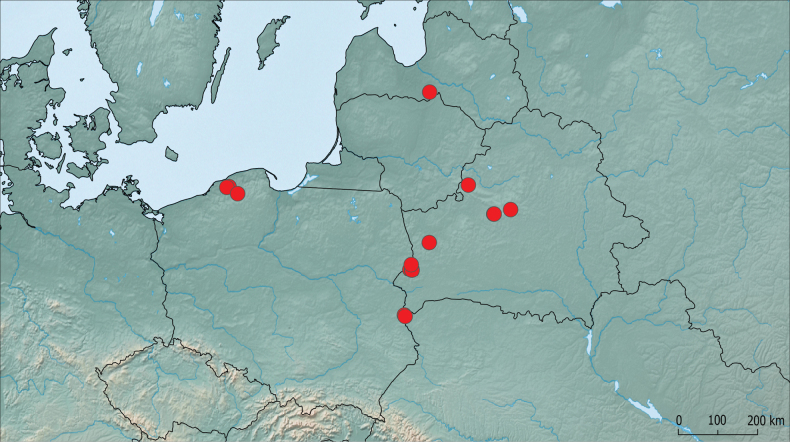 Figure 9
| 1 | Elytral surface and base of pronotum with isodiametric microsculpture (Fig. | |
| – | Elytral surface with transverse microsculpture (Fig. |
Peer Reviews
No public reviews on file for this paper yet. If you reviewed it on a platform where reviews are public (OpenReview, ICLR, NeurIPS, ICML), you can paste yours below so the community can read it here.
Videos
No videos yet. Explain this paper in a talk, walkthrough, or lecture? Add one.
Taxonomy
TopicsColeoptera Taxonomy and Distribution · Lepidoptera: Biology and Taxonomy · Coleoptera: Cerambycidae studies
Introduction
The genus Synuchus Gyllenhal, 1810, a member of the family Carabidae, includes 86 species found in the Palearctic, Oriental, and Nearctic regions (Bousquet 2012; Hovorka 2017; Kurian and Thomas 2022). The species diversity in the genus is unevenly distributed across its range, with the vast majority of species known from East Asia, particularly in Japan, Russian Far East, China, and the Korean Peninsula. Until now, only one species—Synuchusvivalis (Illiger, 1798)—was known to inhabit Europe. It occurs from the Iberian Peninsula, France and the British Isles in the west, Israel and Turkey in the south, through Central and Northern Europe, European Russia, the Caucasus, Siberia, and Central Asia to the Russian Far East, north-east China, and Japan (Hovorka 2017), where it can be found mainly in open habitats (Koch 1989; Lindroth 1992; Magura et al. 2000; Aleksandrowicz 2014) from lowlands to rather high elevations in mountains.
The present paper provides data on the surprising presence of Synuchuscongruus (Morawitz, 1862) in Central and Eastern Europe. Considering its probable widespread distribution in the region, we provide diagnostic characters and an updated key for the identification of Synuchus species of Europe.
Materials and methods
The study is based on specimens collected during various field trips in Belarus, Poland, and Latvia over the last several years. In addition, all available Synuchus specimens preserved in a number of institutional and private collections in the listed countries were examined for the presence of S.congruus. The collections referred to in this study are abbreviated as follows:
SPCMScientific and Practical Center of the National Academy of Sciences of Belarus for Biological Resources, Minsk, Belarus
DUBC Daugavpils University, Institute of Life Sciences and Technology, Daugavpils, Latvia
PUIB Pomeranian University in Słupsk, Institute of Biology, Słupsk, Poland
FRI Forest Research Institute, Białowieża, Poland
cKuz collection of V. Kuznetzov, Minsk, Belarus
An updated key to European Synuchus species was prepared on the basis of a morphological study of collected beetles and existing keys (Lindroth 1956; Lafer 1989). The distributional map was made using SimpleMappr (Shorthouse 2010). Photographs of the beetles and their aedeagi were made using a Canon EoS 6D digital camera with a Canon MP-E 65 mm macro lens, StackShot system and helicon Focus auto montage. Final post-processing of images was done in Adobe Photoshop.
Results
Synuchus
congruus
Taxon classificationAnimaliaColeopteraCarabidae
(Morawitz, 1862)
DD2814B4-A91E-5A48-BFA1-AEC2C826452C
Taphria congrua Morawitz, 1862 Synuchus latus Tschitschérine, 1893
Taxonomic remarks.
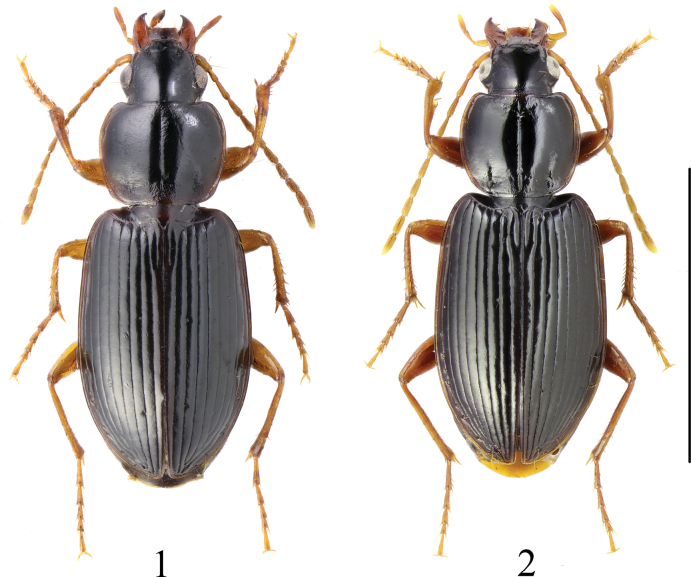
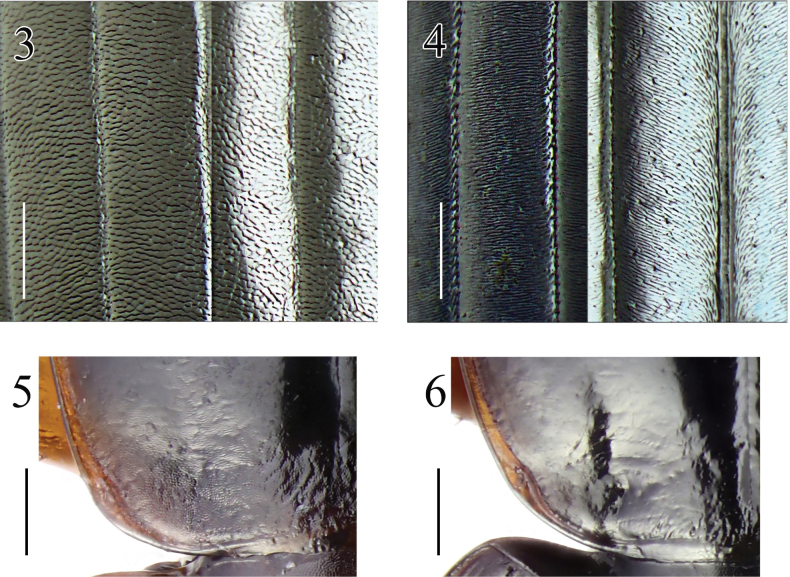
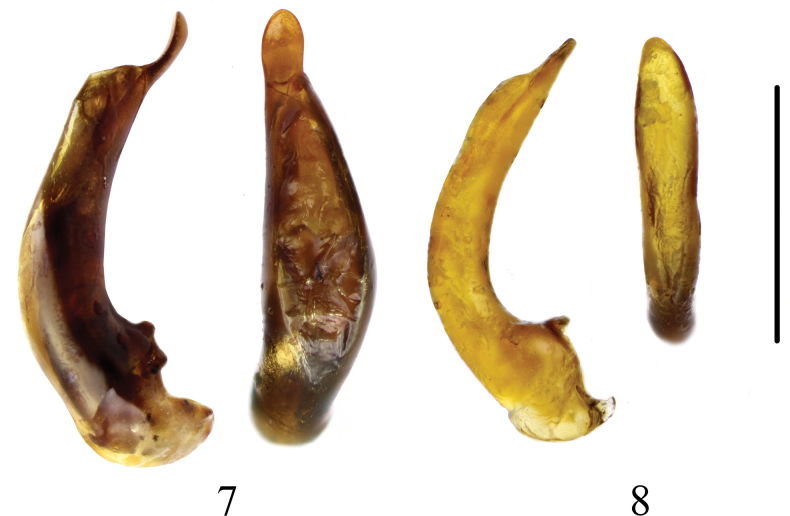
The genus Synuchus has been represented in Europe by a single widespread species Synuchusvivalis. It can be easily distinguished from other European Sphodrini Laporte, 1834 by the following features: dilated last labial palpomere, serrated tarsal claws, rounded base of the pronotum, prosternal process without a border, and characteristic shape of the aedeagus (Lindroth 1956; Aßmann 2004). Despite the extreme similarity in habitus (Figs 1, 2), the morphology of numerous specimens recorded over the past few years differed from that characteristic for S.vivalis. They have transverse reticulation on the elytra (rounded/isodiametric in S.vivalis) (Figs 3, 4), rather faint reticulation on the base and disc of pronotum (clearly visible in S.vivalis) (Figs 5, 6), weaker reticulation on forehead and vertex (clearly visible in S.vivalis), and deeper lateral furrows on middle and hind tarsi (weaker in S.vivalis). The differences also concern the shape of the aedeagus, the apex of which is short and rounded, and the median lobe in dorsal view is almost symmetrical (in S.vivalis the apex is elongated and curved upward, and the median lobe in dorsal view is asymmetrical and enlarged to the right) (Figs 7, 8). Careful examination of these specimens showed that their morphology corresponds to the characteristics of S.congruus given by Lindroth (1956) and Lafer (1989), and they are clearly conspecific with specimens of S.congruus from Eastern Siberia and the Russian Far East.
Habitus of Synuchus. 1.S.vivalis; 2.S.congruus. Scale bar: 5 mm.
Microreticulation in Synuchus (males). 3, 4. on elytra; 5, 6. on base of pronotum; 3, 5.S.vivalis; 4, 6.S.congruus. Scale bars: 0.15 mm (3, 4); 0.3 mm (5, 6).
Aedeagus of Synuchus in lateral and dorsal view. 7.S.vivalis; 8.S.congruus. Scale bar: 1 mm.
Collection and habitat data.
Specimens of S.congruus were collected from multiple locations in western and central Belarus, northern and eastern Poland, and Latvia (Fig. 9). They were mainly found in forests, with several specimens in fallow fields and meadows. One was caught in bush thickets near a river. Almost all specimens were collected using pitfall traps or sifted from leaf litter, except for one, which was found in the fruiting body of Pleurotus sp. on a fallow oak tree in an old-growth oak forest.
Occurrence map of Synuchuscongruus in Belarus, Latvia, and Poland.
Locality data.
Belarus – Minsk region: Dzerzhinsky distr., near Volmechka vlg. (UTM code: MV96), 53°50'44"N, 26°55'15"E, meadow, pitfall traps: 1 ex., 9.X.2011, leg. V. Lukin (SPCM) • Dzerzhinsky distr., near Volmechka vlg. (MV96), 53°50'47"N, 26°56'16"E, meadow, pitfall traps: 1 ex., 9.X.2011, leg. V. Lukin (SPCM) • Minsk (NV37), 53°56'35"N, 27°33'11"E, municipal woodland, hand collecting: 1 ex., 1.VIII.2020, leg. V. Kuznetzov (cKuz) – Brest region: Kamenets dist., near Lyatskie vlg. (FD93), Białowieża Forest (Belovezhskaya Pushcha National Park), 52°36'56"N, 23°52'30"E, birch forest, pitfall traps: 2 ex., 8.IX–11.X.2017, leg. O. Prischepchik (SPCM) • Kamenets dist., near Lyatskie vlg. (FD93), Białowieża Forest, 52°35'19"N, 23°51'42"E, hornbeam forest, pitfall traps: 1 ex., 26.X–7.XI.2024, leg. M. Kazulka (SPCM) • Kamenets dist., near Lyatskie vlg. (FD93), Białowieża Forest, 52°36'11"N, 23°51'39"E, oak forest, pitfall traps: 1 ex., 26.X–7.XI.2024, leg. M. Kazulka (SPCM) • Kamenets dist., near Lyatskie vlg. (FD93), Białowieża Forest, 52°35'14"N, 23°52'33"E, oak-hornbeam forest, pitfall traps: 1 ex., 26.X–7.XI.2024, leg. M. Kazulka (SPCM) • Kamenets dist., near Kamenyuki vlg. (FD83), Białowieża Forest, 52°36'18"N, 23°47'48"E, oak forest, hand collecting (on Pleurotus sp.): 1 ex., 18.VIII.2021; pitfall traps: 4 ex., 26.X–7.XI.2024, leg. M. Kazulka (SPCM) • Brest dist., Tomashovka vlg. (FC71), Pribuzhskoe Polesie Biosphere Reserve, 51°33'18"N, 23°35'30"E, pine forest, pitfall traps: 1 ex., 16.III–17.IV.2022, leg. V. Kuznetzov (cKuz) • Brest dist., near Orkhovo vlg. (FC81), Pribuzhskoe Polesie Biosphere Reserve, 51°31'29"N, 23°37'17"E, broadleaved forest, pitfall traps: 13 ex., 16–23.X.2021; 10 ex., 23–30.X.2021; 31 ex., 31.X–16.XI.2021; 11 ex., 16.XI.2021–12.II.2022, leg. V. Kuznetzov (cKuz) • Brest dist., near Orkhovo vlg. (FC81), Pribuzhskoe Polesie Biosphere Reserve, 51°31'55"N, 23°36'39"E, broadleaved forest, hand collecting: 1 ex., 16.X.2021; pitfall traps: 1 ex., 27.III–11.IV.2021, leg. V. Kuznetzov (cKuz); 7 ex., 30.X–6.XI.2023, leg. M. Kazulka (SPCM) – Grodno region: Volkovysk dist., near Zvezdnaya vlg. (LU39), Zamkavy Les Landscape Reserve, 53°12'49"N, 24°31'09"E, oak forest, pitfall traps: 1 ex., 24.VI–4.VIII.2022; 16 ex., 4.VIII–6.IX.2022; 11 ex., 6.IX–6.X.2022, leg. M. Kazulka (SPCM) • Oshmyany dist., near Pratskovshchina vlg. (MA33), 54°28'44"N, 25°58'37"E, oak-aspen forest, pitfall traps: 4 ex., 5.IX–5.X.2022, leg. M. Kazulka (SPCM).
Latvia – Bārbele parish, Bauska municipality (LC45), 56°27'00"N, 24°32'04"E, bush thickets near a river, pitfall trap: 1 ex., 8–11.VIII.2024 (DUBC).
Poland – Pomeranian Voivodeship: near Widzino vlg. (XA23), 54°25'41"N, 16°58'23"E, fallow field, pitfall traps: 1 ex., 22.V–5.VI.2007; 1 ex., 22.VII–9.VIII.2007; 5 ex., 20.IX–8.X.2007; 4 ex., 8.X–3.XI.2007; 6 ex., 3–20.XI.2007, leg. M. Czyżykowska (PUIB) • Słupsk city (XA33), 54°26'38"N, 17°03'23"E, oak-beech municipal forest, pitfall trap: 1 ex., 15–30.XI.2009, leg. O. Aleksandrowicz (PUIB) • Słupsk city (XA23), 54°29'01"N, 16°59'30"E, fallow field, pitfall trap: 1 ex., 1–20.XI.2012, leg I. Mrozowicz (PUIB) • Near Niepoględzie vlg. (XA51), 54°17'27"N, 17°22'38"E, wooded strip (hornbeam forest), pitfall traps: 9 ex., 15.X–11.XI.2010, leg. M. Janusiak (PUIB) – Podlaskie Voivodeship: near Białowieża vlg. (FD94), Białowieża Forest (Białowieża National Park), comp. 399C, 52°43'04"N, 23°50'52"E, oak–hornbeam forest, pitfall traps: 2 ex., 31.VII.2012, leg. J. Gutowski (FRI).
Discussion
Synuchuscongruus was originally described as Taphriacongrua by Morawitz (1862) from the “Bureja-Gebirge” (Bureinsky Ridge near Amur River, Russian Far East). In 1893, Tschitschérine described Synuchuslatus from the Zabaykalsky Krai, Russia. Habu (1955) recognized that the two forms were conspecific and proposed their synonymy, which was consistent with the views of Lindroth (1956). The previously known range of the species includes Russia (southern Kuril Islands, southern Sakhalin, Primorskii Krai, southern Khabarovskii Krai, Jewish Autonomous Region, Amurskaya Oblast’, Transbaikalia, southern Siberia, southern Ural), Kazakhstan, North and South Korea, Japan, and the northwestern, northern, and northeastern regions of China (Šustek 2003; Sundukov and Makarov 2013; Saimova et al. 2020; Zhu 2022).
New data show that S.congruus has spread across Eastern and Central Europe. It has been recorded from Słupsk in the west to Minsk in the east, from Latvia in the north to Brest Polesie in the south-western Belarus. Although ground beetles have been one of the most active areas in beetle research in Europe over the past decades, what is most surprising is that it was overlooked in the region for many years and probably confused with S.vivalis, since the two species are extremely similar in habitus. In fact, a careful study of the carabids stored in the collections of the SPCM and PUIB showed that several specimens belonging to this species were initially misidentified as S.vivalis.
The earliest detected specimen of S.congruus from the studied collections was sampled in northern Poland in 2007. This suggests that the species was introduced into Europe prior to that year, although the exact time and point of entry are unlikely to be accurately determined. The study of beetles preserved in other collections, primarily those sampled from Poland, Germany, the Baltic countries, and the northwestern part of European Russia, could provide valuable insights. The method of introduction is also unknown, but may be due to the importation of plant stock or associated materials, as is known for other alien ground beetle species, such as Pterostichusvagus in Czech Republic (Hůrka and Šustek 1995) (previously recognized as P.caspius until its revision by Muilwijk et al. 2024), Leistusfulvibarbis in Norway (Westergaard et al. 2015), and multiple cases from North America (Kavanaugh and Erwin 1985; Spence and Spence 1988; Kavanaugh and LaBonte 2008). The ability for active flight allowed S.congruus to spread further in Europe.
In its native range, S.congruus is found in coniferous and deciduous forests, as well as on forest edges, clearings, bush thickets, and meadows, along riverbanks, and in wetlands (Lafer 1976; Sundukov 2009; Rogatnykh 2009; Shabalin et al. 2010; Sundukov and Makarov 2013; Sundukov 2024). In our study, the species was collected both in forest and open habitats of varying degrees of naturalness: from old-growth oak and hornbeam forests in Białowieża Forest and semi-natural oak-dominated forests to municipal woodlands, fallow fields and wooded strips surrounded by agricultural lands. It was observed from spring to late autumn. In several localities, the species was collected together with S.vivalis.
Future studies will help to accumulate data on the distribution of S.congruus in Europe, especially in neighboring countries (Germany, Ukraine, Lithuania, Estonia, and the European part of Russia) and to clarify its habitat and ecological preferences.
Identification key to the species of genus Synuchus in Europe
**: **
Supplementary Material
XML Treatment for Synuchus congruus
The reference list from the paper itself. Each links out to its DOI / PubMed record.
- 1Aleksandrowicz O (2014) Ground Beetles (Coleoptera, Carabidae) of the West of the Forest Zone of the Russian Plain. Fauna, Zoogeography, Ecology and Faunogenesis.Lambert Academic Publishing, Saarbrucken, 456 pp. [In Russian]
- 2Aßmann T (2004) 71. Gattung: Synuchus Gyllenhal, 1810. In: Müller-Motzfeld G (Ed.) Die Käfer Mitteleuropas. Bd. 2 Adephaga 1: Carabidae (Laufkäfer).Spektrum-Verlag, Heidelberg–Berlin, 2. Auflage, 285 pp.
- 3Bousquet Y (2012) Catalogue of Geadephaga (Coleoptera, Adephaga) of America, north of Mexico.Zoo Keys 245: 1–1722. 10.3897/zookeys.245.3416 PMC 357709023431087 · doi ↗ · pubmed ↗
- 4Habu A (1955) Notes and descriptions of the Calathus species (Coleoptera, Carabidae) from Japan.Bulletin of the National Institute of Agricultural Sciences, Series C 5: 157–224. [Plant Pathology and Entomology]
- 5Hovorka O (2017) Subtribe Synuchina Lindroth, 1956. In: Löbl ILöbl D (Eds) Catalogue of Palaearctic Coleoptera.Vol. 1. Archostemata—Myxophaga—Adephaga. Revised and Updated Edition. Brill, Leiden–Boston, 790–794.
- 6Hůrka KŠustek Z (1995) Coleoptera: Carabidae. In: RozkošnýR Vaňhara J (Eds) Terrestrial invertebrates of the Pálava Biosphere Reserve of UNESCO. II.Folia Facultatis Scientiarium Naturalium Universitatis Masarykianae Brunensis, Biologia 93: 349–365.
- 7Kavanaugh DH Erwin TL (1985) Trechusobtusus Erichson (Coleoptera: Carabidae), a European ground beetle, on the Pacific Coast of North America: its distribution, introduction, and spread.The Pan-Pacific Entomologist 61: 170–179.
- 8Kavanaugh DH La Bonte JR (2008) Discovery of Nebriabrevicollis (Fabricius) (Coleoptera: Carabidae: Nebriini), a European ground beetle, established in the Willamette Valley, Oregon. Proceedings of the California Academy of Sciences (Series 4) 59: 481–488.