Carbapenem resistance in Escherichia marmotae: characterization of IncL plasmids carrying blaOXA-48
Astrid Rasmussen, Anette M Hammerum, Frank Hansen, Lillian M Søes, Michael Pedersen, Hans L Nielsen, Flemming Scheutz, Henrik Hasman, Louise Roer

Abstract
Genes, proteins, chemicals, diseases, species, mutations and cell lines named across the full text — each resolved to its canonical identifier and authoritative record.
Click any figure to enlarge with its caption.
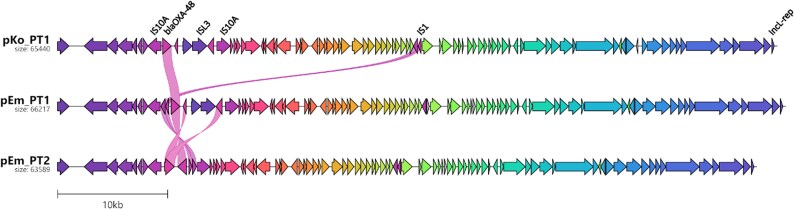 Figure 1
- —Danish Ministry of Health10.13039/501100007037
Peer Reviews
No public reviews on file for this paper yet. If you reviewed it on a platform where reviews are public (OpenReview, ICLR, NeurIPS, ICML), you can paste yours below so the community can read it here.
Videos
No videos yet. Explain this paper in a talk, walkthrough, or lecture? Add one.
Taxonomy
TopicsAntibiotic Resistance in Bacteria · Pharmaceutical and Antibiotic Environmental Impacts · Bacterial biofilms and quorum sensing
Dear Sir,
Carbapenemase-producing Enterobacterales (CPE) represent a significant concern to human health. Among these, the blaOXA-48 gene, often located on the highly stable incompatibility group L (IncL) plasmids. These plasmids enable rapid horizonal gene transfer across bacterial species, posing an emerging threat.
Escherichia marmotae was first described in 2015. It was initially considered susceptible to antimicrobials. However, present-day findings indicate resistance to last-resort agents and high pathogenic potential. The genetic proximity to E. coli raises concerns about its potential in AMR dissemination. A recent study identified E. marmotae isolates harbouring extended-spectrum β-lactamase (ESBL) genes located on plasmids, suggesting the capacity to acquire and propagate AMR via horizontal gene transfer.^1^ Sivertsen et al. reported blaKPC-carrying E. marmotae, reinforcing its invasive pathogen potential,^2^ aligning with findings by Liu et al.^3^
Since 2014, CPE samples have been collected and whole genomes sequenced as part of the Danish CPO surveillance programme. In 2023 and 2024, two carbapenemase-producing E. marmotae isolates were submitted to the National Reference Laboratory at Statens Serum Institut (NRL, SSI) for verification and characterization. Whole-genome sequencing using short- and long-read technologies identified resistance genes, virulence factors, plasmid content and assessed genetic relatedness. The blaOXA-48-carrying IncL plasmids were compared for structural similarities.
The two E. marmotae isolates originated from geographically distinct patients. The first isolate, submitted in 2023 by Aalborg University Hospital, was confirmed as E. marmotae carrying blaOXA-48. Retrospective data revealed that Patient 1 had a previous infection with blaOXA-48-producing K. oxytoca 6 months earlier. In the E. marmotae, virulence factors chuA, iss, ompT and sitA were identified.
In 2024, a second E. marmotae isolate was submitted by Copenhagen University Hospital, Amager and Hvidovre. This isolate also carried blaOXA-48 and a broad array of virulence genes, including the porcine colonization factor F4 (faeD/E/F/H/I) typical of enterotoxigenetic E. coli (ETEC), ExPEC associated genes (papAH/C and kpsMII) and genes characteristic of hybrid ExPEC-STEC O80:H2 strains (cia, etsC, iss, traJ, ompT, hlyF, iroN).^4^ The presence of haemolysin (hlyF) and haem uptake system (chuA) suggest additional virulence factors enhancing bacterial survival and pathogenicity. Retrospective searches revealed that Patient 2 had a previous carbapenemase-negative E. marmotae, which was neither collected nor sequenced.
E. marmotae has often been misidentified as E. coli, partly because it was not included in the Bruker^™^ MALDI-TOF database until 2020. Consequently, a retrospective rMLST analysis of 907 Danish CPE E. coli isolates was performed, but no additional E. marmotae cases were identified.
Although reports of resistant E. marmotae remain limited, Sivertsen et al. found blaKPC in one and blaCTX-M in two out of 45 E. marmotae genomes.^2^ By mid-2024, 259 E. marmotae genomes were available in the NCBI database, with 23 (9%) carrying ESBL (blaCTX-M-14; n = 10, blaCTX-M-15; n = 2, blaCTX-M-1; n = 1, blaCTX-M-32; n = 1), pAmpC (blaCMY-2; n = 6) or carbapenemase genes (blaKPC-2; n = 1, blaKPC-3; n = 1), whereas one isolate carried both blaCTX-M-14 and blaCMY-2. Thus, the two Danish isolates represent, to our knowledge, the first reported cases of OXA-48 producing E. marmotae.
Genomic comparison revealed 28 757 SNP differences between the two Danish E. marmotae isolates. They did not show close genetic relatedness to any of the 257 publicly available E. marmotae genomes. The closest matches were 163 and 251 SNPs apart, respectively, suggesting two independent acquisitions. Epidemiological investigations found no links between the patients, further supporting this conclusion.
Both E. marmotae, as well as the earlier K. oxytoca from Patient 1, carried IncL plasmids associated with blaOXA-48.^5,6^ Genomes annotated with Bakta from long-read assemblies and visualized with Clinker^7^ confirmed similar plasmid backbones (Figure 1). Using Pling,^8^ structural comparison of the E. marmotae plasmid from Patient 1 (pEm_PT1) and the K. oxytoca plasmid (pKo_PT1) revealed a single rearrangement; an IS1 insertion upstream of blaOXA-48 gene (Figure 1). Such rearrangements are common in interspecies plasmid transmissions, suggesting plasmid transfer between the K. oxytoca isolate and the E. marmotae isolate in Patient 1.
Comparison of pEm_PT1 from Patient 1 and the plasmid from Patient 2 (pEm_PT2) identified two additional rearrangements; an inversion between IS10A elements and the insert/deletion of a KilA-N domain protein and ISL3 insertion element downstream of blaOXA-48. Despite structural similarity of the two plasmids, no epidemiological links were found between the two patients. With IncL plasmids carrying blaOXA-48 now near endemic status, the plasmids were probably acquired from another bacterial host.
In conclusion, E. marmotae, traditionally considered susceptible, has now been shown to acquire blaOXA-48-carrying IncL plasmids. Here we report two independent acquisition events, adding E. marmotae to the list of potential recipients of this worldwide disseminated plasmid. The combination of hybrid ETEC-ExPEC virulence traits and resistance potential of E. marmotae, reinforces the importance of continued CPE surveillance and genomic characterization at both species and plasmid level.
The reference list from the paper itself. Each links out to its DOI / PubMed record.
- 1Souguir M, Châtre P, Drapeau A et al Molecular characterization of highly prevalent Escherichia coli and Escherichia marmotae resistant to extended-spectrum cephalosporins in European starlings (Sturnus vulgaris) in Tunisia. Microbiol Spectr 2023; 11: e 0222023. 10.1128/spectrum.02220-2337772831 PMC 10581222 · doi ↗ · pubmed ↗
- 2Sivertsen A, Dyrhovden R, Tellevik MG et al Escherichia marmotae—a human pathogen easily misidentified as Escherichia coli. Microbiol Spectr 2022; 10: 1–8. 10.1128/spectrum.02035-21PMC 904513535380461 · doi ↗ · pubmed ↗
- 3Liu S, Feng J, Pu J et al Genomic and molecular characterisation of Escherichia marmotae from wild rodents in Qinghai-Tibet plateau as a potential pathogen. Sci Rep 2019; 9: 10619. 10.1038/s 41598-018-37186-231337784 PMC 6650469 · doi ↗ · pubmed ↗
- 4Soysal N, Mariani-Kurkdjian P, Smail Y et al Enterohemorrhagic Escherichia coli hybrid pathotype O 80:H 2 as a new therapeutic challenge. Emerg Infect Dis 2016; 22: 1604–12. 10.3201/eid 2209.16030427533474 PMC 4994344 · doi ↗ · pubmed ↗
- 5Pitout JDD, Peirano G, Kock MM et al The global ascendency of OXA-48-type carbapenemases. Clin Microbiol Rev 2019; 33: e 00102-19. 10.1128/CMR.00102-1931722889 PMC 6860007 · doi ↗ · pubmed ↗
- 6Hamprecht A, Sommer J, Willmann M et al Pathogenicity of clinical OXA-48 isolates and impact of the OXA-48 Inc L plasmid on virulence and bacterial fitness. Front Microbiol 2019; 10: 2509. 10.3389/fmicb.2019.0250931736929 PMC 6838017 · doi ↗ · pubmed ↗
- 7Gilchrist CLM, Chooi Y-H. Clinker & clustermap.js: automatic generation of gene cluster comparison figures. Bioinformatics 2021; 37: 2473–5. 10.1093/bioinformatics/btab 00733459763 · doi ↗ · pubmed ↗
- 8Frolova D, Lima L, Roberts LW et al Applying rearrangement distances to enable plasmid epidemiology with pling. Microb Genomics 2024; 10: 001300. 10.1099/mgen.0.001300 PMC 1147288039401066 · doi ↗ · pubmed ↗