Combining the Effects of Mobilization With Movement and Cyriax Physiotherapy in Lateral Epicondylitis: A Case Report
Sivakumar S, Ravindra Reddy C, Prakash Jayabalan

TL;DR
This case report shows that combining mobilization with movement and Cyriax physiotherapy can significantly reduce pain and improve function in a patient with tennis elbow.
Contribution
The study demonstrates a novel combination of MWM and Cyriax techniques for treating lateral epicondylitis in a clinical case.
Findings
Pain levels decreased from 8/10 to 2/10 on the VAS after two weeks of treatment.
Functional ability improved from 81/100 to 34/100 on the PRTEE scale.
The combination of MWM and Cyriax physiotherapy showed enhanced pain relief and functional improvement.
Abstract
Tennis elbow, or lateral epicondylitis (LE), is characterized by a gradual onset of pain over the lateral aspect of the elbow, particularly during wrist extension with a pronated or supinated hand. It is often exacerbated by gripping activities. Common symptoms include pain at the origin of wrist extensor tendons, reduced grip strength, and impaired upper limb function. The etiology may include trauma, degeneration, repetitive grasping, scar tissue formation, or contractures. Diagnosis is based on patient history, functional tests, and palpation of the lateral epicondyle. A 48-year-old woman, a homemaker complained of right elbow pain and swelling and was diagnosed with LE. Pain intensity was assessed with a Visual Analogue Scale (VAS) and functional ability with Patient-Rated Tennis Elbow Evaluation (PRTEE). This case report aims to evaluate the combined effect of mobilization with…
Genes, proteins, chemicals, diseases, species, mutations and cell lines named across the full text — each resolved to its canonical identifier and authoritative record.
Click any figure to enlarge with its caption.
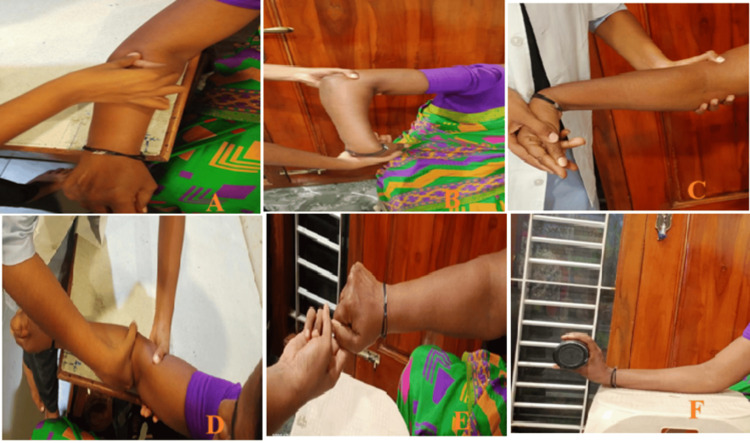 Figure 1
| Joints (active) | Right (pre-treatment) | Right (post treatment) |
| Elbow flexion | 0-125° | 0-130° |
| Elbow extension | 0° | 0° |
| Elbow pronation | 0-75° | 0-80° |
| Elbow supination | 0-60° | 0-80° |
| Wrist flexion | 0-72° | 0-75° |
| Wrist extension | 0-°60° | 0-72° |
| Radial deviation | 0-21° | 0-25° |
| Ulnar deviation | 0-33° | 0-35° |
| Outcome metrics | Pre-intervention | Post intervention |
| VAS at movement | 8/10 | 2/10 |
| VAS at rest | 2/10 | 0/10 |
| PRTEE | 81/100 | 34/100 |
| Goals | Intervention | Procedure | Rationale | Dosage |
| To reduce pain and to correct dysfunction | Movement With Mobilization (MWM) | Manually glide the elbow laterally while the subject grips the object. | To reduce pain and improve range of motion (ROM) | Five repetitions, two sets per day, three days per week for two weeks |
| Cyriax physiotherapy with Mill's manipulation | The tendons were given deep friction before being manipulated with limited amplitude and high velocity thrust | Elongates the scar tissue and makes the area mobile and pain-free | 10 to 15 minutes of friction massage followed by one manipulation and two sets per day, three days per week for two weeks | |
| To improve muscle strength and enhance elbow stability | Isometric strengthening | Instruct the patient to contract the wrist extensors without moving the joint for five to ten seconds and relax | Strengthens without exacerbating pain, maintains muscle function | Two times per day, three sets of 10 to 15 repetitions, two days per week |
| Eccentric strengthening with a 5 kg weight | Wrist in flexed position holding a 5 kg weight, slowly raise the wrist into extension. Return to the starting position | Improves strength and flexibility in the wrist, forearm, and elbow | Two times per day, three sets of 10 to 15 repetitions, two days per week |
Peer Reviews
No public reviews on file for this paper yet. If you reviewed it on a platform where reviews are public (OpenReview, ICLR, NeurIPS, ICML), you can paste yours below so the community can read it here.
Videos
No videos yet. Explain this paper in a talk, walkthrough, or lecture? Add one.
Taxonomy
TopicsTendon Structure and Treatment · Myofascial pain diagnosis and treatment · Sports injuries and prevention
Introduction
Lateral epicondylitis (LE), commonly referred to as tennis elbow, is a prevalent overuse injury that causes pain and tenderness over the lateral epicondyle of the humerus. It frequently affects individuals whose occupations involve repetitive forearm motions. While the precise etiology remains unclear, it is often associated with microtrauma or overuse, leading to decreased vascularity and delayed healing in the affected area. Histologically, LE is marked by disorganized collagen, increased fibroblast proliferation, and vascular hyperplasia at the extensor tendon origin. Symptoms may persist for months or even years in some cases. LE is characterized by macroscopic and microscopic tears in the extensor carpi radialis brevis tendon, typically resulting from repetitive wrist extension and eccentric muscle contractions (muscle lengthening under tension). The condition affects approximately 1% to 3% of the general population, with peak incidence between 45 and 54 years of age. Both genders are equally affected, though individuals using vibrating tools or engaged in high-demand occupations are at greater risk. Pain typically localizes at the lateral epicondyle but may radiate to the shoulder or wrist in severe cases [1,2].
There are physical interventions available, including electrotherapy like extracorporeal shock wave therapy, ultrasound, and exercise, but the efficacy of these is reported to be low, and larger trials are needed [3]. However, trials have shown greater benefits for manipulation and exercises compared to corticosteroid injections [4]. Cyriax physiotherapy, a combination of deep transverse friction massage and Mill's manipulation, has been shown to alleviate symptoms when applied in a specific sequence [5,6]. Similarly, Mulligan’s Mobilization with Movement (MWM) involves a sustained lateral glide of the elbow during functional movement, effectively reducing pain and improving joint mobility [7,8]. While a standalone manipulation over four weeks typically yields favorable outcomes, we aimed to investigate whether a combined manipulation approach offers additional benefit in pain recovery and functional improvement in patients with LE over a two-week period.
Case presentation
A 48-year-old woman, a homemaker, presented with persistent right elbow pain and swelling for five months. Initial self-management with analgesics and ice provided only temporary relief. Recurrences were frequent, especially after lifting heavy objects or performing gripping tasks, significantly affecting her daily tasks, such as house cleaning and washing utensils. Upon clinical evaluation by a medical doctor, the patient presented with characteristic signs and symptoms and physical examination findings like tenderness and positive provocative tests consistent with LE. Management initially included the prescription of corticosteroids and the use of a tennis elbow strap, which the patient utilized intermittently. However, the pain persisted, and she was referred to physiotherapy.
At the time of evaluation, the patient reported pain aggravated by gripping and lifting, accompanied by localized swelling and tenderness below the LE. Palpable trigger points and edema were noted. The diagnosis was confirmed based on physical tests, Mill's and Cozen’s test showing positive for tenderness and pain. Functionally, she had difficulty with household chores involving wrist movements. Range of motion was not significantly affected, but it was painful, as reported in Table 1. The Patient-Rated Tennis Elbow Evaluation (PRTEE) scale is a 15-item questionnaire to measure pain (0-50) and functional disability (0-50), with total scores ranging from 0-100, indicating no pain/disability to maximum pain/disability [9]. The PRTEE total score was 81/100, confirming significant disability, and pain intensity was rated 8/10 during activity and 2/10 at rest on the Visual Analogue Scale (VAS) (Table 2). These findings supported the initiation of physiotherapeutic management. Informed consent was taken from the patient for further management.
Physiotherapy management
A comprehensive physiotherapy management plan was developed, comprising Cyriax therapy (deep friction massage) (Figure 1A), followed by Mill's manipulation (Figures 1B, 1C) and MWM (Figure 1D), and strengthening exercises like isometric (Figure 1E) and eccentric (Figure 1F) were given with an adequate rest period (15-30 minutes) between treatments. Treatment duration, sessions, and days are presented in Table 3.
Physiotherapy interventions(A) Cyriax technique; (B, C) Mill's manipulation; (D) Mobilization with movement (MWM); (E, F) Isometric and eccentric strengthening exercises
Discussion
LE affects approximately 1% to 3% of the general population, with a slightly higher prevalence among women [10]. It presents as lateral elbow pain, grip weakness, and functional impairment, impacting daily tasks. Diagnosis is typically confirmed through clinical tests that elicit tenderness over the lateral epicondyle, including resisted wrist extension and passive wrist flexion [11]. Various non-invasive therapeutic interventions are available to treat pain or tenderness for LE. Evidence shows that manual therapy techniques and comprehensive strengthening exercise programs yielded better improvements [12]. In our case, we evaluated the effectiveness of the combined two manual therapy techniques. The patient underwent a two-week intervention combining Cyriax's friction massage, Mulligan’s lateral glides, and strengthening exercises (usual). Cyriax therapy, through deep friction and Mill's manipulation, aims to disrupt adhesions and enhance mobility by lengthening scar tissue. MWM, as proposed by Mulligan, involves an accessory glide during active movement, helping reduce pain and improve function. Post-treatment outcomes showed notable improvements, with a 75% reduction in VAS pain score and a 58% improvement in PRTEE functional scores, with no adverse events reported.
When used separately, both Cyriax and MWM typically require a four-week protocol [6,13,14,15] for better outcomes. Our study results suggest that integrating Cyriax, MWM, and isometric exercises may provide a faster and enhanced recovery compared to using either technique in isolation [16] and also support the recommendations of incorporating multimodal interventions in managing lateral epicondylitis [12]. Notably, the combined approach yielded substantial results within two weeks, indicating potential for faster rehabilitation. However, although the combined technique offers temporary pain relief, there remains a possibility of future exacerbation. The patient was discontinued for long-term follow-up after she had a transient recovery. This study is limited by its design, and future trials with a larger sample size and robust randomized controlled trials are warranted to find combined efficacy.
Conclusions
The observed reduction in VAS and PRTEE scores indicates that this combinational manual therapy approach can accelerate recovery within a short treatment duration. While the results are promising, they should be interpreted cautiously since it is a single case study. Future trials with larger sample sizes and longer follow-ups are needed to validate the efficacy and sustainability of these combined manual therapy techniques in managing LE.
The reference list from the paper itself. Each links out to its DOI / PubMed record.
- 1The epidemiology and health care burden of tennis elbow: a population-based study Am J Sports Med Sanders TL Jr Maradit Kremers H Bryan AJ Ransom JE Smith J Morrey BF 106610714320152565654610.1177/0363546514568087 PMC 4517446 · doi ↗ · pubmed ↗
- 2Lateral elbow tendinopathy: development of a pathophysiology-based treatment algorithm Orthop J Sports Med Bhabra G Wang A Ebert JR Edwards P Zheng M Zheng MH 2325967116670635420162783392510.1177/2325967116670635 PMC 5094303 · doi ↗ · pubmed ↗
- 3A systematic review and meta-analysis of clinical trials on physical interventions for lateral epicondylalgia Br J Sports Med Bisset L Paungmali A Vicenzino B Beller E 4114223920051597616110.1136/bjsm.2004.016170 PMC 1725258 · doi ↗ · pubmed ↗
- 4Mobilisation with movement and exercise, corticosteroid injection, or wait and see for tennis elbow: randomised trial BMJ Bisset L Beller E Jull G Brooks P Darnell R Vicenzino B 93933320061701226610.1136/bmj.38961.584653.AEPMC 1633771 · doi ↗ · pubmed ↗
- 5Deep transverse friction massage for treating lateral elbow or lateral knee tendinitis Cochrane Database Syst Rev Loew LM Brosseau L Tugwell P 02014201410.1002/14651858.CD 003528.pub 2PMC 715457625380079 · doi ↗ · pubmed ↗
- 6Comparison of effectiveness of supervised exercise program and Cyriax physiotherapy in patients with tennis elbow (lateral epicondylitis): a randomized clinical trial Scientific World Journal Viswas R Ramachandran R Korde Anantkumar P 939645201220122262922510.1100/2012/939645 PMC 3353712 · doi ↗ · pubmed ↗
- 7The effects of Mulligan mobilisation with movement and taping techniques on pain, grip strength, and function in patients with lateral epicondylitis Hong Kong Physiother J Amro A Diener I Bdair WO Hameda IM Shalabi AI Ilyyan DI 1923282010
- 8The effects of Mulligan's mobilization with movement technique in patients with lateral epicondylitis J Back Musculoskelet Rehabil Reyhan AC Sindel D Dereli EE 991073320203110400510.3233/BMR-181135 · doi ↗ · pubmed ↗