Spontaneous umbilical endometriosis
Vasilina Tambovskaya, Luis Escalante, Astrid Maldonado, Maria Antonieta Touriz Bonifaz, Edgar Escalante

TL;DR
Spontaneous umbilical endometriosis is a rare condition where endometrial tissue appears in the umbilical area without prior surgery.
Contribution
The paper highlights the rarity and distinct characteristics of the primary form of umbilical endometriosis.
Findings
Umbilical endometriosis is the most common type of cutaneous endometriosis.
The primary form occurs without prior surgical intervention and is rare.
It has a predilection for the umbilical area.
Abstract
Endometriosis is defined as the presence of endometrial tissue (glands and stroma) outside the uterine cavity. Various organs can be affected, including the skin. Umbilical endometriosis is the most common clinical form of extrapelvic endometriosis and the most frequent type of cutaneous endometriosis, classified into primary and secondary forms. The primary or spontaneous form is rare, occurring without any prior surgical intervention, with a predilection for the umbilical area.
Genes, proteins, chemicals, diseases, species, mutations and cell lines named across the full text — each resolved to its canonical identifier and authoritative record.
Click any figure to enlarge with its caption.
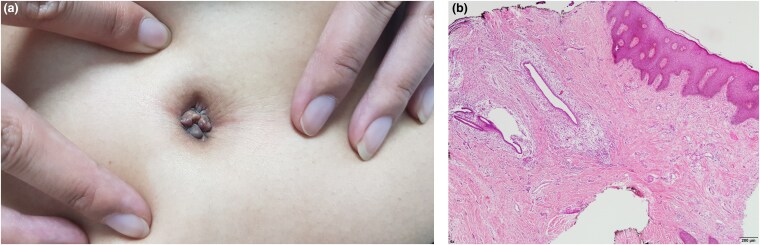 Figure 1
Peer Reviews
No public reviews on file for this paper yet. If you reviewed it on a platform where reviews are public (OpenReview, ICLR, NeurIPS, ICML), you can paste yours below so the community can read it here.
Videos
No videos yet. Explain this paper in a talk, walkthrough, or lecture? Add one.
Taxonomy
TopicsEndometriosis Research and Treatment · Uterine Myomas and Treatments · Gynecological conditions and treatments
A 30-year-old woman presented with a 6-month history of a painful umbilical nodule that exhibited cyclical bleeding corresponding to her menstrual cycle. The lesion was firm, brownish-grey, and measured 0.4–1 cm in diameter. No prior history of abdominal or pelvic surgery was reported (Figure 1a).
A soft-tissue ultrasound was performed, revealing a well-defined, hypoechoic subcutaneous lesion with no deep extension. Surgical excision under local anesthesia was performed without prior biopsy, given the small size and well-circumscribed nature of the nodule.
Histopathological examination confirmed the presence of ectopic endometrial tissue with characteristic endometrial glands and stroma. The findings were consistent with spontaneous umbilical endometriosis, a rare form of extrapelvic endometriosis (Figure 1b).
The patient was referred to a gynecologist for further evaluation. Pelvic imaging and clinical assessment showed no other endometriotic foci. At 6-month follow-up, she remained asymptomatic with no recurrence.
Umbilical endometriosis, also known as Villar’s nodule, is the most common type of cutaneous endometriosis and may occur spontaneously or secondary to surgical intervention. Primary umbilical endometriosis is a rare entity, with an incidence of 0.5–1% among ectopic endometrial cases.^1,2^ The lesion may present as a reddish-blue or brown nodule, often associated with premenstrual or menstrual pain.
Surgical excision remains the gold standard for diagnosis and treatment. Imaging, such as ultrasound or magnetic resonance imaging, may help assess lesion extent. Women presenting with painful umbilical nodules should be evaluated for possible endometriosis.
Funding sources: This research received no specific grant from any funding agency in the public, commercial or not-for-profit sectors.
Data availability: No data generated.
Ethics statement: The study adheres to the ethical guidelines for case reports and image submissions.
Patient consent: Informed patient consent for publication, including for use in social media, has been obtained.
The reference list from the paper itself. Each links out to its DOI / PubMed record.
- 1Bordel Gómez MT, Román Curto C, Cardeñoso Álvarez E et al Endometriosis cutánea umbilical espontánea. Actas Dermosifiliogr 2006; 97:666–8.17173832 10.1016/s 0001-7310(06)73491-3 · doi ↗ · pubmed ↗
- 2Yahaya JJ, Morgan ED, Abraham ZS. Endometriosis of the umbilicus in a 36-year-old woman: a case report and literature review. Ann Med Surg (Lond) 2023; 85:1011–4.37113870 10.1097/MS 9.0000000000000306 PMC 10129073 · doi ↗ · pubmed ↗