Complete Genome Analysis of African Swine Fever Virus Isolated from Wild Boar, India, 2021
Dhanapal Senthilkumar, Katherukamem Rajukumar, Govindarajulu Venkatesh, Fateh Singh, Gopal Sarkar, Jaswant Patel, Suman Mishra, Rohit Sahu, Nourin Khan, C. Neihthangpuii, Esther Lalzolian, Vijendra Pal Singh, Aniket Sanyal

TL;DR
African swine fever virus from a wild boar in India has genome similarities to pig strains but with unique mutations.
Contribution
The study identifies unique mutations in the African swine fever virus genome from a wild boar in India.
Findings
The virus genome showed ≈99% nucleotide identity with domestic pig-origin strains.
Unique mutations were detected in the wild boar-isolated virus genome.
Abstract
Complete genome analysis of African swine fever virus isolated from a wild boar in Mizoram, India, revealed ≈99% nucleotide identity with those of domestic pig origin but with unique mutations. A One Health approach toward food security necessitates awareness among veterinary and public health professionals on virus evolution and domestic–wild pig transmission.
Genes, proteins, chemicals, diseases, species, mutations and cell lines named across the full text — each resolved to its canonical identifier and authoritative record.
Click any figure to enlarge with its caption.
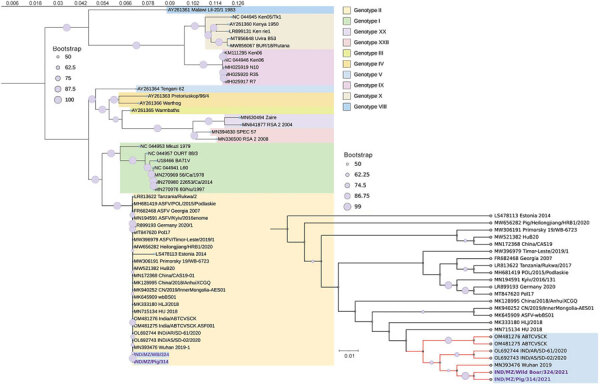 Figure 1
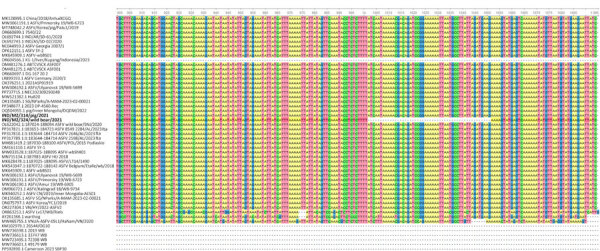 Figure 2
Peer Reviews
No public reviews on file for this paper yet. If you reviewed it on a platform where reviews are public (OpenReview, ICLR, NeurIPS, ICML), you can paste yours below so the community can read it here.
Videos
No videos yet. Explain this paper in a talk, walkthrough, or lecture? Add one.
Taxonomy
TopicsAnimal Disease Management and Epidemiology · Animal Virus Infections Studies · Viral Infections and Immunology Research
African swine fever (ASF) is a devastating disease affecting pigs, with death rates reaching 100%. Wild boars (Sus scrofa), warthogs (Phacochoerus aethiopicus), and bushpigs (Potamochoerus porcus) can act as asymptomatic carriers, contributing to virus persistence in a sylvatic cycle (1). Soft ticks of the genus Ornithodoros further complicate ASF epidemiology. The disease is caused by ASF virus (ASFV), a large, double-stranded DNA virus belonging to the genus Asfivirus in the Asfarviridae family. The ASFV genome range is 171–193 kb, featuring inverted terminal repeats (ITRs) at both ends. Different ASFV genotypes are based on the 3′ end of the B646L gene; genotype II predominates in Asia, Europe, Oceania, and the Americas. Recent emergence of novel recombinant genotype I/II strains in China and Vietnam (2,3) is of great concern.
ASF was first reported in India in 2020 after outbreaks in domestic pigs in northeastern states (4). Outbreaks in wild boars have been documented in Assam, Karnataka, and Tamilnadu states (5,6). ASFVs circulating in India belong to genotype II and intergenic region (IGR) subcluster II. Complete genome sequencing of Indian ASFV isolates of domestic pig origin revealed unique mutations in the MGF 360–11L, MGF 505–4R, K205R, and B263R genes (7). We analyzed the complete genome of ASFVs isolated after ASF outbreaks affecting domestic pigs and wild boars in Mizoram, India, in August 2021.
We collected 40 samples from dead domestic pigs and those suspected of having ASF (Appendix Figure 1); 38 of those samples and a dead wild boar tested positive for ASF genome by quantitative PCR and were confirmed by virus isolation. We grew, processed for viral enrichment, and sequenced 1 ASFV isolate (MZ/21/PO-324) of wild boar origin and 1 isolate (MZ/21/PO-314) of domestic pig origin. We submitted nucleotide sequences to GenBank (accession nos. PV023909 and PV023910) (Appendix).
The wild boar ASFV genome comprised 190,489 bp with ITRs at the 5′ end (1,597 bp) and 3′ end (1,122 bp), whereas the ASFV genome from domestic pig measured 189,390 bp and had a 5′ end ITR of 422 bp and 3′ end ITR of 1,150 bp. Comparative analysis showed 99.93% nucleotide identity between those isolates (Appendix Figure 2). Phylogenetic analysis placed the ASFV in India within genotype II clade 2.2.2, alongside genotype II viruses reported during 2007–2023 across diverse regions. Within p72 genotype II viruses, isolates from India formed a distinct cluster with isolate ASFV/Wuhan/2019 (Figure 1). EP402R gene–based serogrouping confirmed isolates from India as part of serogroup 8, consistent with hemadsorption-positive viruses (Appendix Figure 3). There was an insertion of an additional tandem repeat sequence in the extragenic region between I73R and I329L (Appendix Figure 4), aligning with intergenic region II cluster isolates of genotype II. Central variable region analysis of the B602L gene indicated similarity to the Georgia 2007/1 central variable region I variant (8).
We observed multiple nucleotide insertions and deletions (Appendix Table 1) in the genome sequence of the wild boar isolate compared with isolate ASFV-Georgia/2007, leading to frame shift mutations in DP60R and ASFV-GACD 190 genes, amino acid additions in ASFV GACD-00300 and ASFV GACD-00350 genes, and protein truncations in immune-modulatory genes, MGF 110–7L, MGF 110–10L, MGF 110–14L, MGF 110–13Lb, I196L, B475L, and MGF 360–21R, of which the last 3 mutations were unique to the wild boar isolate (Appendix). A 50-nt deletion in the MGF 360–21R gene resulted in a truncated protein of 327 aa. We did not observe that deletion in the ASFV isolate of domestic pig origin, and the deletion was unique to the wild boar isolate reported in this study. Further analyses and multiple sequence alignment of MGF-360–21R gene of ASFV isolates obtained from wild boar, warthog, and domestic pigs across different countries revealed that the gene is particularly susceptible to mutations during replication in wild boars compared with domestic pigs (Figure 2) and causes truncations at the carboxyl terminus of the encoded protein. Those observations reflect the role of the MGF-360–21R gene in evolutionary adaptations of ASFV in wild boar populations.
A comparative analysis of genotype II ASFV revealed 20 single-nucleotide polymorphisms comprising 16 nonsynonymous and 4 synonymous mutations across 18 open reading frames (Appendix Figure 5). Key nonsynonymous mutations included K32E in ASFV GACD 300, P406L in EP1242L, R188K in K205R, and Q104H in E199L. The proteins encoded by K205R and E199L genes are noted to interact with host proteins, potentially activating cellular responses such as unfolded protein response and autophagy (9,10).
In conclusion, ASFV sequences from both hosts showed ≈99% identity and highlighted transmission between domestic and wild pigs. However, we identified unique genetic variations in ASFVs isolated from wild boar, which may influence viral interactions with host cellular machinery. Our findings highlight the critical role of wild boars in ASF epidemiology and underscore the need for veterinary, wildlife and public health authorities to be aware of transmission dynamics between domestic and wild pigs and viral evolution, with implications for viral survival, immune modulation, and control strategies.
The reference list from the paper itself. Each links out to its DOI / PubMed record.
- 1Lubisi BA, Bastos AD, Dwarka RM, Vosloo W. Molecular epidemiology of African swine fever in East Africa. Arch Virol. 2005;150:2439–52. 10.1007/s 00705-005-0602-116052280 · doi ↗ · pubmed ↗
- 2Zhao D, Sun E, Huang L, Ding L, Zhu Y, Zhang J, et al. Highly lethal genotype I and II recombinant African swine fever viruses detected in pigs. Nat Commun. 2023;14:3096. 10.1038/s 41467-023-38868-w 37248233 PMC 10226439 · doi ↗ · pubmed ↗
- 3Lee K, Vu TTH, Yeom M, Nguyen VD, Than TT, Nguyen VT, et al. Molecular characterization of emerging recombinant African swine fever virus of genotype I and II in Vietnam, 2023. Emerg Microbes Infect. 2024;13:2404156. 10.1080/22221751.2024.240415639258419 PMC 11421136 · doi ↗ · pubmed ↗
- 4Rajukumar K, Senthilkumar D, Venkatesh G, Singh F, Patil VP, Kombiah S, et al. Genetic characterization of African swine fever virus from domestic pigs in India. Transbound Emerg Dis. 2021;68:2687–92. 10.1111/tbed.1398633415828 · doi ↗ · pubmed ↗
- 5Buragohain L, Barman NN, Sen S, Bharali A, Dutta B, Choudhury B, et al. Transmission of African swine fever virus to the wild boars of Northeast India. Vet Q. 2023;43:1–10. 10.1080/01652176.2023.217868936786106 PMC 10124978 · doi ↗ · pubmed ↗
- 6Sai Balaji KG, Karikalan M, Saravanan S, Mahajan S, Rajeshkumar K, Vaseem M, et al. High mortality in free-ranging wild boars associated with African swine fever virus in India. Arch Virol. 2024;169:137. 10.1007/s 00705-024-06065-938847873 · doi ↗ · pubmed ↗
- 7Senthilkumar D, Rajukumar K, Venkatesh G, Singh F, Tosh C, Kombiah S, et al. Complete genome analysis of African swine fever virus isolated from domestic pigs during the first ASF outbreaks in India. Transbound Emerg Dis. 2022;69:e 2020–7. 10.1111/tbed.1453635338792 · doi ↗ · pubmed ↗
- 8Gallardo C, Casado N, Soler A, Djadjovski I, Krivko L, Madueño E, et al. A multi gene-approach genotyping method identifies 24 genetic clusters within the genotype II-European African swine fever viruses circulating from 2007 to 2022. Front Vet Sci. 2023;10:1112850. 10.3389/fvets.2023.111285036761884 PMC 9905734 · doi ↗ · pubmed ↗