Mpox [em′poks] and Monkeypox Virus [muhng′kee poks′ vī-ruhs′]
Clyde Partin

Abstract
Click any figure to enlarge with its caption.
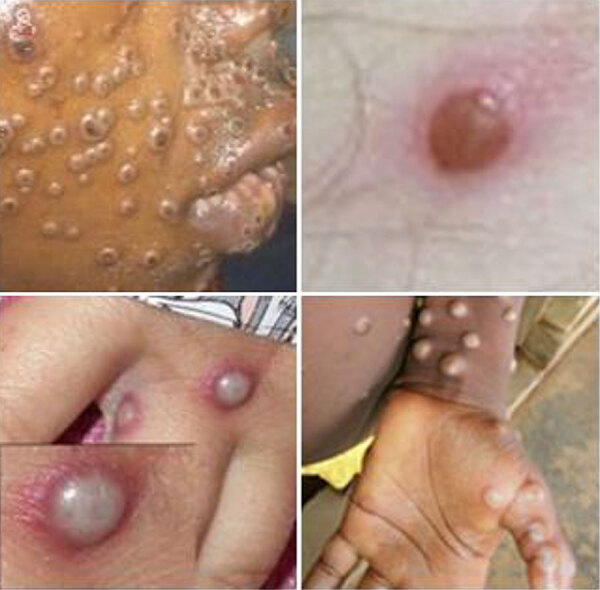 Figure 1
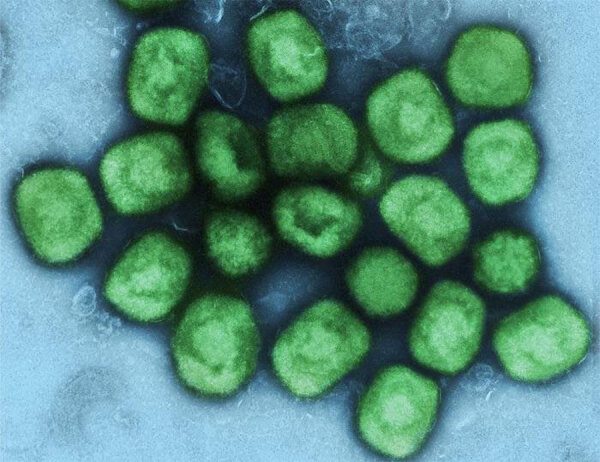 Figure 2
Peer Reviews
No public reviews on file for this paper yet. If you reviewed it on a platform where reviews are public (OpenReview, ICLR, NeurIPS, ICML), you can paste yours below so the community can read it here.
Videos
No videos yet. Explain this paper in a talk, walkthrough, or lecture? Add one.
Taxonomy
TopicsPoxvirus research and outbreaks · Bacteriophages and microbial interactions · Plant Virus Research Studies
Mpox, the infectious disease caused by monkeypox virus (MPXV), is characterized in humans by fever, lymphadenopathy, and a painful mucocutaneous rash. During 1958–1959, Danish virologist Preben von Magnus isolated the virus in macaque monkeys—hence, the name monkeypox (Figures 1,2). However, small mammals are likely the MPXV reservoir, not the aberrantly infected monkeys that received unwarranted blame as the host and created the misnomer monkeypox.
The derivation of the word monkey is shrouded in debate, antiquity, and complexity. The Oxford English Dictionary postulates Moneke referred to the son of Martin the Ape, a character in a collection of beloved European fables, Reynard the Fox, and the moniker might have accompanied continental showmen to England in the 1400s, but earlier variations of Moneke exist in other languages.
Pox, plural of pock, is Norman-French in origin from poque, meaning pouch. The diminutive form was poquet, or little pocket, describing the small scars remaining in the wake of various viral pustular eruptions, classically smallpox or syphilis. Plague and pox appear interchangeably in Shakespeare’s 1597 play Romeo and Juliet, in which Mercutio utters the famous and pejorative phrase, “A pox on both your houses.”
The first known human case of MPXV infection was reported in the Democratic Republic of the Congo in 1970. A global outbreak in 2022 was the first that involved widespread human-to-human MPXV transmission outside of Africa, prompting the World Health Organization to declare a Public Health Emergency. In November 2022, citing concerns of “racist and stigmatizing language” provoked by the original disease name, the World Health Organization renamed MPXV infection as mpox, but the virus name remains unchanged.
The reference list from the paper itself. Each links out to its DOI / PubMed record.
- 1News AP. WHO renames monkeypox as mpox, citing racism concerns [cited 2024 Feb 4]. https://apnews.com/article/who-renames-monkeypox-to-mpox
- 2Book Browse. Well-known expressions: a plague on both your houses [cited 2024 Feb 4]. https://www.bookbrowse.com/expressions/detail/index.cfm/expression_number/666/a-plague-on-both-your-houses
- 3Cho CT, Wenner HA. Monkeypox virus. Bacteriol Rev. 1973;37:1–18. 10.1128/br.37.1.1-18.19734349404 PMC 413801 · doi ↗ · pubmed ↗
- 4Haubrich WS. Medical meanings: a glossary of word options, 2nd edition. Philadelphia: American College of Physicians; 2003. p. 189.
- 5OU Pblog. Wrenching an etymology out of a monkey [cited 2024 Feb 4]. https://blog.oup.com/2013/01/monkey-word-origin-etymology
- 6Rondle C. The natural history of smallpox. New Sci. 1978;20:680–2.
- 7Weiner ESC, Simpson JA. Compact edition of the Oxford English Dictionary. Oxford University Press; 1971. p. 1838.
- 8World Health Organization. Mpox [cited 2024 Feb 4]. https://www.who.int/news-room/fact-sheets/detail/monkeypox