Psychological Well-Being in Clinical Research Coordinators
Regina M. Longley, M. Tim Song, Daniel A. Schaefer, Annabella C. Boardman, Emma P. Keane, Isabella S. Larizza, Emma D. Wolfe, Michelle Guo, Joseph Wu, Janet Abrahm, Hermioni L. Amonoo

TL;DR
This study explores the psychological well-being of clinical research coordinators to help develop better support strategies for them.
Contribution
The study provides insights into the psychological characteristics of clinical research coordinators for targeted workforce support.
Findings
Demographic and psychological characteristics were analyzed in a cohort of clinical research coordinators.
Findings aim to inform strategies for improving the well-being of this workforce.
Abstract
This cohort study examines demographic and psychological characteristics of clinical research coordinators to inform targeted workforce support strategies.
Genes, proteins, chemicals, diseases, species, mutations and cell lines named across the full text — each resolved to its canonical identifier and authoritative record.
Click any figure to enlarge with its caption.
 Figure
| Characteristic | Participants, No. (%) |
|---|---|
| Total, No. | 358 |
| Age, y | |
| 18-24 | 220 (61.5) |
| 25-34 | 126 (35.2) |
| 35-44 | 6 (1.7) |
| 45-54 | 1 (0.3) |
| 55-64 | 2 (0.6) |
| ≥65 | 3 (0.8) |
| Gender | |
| Man | 46 (12.8) |
| Woman | 307 (85.8) |
| Queer, genderqueer, or nonbinary | 5 (1.4) |
| Sexual orientation | |
| Asexual | 1 (0.3) |
| Bisexual or pansexual | 56 (15.6) |
| Gay, lesbian, or homosexual | 18 (5.0) |
| Straight or heterosexual | 254 (70.9) |
| Queer | 19 (5.3) |
| Questioning or unsure | 8 (2.2) |
| Other | 2 (0.6) |
| Ethnicity | |
| Hispanic or Latino/a/x | 34 (9.5) |
| Not Hispanic or Latino/a/x | 324 (90.5) |
| Race | |
| Asian, Asian American, or Asian background (including Indian subcontinent) | 63 (17.6) |
| Black, African American, or African background | 17 (4.7) |
| Middle Eastern | 5 (1.4) |
| White or European background | 250 (69.8) |
| More than 1 race | 17 (4.7) |
| Other | 6 (1.7) |
| Relationship status | |
| In a relationship, not living together | 113 (31.6) |
| Married or living with partner | 86 (24.0) |
| Separated or divorced | 1 (0.3) |
| Single | 158 (44.1) |
| Education | |
| High school diploma or GED | 1 (0.3) |
| Some college, associate’s degree, or technical or vocational school | 3 (0.8) |
| College degree | 277 (77.4) |
| Some postgraduate or professional education | 20 (5.6) |
| Postgraduate, professional, or doctorate degree | 57 (15.9) |
| Degree field | |
| Arts or humanities | 17 (4.7) |
| Business | 1 (0.3) |
| Health or medical studies | 16 (4.5) |
| Interdisciplinary fields | 60 (16.8) |
| Social sciences | 63 (17.6) |
| STEM | 201 (56.1) |
| Total annual household income | |
| >$25 000 | 5 (1.4) |
| $25 000-$49 999 | 195 (54.5) |
| $50 000-$74 999 | 83 (23.2) |
| $75 000-$99 999 | 18 (5.0) |
| $100 000-$149 999 | 22 (6.1) |
| ≥$150 000 | 34 (9.5) |
| Missing | 1 (0.3) |
| Second job | |
| No | 262 (73.2) |
| Yes, in clinical research | 10 (2.8) |
| Yes, not in clinical research | 86 (24.0) |
| Living situation | |
| By myself | 51 (14.2) |
| Family member(s) | 37 (10.3) |
| Partner or spouse | 72 (20.1) |
| Roommate(s) or friend(s) | 181 (50.6) |
| Multiple living situations indicated (eg, with partner and roommates) | 16 (4.5) |
| Other | 1 (0.3) |
| Region of origin | |
| Midwest | 35 (10.3) |
| East north central | 26 (7.3) |
| West north central | 9 (2.5) |
| Northeast | 203 (59.9) |
| New England | 147 (41.1) |
| Mid-Atlantic | 56 (15.6) |
| South | 44 (13.0) |
| South Atlantic | 33 (9.2) |
| East south central | 2 (0.6) |
| West south central | 9 (2.5) |
| West | 41 (12.1) |
| Mountain | 7 (2.0) |
| Pacific | 34 (9.5) |
| Puerto Rico | 1 (0.3) |
| Outside of US | 15 (4.2) |
| Missing | 19 (5.3) |
| State of work | |
| MA | 323 (90.2) |
| Not MA | 16 (4.5) |
| Missing | 19 (5.3) |
| Research focus | |
| Cardiovascular | 24 (6.7) |
| Congenital disorders | 3 (0.8) |
| Infectious diseases | 5 (1.4) |
| Inflammatory and immune systems | 8 (2.2) |
| Mental health, psychology, and/or psychiatry | 62 (17.3) |
| Metabolic and endocrine disorders | 11 (3.1) |
| Neurological | 68 (19.0) |
| Oncology | 44 (12.3) |
| Orthopedic | 10 (2.8) |
| Pulmonary | 7 (2.0) |
| Reproductive health | 5 (1.4) |
| More than 1 | 56 (15.6) |
| Other | 55 (15.4) |
| Duration of time worked as a CRC, median (IQR), mo | 14.5 (11.0-24.0) |
| Psychological scale | |
| GAD-7 scale, mean (SD) | 6.61 (5.29) |
| Minimal (0-4) | 148 (41.3) |
| Mild (5-9) | 105 (29.3) |
| Moderate (10-14) | 54 (15.1) |
| Severe (15-21) | 34 (9.5) |
| Missing | 17 (4.7) |
| CES-D, mean (SD) | 14.57 (9.90) |
| Minimal (0-9) | 123 (34.3) |
| Mild (10-15) | 82 (22.9) |
| Moderate (16-24) | 77 (21.5) |
| Severe (25-60) | 54 (15.1) |
| Missing | 22 (6.1) |
| OLBI-Total, mean (SD) | 41.28 (7.19) |
| OLBI-Disengagement subscale, mean (SD) | 20.63 (4.01) |
| OLBI-Exhaustion subscale, mean (SD) | 20.65 (4.19) |
| MSPSS-Total, mean (SD) | 5.75 (0.97) |
| MSPSS-Family subscale, mean (SD) | 5.55 (1.42) |
| MSPSS-Friends subscale, mean (SD) | 5.86 (1.13) |
| MSPSS-Significant Others subscale, mean (SD) | 5.85 (1.42) |
Peer Reviews
No public reviews on file for this paper yet. If you reviewed it on a platform where reviews are public (OpenReview, ICLR, NeurIPS, ICML), you can paste yours below so the community can read it here.
Videos
No videos yet. Explain this paper in a talk, walkthrough, or lecture? Add one.
Taxonomy
TopicsHealth and Medical Research Impacts · Healthcare professionals’ stress and burnout · Innovations in Medical Education
Introduction
Clinical research coordinators (CRCs) are essential to the $93 billion^1^ US medical research enterprise, balancing administrative and participant-facing tasks to uphold research integrity.^2^ Little is known about CRCs’ demographics and psychological well-being despite their central role.^2,3^ High turnover, unclear role expectations, and limited training may contribute to psychological distress.^2^ Understanding CRC well-being is critical as burnout and job dissatisfaction could jeopardize data integrity and research continuity. As medical research flourishes, supporting CRCs is vital to sustaining a reliable research infrastructure. This study describes CRCs’ demographic and psychological characteristics to inform targeted workforce support strategies.
Methods
This cross-sectional study was approved by the Mass General Brigham institutional review board and followed the STROBE reporting guideline. All participants provided informed consent electronically before completing the online surveys. We analyzed data collected from a cross-sectional survey of 358 primarily Massachusetts-based CRCs working (December 2023 to August 2024) with CRCs who have worked with human participants for 6 months or longer. Participants self-reported demographic and employment information and completed psychological scales for perceived social support, depression (measured by Center for Epidemiologic Studies Depression Scale [CES-D]), anxiety (measured by General Anxiety Disorder-7 [GAD-7]), and burnout (measured by Oldenburg Burnout Inventory [OLBI]) (eMethods in Supplement 1).
Analyses were conducted using RStudio 2024.09.0 Build 375 (Posit Software, PBC). Descriptive statistics were used to summarize participant characteristics and outcomes. Continuous psychological outcomes (GAD-7, CES-D, and total OLBI scores) were compared using independent sample t tests. Demographic variables with multiple levels were collapsed a priori into binary contrasts (eg, undergraduate degree or below vs graduate degree or above, man vs not man, heterosexual vs not heterosexual, single vs not single, living alone vs not living alone) due to small cell sizes and to preserve power. For each binary variable, the larger subgroup was the referent. We reported group mean (SD) and computed Cohen d for effect size (0.2, small; 0.5, medium; 0.8, large). Raw P values from t tests were adjusted for multiple comparisons using the Benjamini–Hochberg false-discovery-rate procedure, with 2-tailed α = .05.
Results
Among 358 participants, most were from Massachusetts (90.2%), aged 35 years or younger (96.7%), female (85.8%), and heterosexual (70.9%); had household incomes of 49 999 (54.5%); and held 1 job (73.2%). Additionally, 44.1% were single, 31.6% in a relationship without cohabitation, and 77.4% held an undergraduate degree, primarily in Science, Technology, Engineering, and Mathematics (56.1%) (Table). CRCs worked in diverse disciplines, with median (IQR) work duration of 14.5 (11.0-24.0) months at time of survey completion.
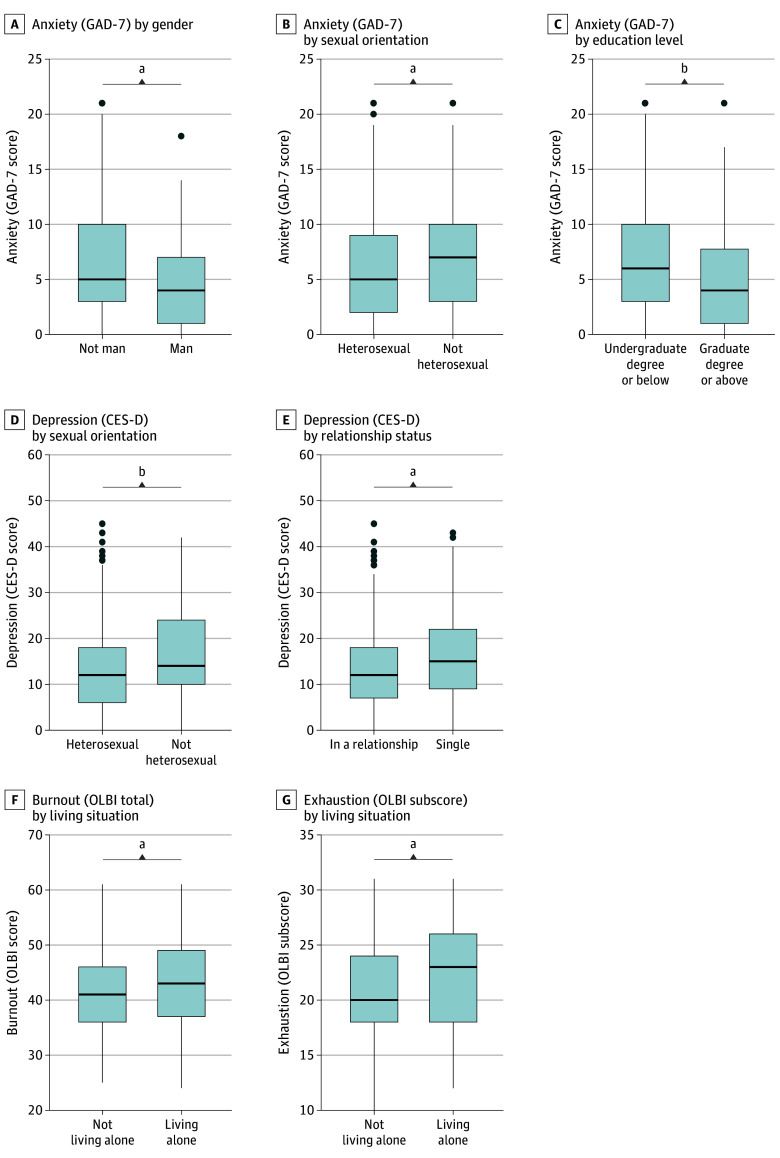
CRCs reported high perceived social support (mean [SD], 5.75 [0.97]), particularly those in a relationship (d = 0.38; P = .001) and with graduate-level or greater education (d = 0.25; P = .04). GAD-7 scores (mean [SD], 6.61 [5.29]) indicated 24.6% had clinically significant anxiety. Men (d = 0.35; P = .02) and graduate degree or higher–bearing (d = 0.35; P = .006) participants reported lower anxiety scores, while nonheterosexual participants reported higher anxiety scores (d = 0.24; P = .048). CES-D scores (mean [SD], 14.57 [9.90]) indicated 36.6% had moderate-to-severe depression; nonheterosexual participants (d = 0.34; P = .004) and single participants reported higher depression scores (d = 0.24; P = .03). OLBI scores (mean [SD], 41.28 [7.19]) indicated higher burnout (d = 0.38; P = .04) and exhaustion (d = 0.44; P = .01) in those living alone (Figure).
Significant Differences in Anxiety, Depression, and Burnout Scores by Demographic GroupaP < .05.bP < .01.CES-D indicates Center for Epidemiologic Studies Depression Scale; GAD-7, General Anxiety Disorder-7; OLBI, Oldenburg Burnout Inventory.
Discussion
This first comprehensive survey describing Massachusetts-based CRCs’ sociodemographic and psychological characteristics found most CRCs were young, female, heterosexual, not Hispanic, and White. Reported rates of clinically significant anxiety and depression exceeded prevalence within similar age groups,^4^ resembling elevated rates observed in medical students.^5^ Since many CRCs pursue medical school, compounding psychological risks may be concerning.
Role-specific stressors like heavy workload,^2^ role ambiguity, and career uncertainty may erode CRC well-being. Psychological distress varied across demographic groups, highlighting the need for targeted, contextualized support. Social support may buffer psychological distress, promotable by supportive work culture^3^ and peer support.^6^ The financial inaccessibility of low-paying CRC roles may also reinforce barriers to academia and medicine.^2^
This study’s cross-sectional design and homogeneous sample limit causal inference and generalizability. Our findings encourage further exploration of CRC well-being to uphold health outcomes and research advancements. Future research should examine role-specific stressors and sociodemographic underrepresentation. Institutions should consider peer support programs, wellness screenings, and structured interventions to promote CRC well-being.
The reference list from the paper itself. Each links out to its DOI / PubMed record.
- 1NIH’s role in sustaining the US economy FY 2023. United for Medical Research. Accessed June 23, 2025. https://www.unitedformedicalresearch.org/annual-economic-report/
- 2Speicher LA, Fromell G, Avery S, . The critical need for academic health centers to assess the training, support, and career development requirements of clinical research coordinators: recommendations from the Clinical and Translational Science Award Research Coordinator Taskforce. Clin Transl Sci. 2012;5(6):470-475. doi:10.1111/j.1752-8062.2012.00423.x 23253669 PMC 3531899 · doi ↗ · pubmed ↗
- 3Qi L, Fu Q, Li W, Wu J, Li J, Ni S. Analysis of job satisfaction among clinical research coordinators. Work. 2024;79(3):1121-1132. doi:10.3233/WOR-23073238875070 PMC 11612937 · doi ↗ · pubmed ↗
- 4Terlizzi EPVM, Villarroel MA. Symptoms of generalized anxiety disorder among adults: United States, 2019. NCHS Data Brief. 2020;378:1-8.33054928 · pubmed ↗
- 5Rotenstein LS, Ramos MA, Torre M, . Prevalence of depression, depressive symptoms, and suicidal ideation among medical students: a systematic review and meta-analysis. JAMA. 2016;316(21):2214-2236. doi:10.1001/jama.2016.1732427923088 PMC 5613659 · doi ↗ · pubmed ↗
- 6Deary EC, Daskalakis E, Abrahm JL, Morris SE, Amonoo HL. At a loss: patient deaths and clinical research coordinators. J Clin Oncol. 2023;41(16):3072-3073. doi:10.1200/JCO.23.0004037098231 PMC 10414706 · doi ↗ · pubmed ↗