Using Machine Learning to Improve Control for Confounding in the Dynamic Weighted Ordinary Least Squares Estimator of Optimal Adaptive Treatment Strategies
Kossi Clément Trenou, Miceline Mésidor, Aida Eslami, Hermann Nabi, Caroline Diorio, Denis Talbot

TL;DR
This paper explores using machine learning in a statistical method to better estimate personalized treatment strategies, showing improved performance over traditional models.
Contribution
The paper introduces the use of machine learning within the dWOLS estimator for adaptive treatment strategies, demonstrating its effectiveness.
Findings
SuperLearner performed as well as logistic regression in simple scenarios and better in complex ones.
The m-out-of-n bootstrap method produced accurate confidence intervals for low-bias estimates.
The method was successfully applied to breast cancer data for personalized hormonal therapy recommendations.
Abstract
Estimating optimal adaptive treatment strategies (ATSs) can be done in several ways, including dynamic weighted ordinary least squares (dWOLS). This approach is doubly robust as it requires modeling both the treatment and the response, but only one of those models needs to be correctly specified to obtain a consistent estimator. For estimating an average treatment effect, doubly robust methods have been shown to combine better with machine learning methods than alternatives. However, the use of machine learning within dWOLS has not yet been investigated. Using simulation studies, we evaluate and compare the performance of the dWOLS estimator when the treatment probability is estimated either using machine learning algorithms or a logistic regression model. We further investigate the use of an adaptive m‐out‐of‐n bootstrap method for producing inferences. SuperLearner performed at least…
Genes, proteins, chemicals, diseases, species, mutations and cell lines named across the full text — each resolved to its canonical identifier and authoritative record.
Click any figure to enlarge with its caption.
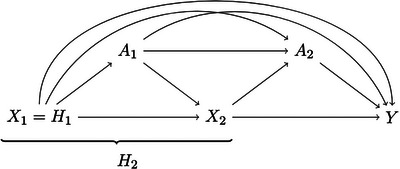 Figure 1
Peer Reviews
No public reviews on file for this paper yet. If you reviewed it on a platform where reviews are public (OpenReview, ICLR, NeurIPS, ICML), you can paste yours below so the community can read it here.
Videos
No videos yet. Explain this paper in a talk, walkthrough, or lecture? Add one.
Taxonomy
TopicsStatistical Methods and Inference · Advanced Causal Inference Techniques · Statistical Methods in Clinical Trials