Sleeping upside-down: Knockdown of a sleep-associated gene induces daytime sleep in the jellyfish Cassiopea
Michael J. Abrams, Aki Ohdera, Diana A. Francis, Owen Donayre, Henry Chen, Kevin Lu, Celeste Y. Hsu, Hannah Zeigler, Richard M. Harland

TL;DR
This study shows that a specific gene in jellyfish is linked to sleep regulation, suggesting that sleep mechanisms are evolutionarily conserved.
Contribution
The study identifies a cholinergic-like receptor gene involved in sleep regulation in Cassiopea, revealing deep evolutionary conservation.
Findings
Knockdown of chrnal-E in Cassiopea promotes wakefulness, indicating its role in sleep regulation.
Chrnal-E expression expands in the ganglia after sleep deprivation, linking it to wakefulness.
Cholinergic-like receptors are conserved in sleep regulation even in organisms with distributed nervous systems.
Abstract
Sleep is a fundamental behavioral and physiological process conserved across diverse animals, yet its regulatory mechanisms remain unclear. We investigated the regulation of sleep in an early branching animal lineage with a relatively simple nervous system to gain insight into the evolution of sleep. The upside-down jellyfish Cassiopea xamachana exhibits sleep, behaviorally controlled by marginal ganglia. We focused on how sleep deprivation strongly altered ganglionic expression of a nicotinic acetylcholine receptor alpha-like subunit, chrnal-E. RNAi-mediated knockdown determined that Chrnal-E promotes wakefulness. Our findings suggest deep evolutionary conservation of cholinergic-like receptors in sleep regulation. Understanding how sleep is controlled in relatively simple organisms provides insight into its fundamental biological importance and may inform broader studies of…
Genes, proteins, chemicals, diseases, species, mutations and cell lines named across the full text — each resolved to its canonical identifier and authoritative record.
Click any figure to enlarge with its caption.
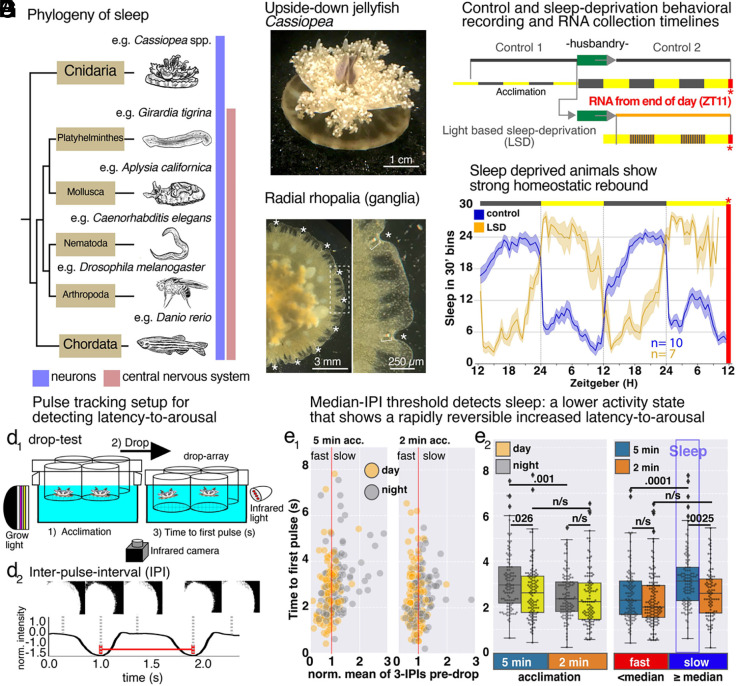 Figure 1
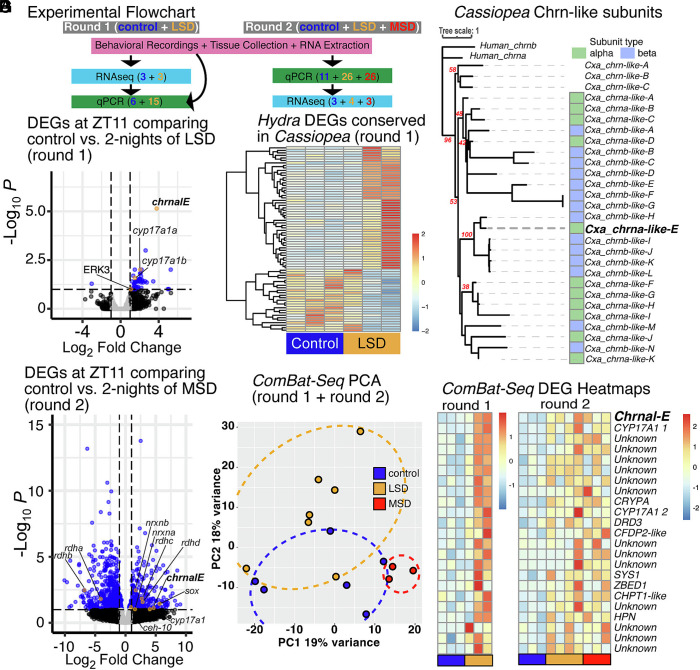 Figure 2
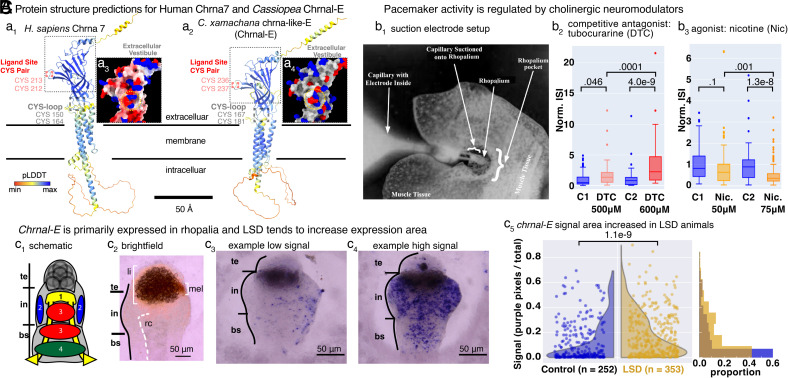 Figure 3
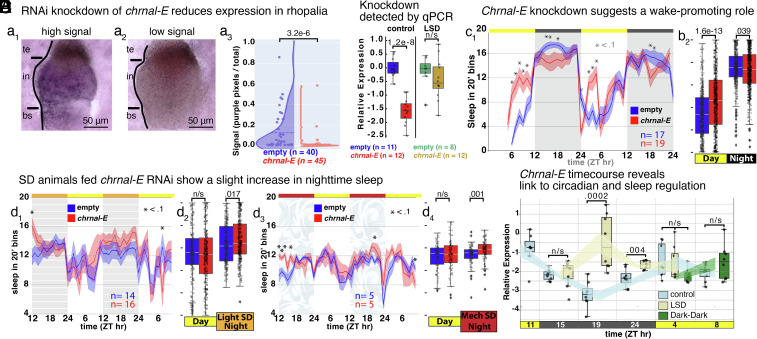 Figure 4
Peer Reviews
No public reviews on file for this paper yet. If you reviewed it on a platform where reviews are public (OpenReview, ICLR, NeurIPS, ICML), you can paste yours below so the community can read it here.
Videos
No videos yet. Explain this paper in a talk, walkthrough, or lecture? Add one.
Taxonomy
TopicsSleep and Wakefulness Research · Photoreceptor and optogenetics research · Marine Invertebrate Physiology and Ecology