Redirecting the Peptide Cleavage Causes Protease Inactivation
Christian Breuer, Jim Küppers, Anna‐Christina Schulz‐Fincke, Anna Heilos, Carina Lemke, Petra Spiwoková, Janina Schmitz, Laura Cremer, Marta Frigolé‐Vivas, Michael Lülsdorff, Matthias D. Mertens, Filip Wichterle, Miloš Apeltauer, Martin Horn, Erik Gilberg, Norbert Furtmann

TL;DR
Scientists designed new inhibitors that irreversibly disable a key enzyme, human cathepsin B, by redirecting its normal cleavage process.
Contribution
A novel irreversible inhibition mechanism for cysteine proteases using redirected cleavage and carbamate warheads is introduced.
Findings
Inhibitors with N-terminal carbamate warheads cause irreversible inactivation of human cathepsin B.
Redirected cleavage forms non-canonical covalent complexes that resist hydrolysis.
Inhibitors show second-order rate constants exceeding 10,000 M⁻¹s⁻¹.
Abstract
Cysteine and serine proteases cleave peptides through covalent catalysis by generating a transient adduct with the N‐terminal part of the substrate after releasing its C‐terminal part. We demonstrate the unique redirection of this event leading to strong enzyme inactivation. For targeting human cathepsin B, a cysteine protease of significant therapeutic importance, we designed tailored peptidomimetics with a variety of dipeptide fragments directed toward the occluding loop and equipped with numerous N‐terminal carbamate warheads. The carbamate deprotonation catalyzed by the active site thiolate initiates the redirected cleavage. The C‐terminal part of the inhibitors remains covalently attached to the protease. Hydrolysis of such carbamoyl‐enzyme complexes is catalytically unsupported rendering inhibition irreversible. This novel mechanism of action comprises a significant extension of…
Genes, proteins, chemicals, diseases, species, mutations and cell lines named across the full text — each resolved to its canonical identifier and authoritative record.
Click any figure to enlarge with its caption.
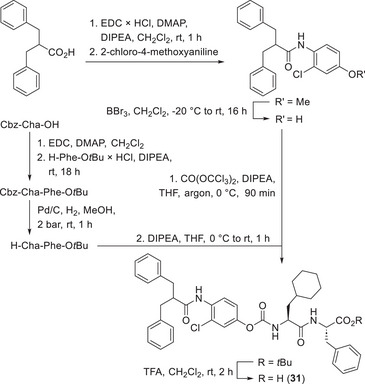 Figure 1
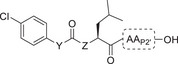 Figure 2
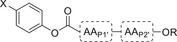 Figure 3
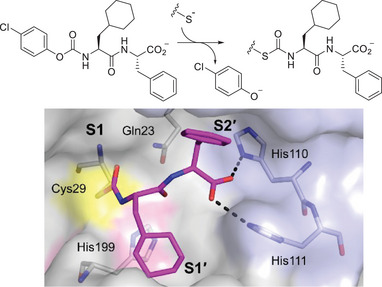 Figure 4
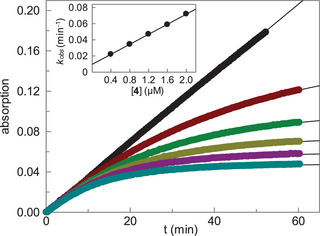 Figure 5
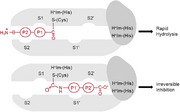 Figure 6
 Figure 7
Peer Reviews
No public reviews on file for this paper yet. If you reviewed it on a platform where reviews are public (OpenReview, ICLR, NeurIPS, ICML), you can paste yours below so the community can read it here.
Videos
No videos yet. Explain this paper in a talk, walkthrough, or lecture? Add one.
Taxonomy
TopicsPeptidase Inhibition and Analysis · Chemical Synthesis and Analysis · Click Chemistry and Applications