A Personalized, Texting-Based Conversational Agent to Address Sleep Disturbance in Individuals Who Have Survived Breast Cancer: Protocol for a Pilot Waitlist Randomized Controlled Trial
Chi-shan Tsai, Warren Szewczyk, Michelle Drerup, Jason Liao, Alexi Vasbinder, Heather Greenlee, Jaimee L Heffner, Rachel Yung, Kerryn W Reding

TL;DR
This study tests a text-based AI tool called Cecebot to help breast cancer survivors improve their sleep through personalized messaging and support.
Contribution
The study introduces a novel conversational agent that combines CBTi with physical activity support via SMS for breast cancer survivors.
Findings
The Cecebot intervention will be tested for safety, acceptability, and efficacy in improving sleep among breast cancer survivors.
Feasibility will be measured through recruitment, enrollment, and retention rates during the trial.
The study will explore the impact of SMS-based CBTi and physical activity support on sleep outcomes.
Abstract
Sleep disturbance is one of the most common health concerns reported by individuals who have survived breast cancer (BC) and is associated with poor quality of life (QoL) and greater mortality after treatment. Cognitive behavioral therapy for insomnia (CBTi) has shown efficacy for improving sleep and QoL for this population. Considered the gold standard for insomnia treatment, CBTi can be delivered remotely, including via digital intervention. Despite the potential for wider dissemination of CBTi via digital means, these modalities have unique challenges, including technology barriers and poor adherence. We developed a conversational agent (CA) to deliver CBTi via a SMS text messaging intervention, supported by mobile-ready web content. Named “Cecebot,” this CA delivers sleep education, implements sleep compression, provides just-in-time interventions for sleep-disrupting behaviors, and…
Genes, proteins, chemicals, diseases, species, mutations and cell lines named across the full text — each resolved to its canonical identifier and authoritative record.
Click any figure to enlarge with its caption.
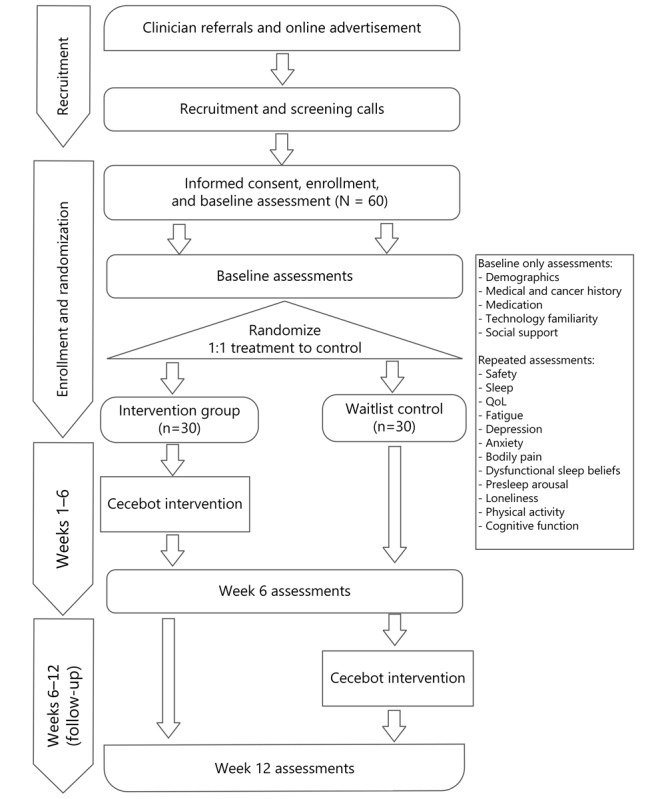 Figure 1
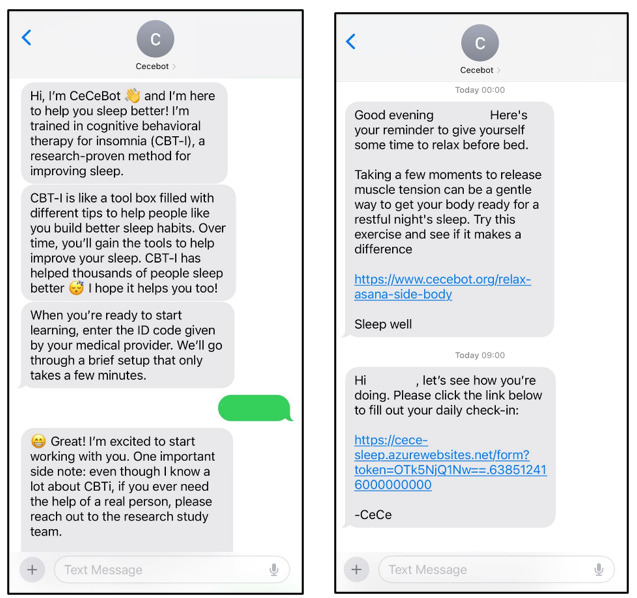 Figure 2
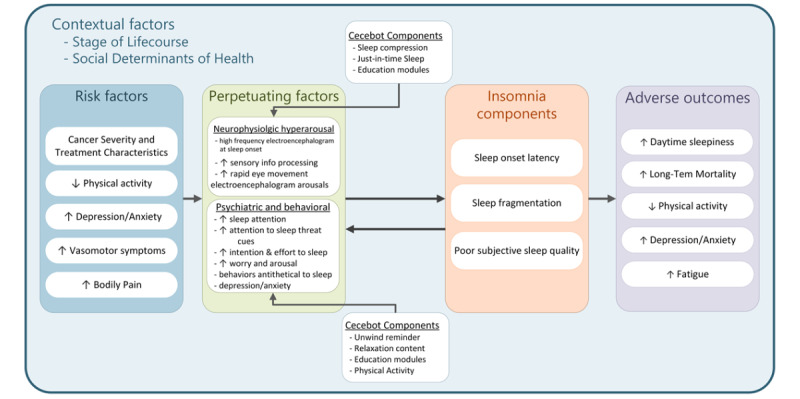 Figure 3
Peer Reviews
No public reviews on file for this paper yet. If you reviewed it on a platform where reviews are public (OpenReview, ICLR, NeurIPS, ICML), you can paste yours below so the community can read it here.
Videos
No videos yet. Explain this paper in a talk, walkthrough, or lecture? Add one.
Taxonomy
TopicsSleep and related disorders · Digital Mental Health Interventions · Circadian rhythm and melatonin