Characteristics of Optimal Cancer Referrals Made by Primary Care Clinicians: Scoping Review
Olufisayo Olakotan, Judith Yargawa, Julie-Ann Moreland, Claire Friedemann Smith, Brian D. Nicholson, Andrew Millar, Georgia B. Black

TL;DR
This study reviews what makes cancer referral letters effective, finding that detailed symptom descriptions and test results are important but more research is needed to improve cancer diagnoses.
Contribution
The study identifies key elements of optimal cancer referral letters and highlights gaps in evidence linking referral content to diagnostic outcomes.
Findings
Referral letters often lack detailed symptom information like duration and appearance.
Including clinical examination findings and test results may improve diagnostic outcomes.
There is limited evidence on whether guidelines or templates improve referral effectiveness.
Abstract
In England, over 2 million patients are referred each year on urgent pathways to investigate suspected cancer. The content and quality of referrals have often been audited, but there is no consensus on what should be included in a referral to optimise diagnostic outcomes. To identify and describe the characteristics of referral letters for suspected cancer from primary to secondary care that may optimise diagnostic outcomes. The scoping review employed the methodology developed by Arksey and O'Malley in 2005 and further expanded by Levac and Colquhoun 2010. We searched PubMed, Embase, and PsycINFO to identify relevant studies in English Language published between 2000 and 2023. All findings were reported according to PRISMA guidelines for scoping reviews. Of 3463 identified records, only thirteen met the inclusion criteria, employing qualitative and mixed methods, as well as…
Genes, proteins, chemicals, diseases, species, mutations and cell lines named across the full text — each resolved to its canonical identifier and authoritative record.
Click any figure to enlarge with its caption.
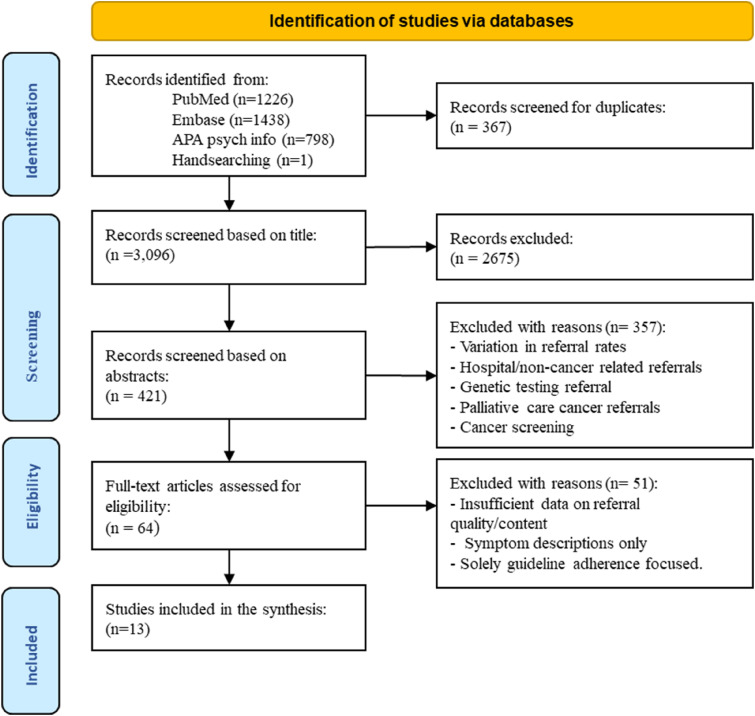 Figure 1
Peer Reviews
No public reviews on file for this paper yet. If you reviewed it on a platform where reviews are public (OpenReview, ICLR, NeurIPS, ICML), you can paste yours below so the community can read it here.
Videos
No videos yet. Explain this paper in a talk, walkthrough, or lecture? Add one.
Taxonomy
TopicsHealthcare Systems and Technology · Global Cancer Incidence and Screening · Patient-Provider Communication in Healthcare