Signal Transducer and Activator of Transcription 3 (STAT3) Variant p.K709N Causes Hyper‐IgE Syndrome Likely by Impaired STAT3‐Dimer Formation
Beate Hagl, Benedikt D. Spielberger, Betina Neumann, Simon J. Pelham, Dharmendra Pandey, Andreas Schlundt, Camille Barro, Anica Lechner, Christine Wolf, Elissa K. Deenick, Michael Sattler, Stuart G. Tangye, Simon Rothenfusser, Ellen D. Renner

TL;DR
A new STAT3 mutation, p.K709N, causes hyper-IgE syndrome by disrupting STAT3 dimer formation and gene expression.
Contribution
Identifies a novel STAT3 variant p.K709N as a cause of hyper-IgE syndrome through impaired dimerization.
Findings
The STAT3 p.K709N variant impairs dimer formation and DNA binding.
The mutation leads to reduced target gene expression and a dominant-negative effect.
3D structural analysis shows K709 is critical for dimer stabilization.
Abstract
STAT3‐hyper‐IgE syndrome (STAT3‐HIES) is an inborn error of immunity caused by heterozygous dominant‐negative mutations in the signal transducer and activator of transcription 3 (STAT3). In this study, we evaluate the functional relevance of a previously undescribed heterozygous STAT3 variant in a patient with clinical findings of STAT3‐HIES. Flow cytometry, quantitative real‐time PCR, pull‐down assays, native PAGE, DNA‐binding ELISA, and 3D‐structural data analysis were performed. Genetic analysis identified the heterozygous STAT3 variant NM_139276.2:c.2127G>C (NP_644805.1:p.(K709N); short: p.K709N) in a patient with a clinical and laboratory phenotype characteristic of STAT3‐HIES, including early onset severe eczema, chronic lung disease, eosinophilia, and elevated serum IgE levels. While STAT3 p.K709N did not significantly affect STAT3 phosphorylation, STAT3 target gene expression…
Genes, proteins, chemicals, diseases, species, mutations and cell lines named across the full text — each resolved to its canonical identifier and authoritative record.
Click any figure to enlarge with its caption.
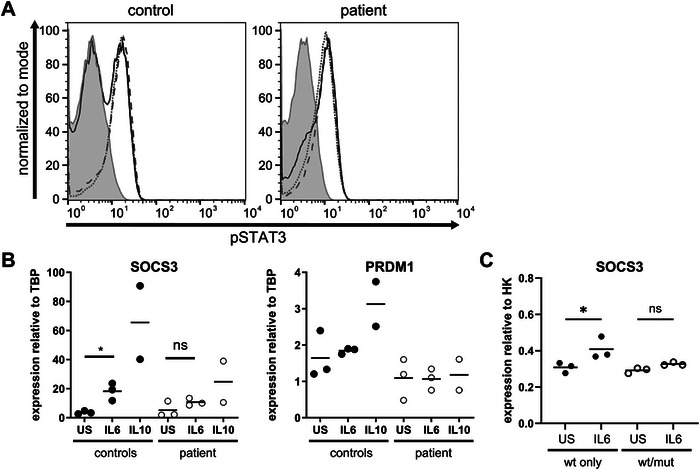 Figure 1
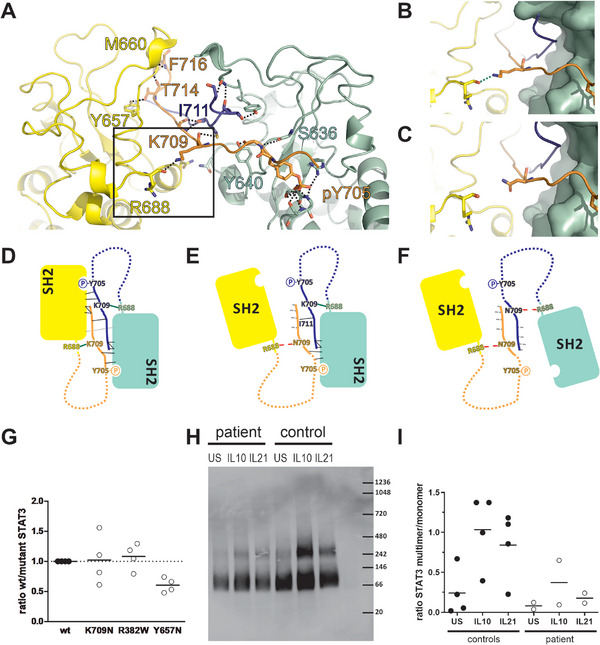 Figure 2
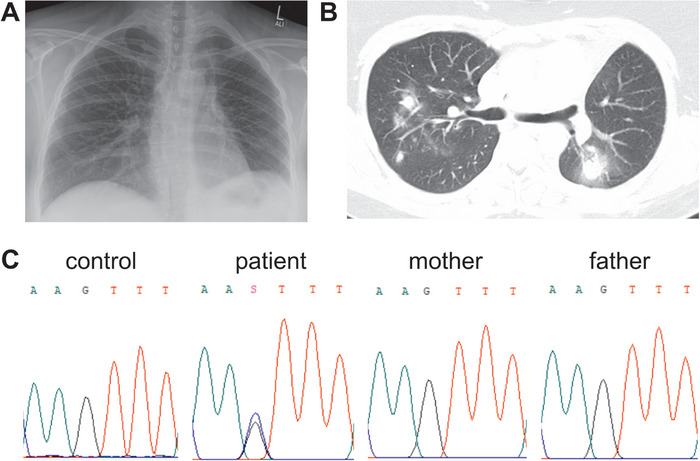 Figure 3
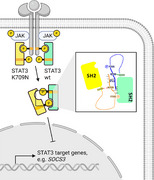 Figure 4
Peer Reviews
No public reviews on file for this paper yet. If you reviewed it on a platform where reviews are public (OpenReview, ICLR, NeurIPS, ICML), you can paste yours below so the community can read it here.
Videos
No videos yet. Explain this paper in a talk, walkthrough, or lecture? Add one.
Taxonomy
TopicsImmunodeficiency and Autoimmune Disorders · Immune Cell Function and Interaction · T-cell and B-cell Immunology