Contrasting Roles of the Multiple Seas in East Asia on Population Divergence of Smilax sieboldii (Smilacaceae)
Ya‐Lu Ru, Shan‐Shan Zhu, Xin‐Yi Fan, Wen‐Hao Li, Cheng‐Xin Fu, Yun‐Peng Zhao

TL;DR
This study shows how different seas in East Asia affected the genetic divergence of Smilax sieboldii, revealing that some seas acted as barriers while others facilitated gene flow.
Contribution
The study provides new insights into the contrasting roles of multiple seas in shaping population divergence in a temperate forest species.
Findings
The East China Sea and Korea-Tsushima Strait acted as effective geographic barriers to gene flow.
The Yellow-Bohai Sea and Taiwan Strait functioned as dispersal corridors, facilitating greater genetic exchange.
Phylogeographic patterns in S. sieboldii were shaped by sea-level fluctuations since the Pleistocene.
Abstract
Multiple seas in East Asia have played distinct roles during the Quaternary climatic cycles, which have repeatedly isolated and reconnected temperate forest species, while it remains unclear whether their roles differ. In this study, we used Smilax sieboldii, a widely distributed species along the eastern coast of East Asia, to simultaneously evaluate the roles of multiple seas, including the East China Sea, the Yellow‐Bohai Sea, the Korea‐Tsushima Strait, and the Taiwan Strait, as geographic barriers and dispersal corridors during historical sea‐level fluctuations. We employed Bayesian clustering analysis and demographic simulations to elucidate the genetic structure and evolutionary history. The effects of spatial or environmental differences on population structure were examined through isolation by distance (IBD) and isolation by environment (IBE) tests. Further, genetic…
Genes, proteins, chemicals, diseases, species, mutations and cell lines named across the full text — each resolved to its canonical identifier and authoritative record.
Click any figure to enlarge with its caption.
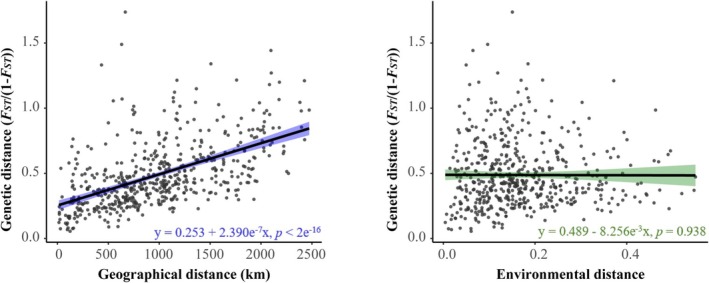 Figure 1
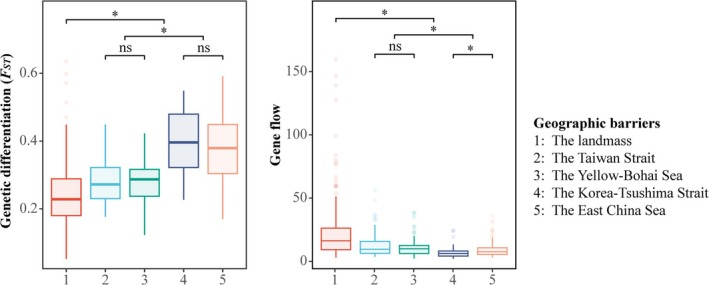 Figure 2
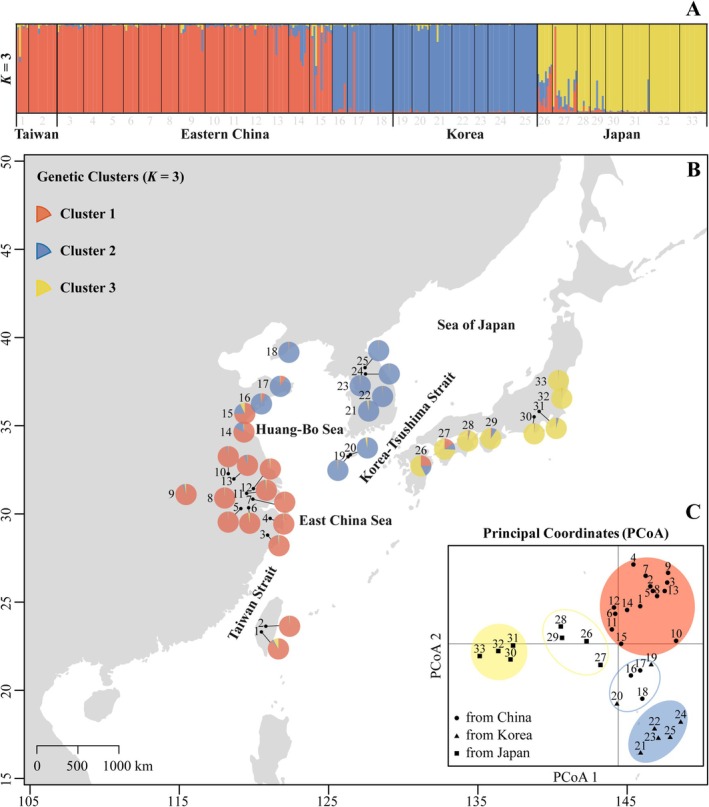 Figure 3
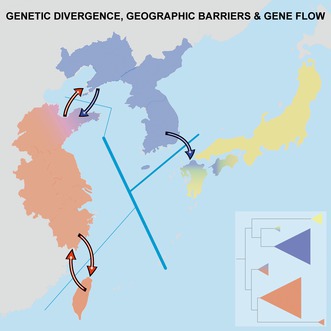 Figure 4
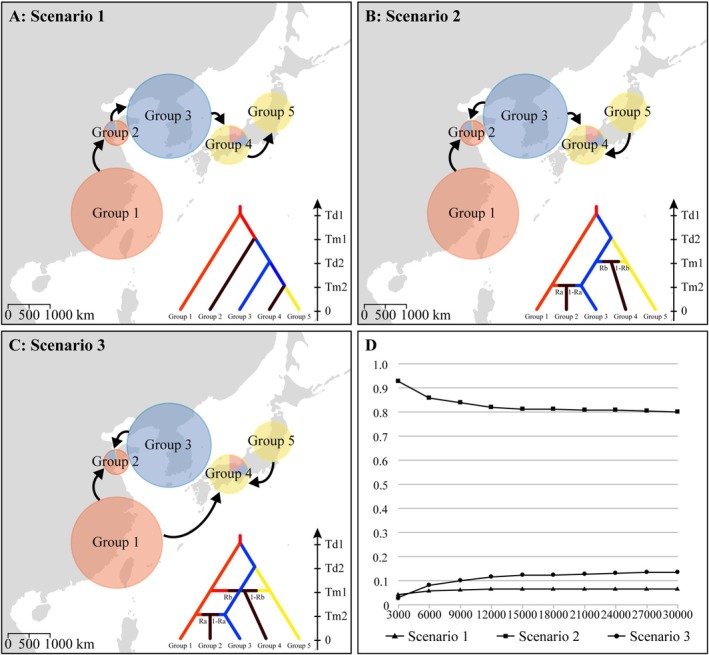 Figure 5
Peer Reviews
No public reviews on file for this paper yet. If you reviewed it on a platform where reviews are public (OpenReview, ICLR, NeurIPS, ICML), you can paste yours below so the community can read it here.
Videos
No videos yet. Explain this paper in a talk, walkthrough, or lecture? Add one.
Taxonomy
TopicsGenetic diversity and population structure · Plant and Fungal Species Descriptions · Geology and Paleoclimatology Research