Diversity of Environmental Escherichia coli in Subtropical Freshwater Systems of South Africa
Tarren Seale, Volker S. Brözel, Sarah C. Potgieter, Oliver Rupp, Jochen Blom, Emma T. Steenkamp, Stephanus N. Venter

TL;DR
This study explores the diversity of Escherichia coli in South African freshwater systems, revealing unexpected phylogroup B2 isolates that may have disease-causing potential.
Contribution
The study identifies a significant presence of phylogroup B2 E. coli in environmental samples, which is novel for this region.
Findings
Phylogroup B2 E. coli isolates formed a distinct phylogenetic cluster, independent of niche or geographic origin.
Environmental E. coli isolates harbored virulence factors associated with extraintestinal disease.
Phylogroup B1 was the most dominant, but B2 was unexpectedly the second most dominant.
Abstract
Escherichia coli is widely used as an indicator of faecal contamination, as it is assumed that faeces from warm-blooded animals is the primary source of E. coli in the environment. However, various studies have shown that E. coli can survive and multiply in environmental niches, including soil, sand and sediment. E. coli can be assigned to eight main phylogroups but environmental E. coli are associated primarily with phylogroups A and B1. In this study, 410 E. coli were isolated from different niches within two peri-urban catchments in the Gauteng province of South Africa. To represent the E. coli circulating within the human population, E. coli was also isolated from sewage before treatment and released into these reservoirs. To capture the diversity of E. coli among these isolates, the β-D-glucuronidase (uidA) and mismatch repair (mutS) genes were sequenced. While isolates linked to…
Genes, proteins, chemicals, diseases, species, mutations and cell lines named across the full text — each resolved to its canonical identifier and authoritative record.
Click any figure to enlarge with its caption.
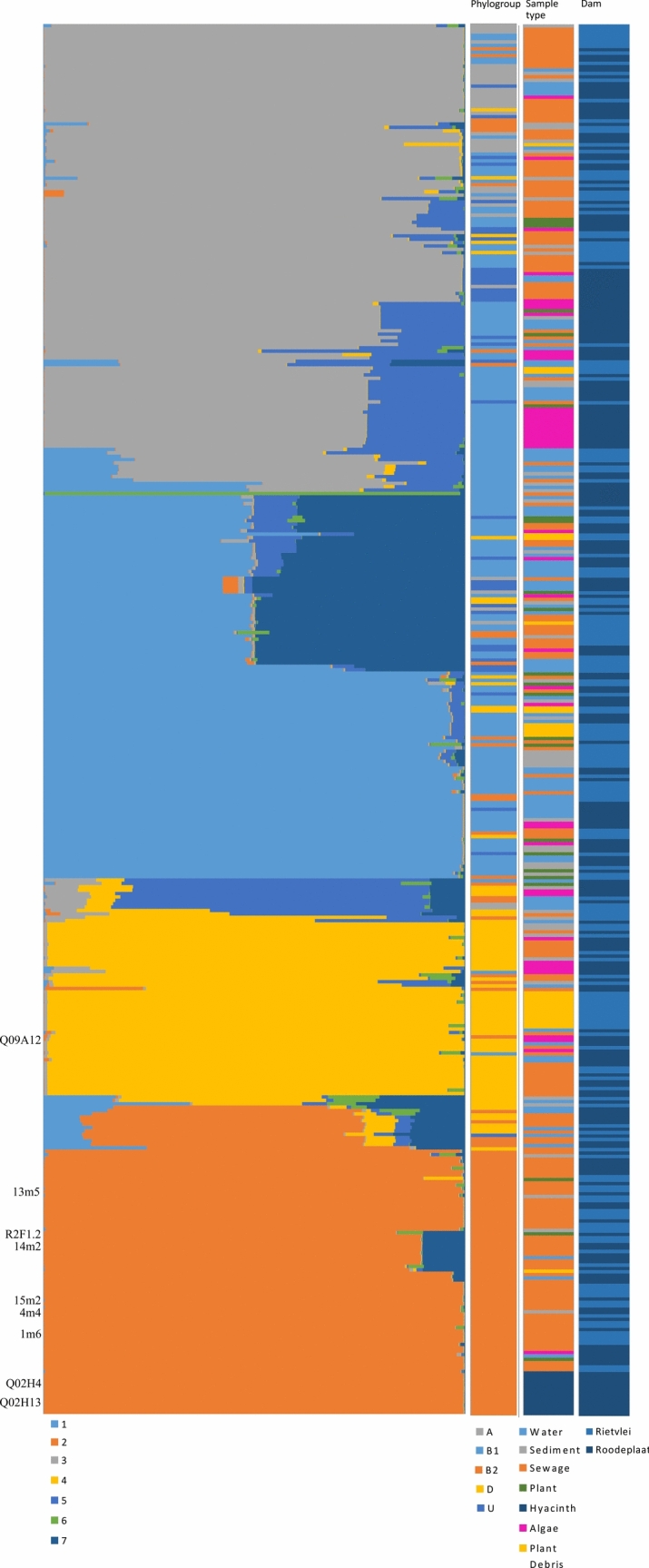 Figure 1
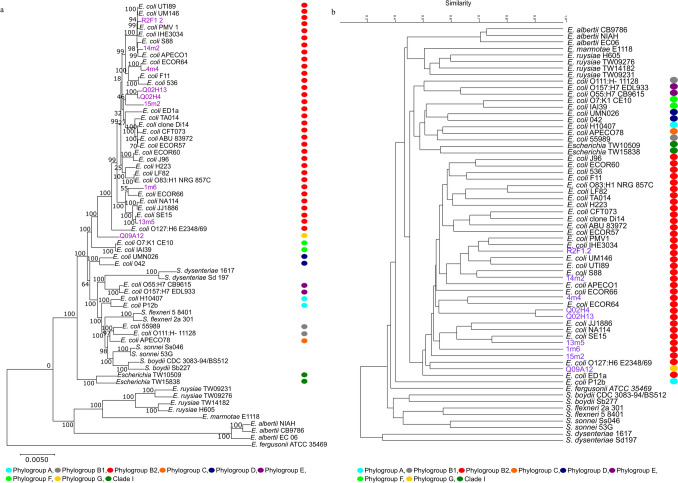 Figure 2
Peer Reviews
No public reviews on file for this paper yet. If you reviewed it on a platform where reviews are public (OpenReview, ICLR, NeurIPS, ICML), you can paste yours below so the community can read it here.
Videos
No videos yet. Explain this paper in a talk, walkthrough, or lecture? Add one.
Taxonomy
TopicsEscherichia coli research studies · Gut microbiota and health · Genomics and Phylogenetic Studies