Enhanced response to dabrafenib plus trametinib in a patient with BRAF V600E lung cancer harboring an RNF43 variant of unknown significance: a case report
Ettore D’Argento, Antonio Vitale, Jacopo Russo, Angelo Minucci, Alessandra Cancellieri, Alessio Stefani, Federico Monaca, Guido Horn, Denis Occhipinti, Paola Troisi, Alessandro Scala, Sara Polidori, Francesco D’Argento, Mariantonietta Di Salvatore, Emilio Bria, Giampaolo Tortora

TL;DR
An 85-year-old lung cancer patient with BRAF V600E and RNF43 mutations showed strong response to dabrafenib and trametinib, suggesting RNF43 may predict treatment success.
Contribution
First reported case of RNF43 mutation predicting response to dabrafenib-trametinib in BRAF V600E lung cancer.
Findings
Patient showed significant tumor reduction after one month of dabrafenib-trametinib treatment.
After nine months, the tumor remained reduced with stable or resolved metastases.
RNF43 mutations may help prioritize targeted therapies in lung cancer patients.
Abstract
Literature evidence reports that RNF43 (ring finger protein 43) gene mutations could serve as predictive biomarkers of response to certain anti-cancer therapies. To delve deeper into the specific role of RNF43 mutations in lung cancer and their relevance to therapy response, we provide the first report of marked efficacy of the dabrafenib and trametinib therapeutic combination in a patient with microsatellite-stable (MSS) non-small-cell lung cancer (NSCLC) with BRAFV600 and RNF43 mutations. An 85-year-old patient was diagnosed with NSCLC with the presence of MSS, BRAF V600E and RNF43 mutations. The patient started the combination treatment with dabrafenib and trametinib, soon reporting an overall clinical benefit. A contrast-enhanced cranio–thorax–abdomen CT scan performed after 1 month of therapy reported a sharp reduction in lung cancer and hilo-mediastinal lymphadenomegaly; the…
Genes, proteins, chemicals, diseases, species, mutations and cell lines named across the full text — each resolved to its canonical identifier and authoritative record.
Click any figure to enlarge with its caption.
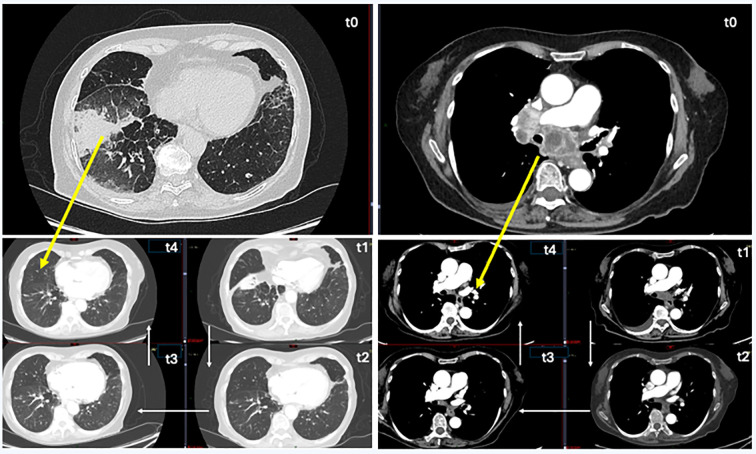 Figure 1
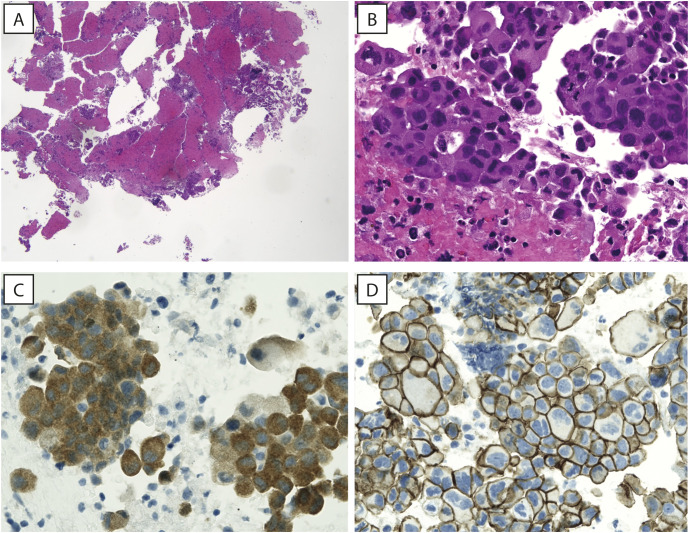 Figure 2
 Figure 3
Peer Reviews
No public reviews on file for this paper yet. If you reviewed it on a platform where reviews are public (OpenReview, ICLR, NeurIPS, ICML), you can paste yours below so the community can read it here.
Videos
No videos yet. Explain this paper in a talk, walkthrough, or lecture? Add one.
Taxonomy
TopicsLung Cancer Treatments and Mutations · Peptidase Inhibition and Analysis · Cancer Mechanisms and Therapy