Cardiac Tamponade Secondary to a Giant Pleuropericardial Cyst in a Child: A Surgical Case Report from Sub-Saharan Africa
Abdel Kémal Bori Bata, Yacoubou Imorou-Souaibou, Ahmad Ibrahim, Désiré Nékoua, Joseph Adoco, Arnaud Sonou

TL;DR
A 14-year-old boy in Sub-Saharan Africa had a rare heart condition caused by a large cyst, which was successfully surgically removed.
Contribution
This case report highlights a rare pediatric condition and its successful surgical management in a resource-limited setting.
Findings
A mediastinal cyst caused cardiac tamponade in a previously healthy child.
Emergency surgical resection via median sternotomy resolved the condition.
The patient had no recurrence after 2 years of follow-up.
Abstract
Pleuropericardial cysts are rare mediastinal tumors with variable, often severe, clinical presentations in children, occasionally requiring urgent intervention. We report the case of a previously healthy 14-year-old male who was admitted with signs of severe congestive heart failure and clinical evidence of cardiac tamponade. Transthoracic echocardiography and thoracic CT scan confirmed the presence of a compressive mediastinal cystic mass. The patient underwent emergency surgical resection via median sternotomy. Histopathological examination confirmed a benign pericardial cyst. Postoperative recovery was uneventful, and no recurrence was observed after 2 years of follow-up.
Genes, proteins, chemicals, diseases, species, mutations and cell lines named across the full text — each resolved to its canonical identifier and authoritative record.
Click any figure to enlarge with its caption.
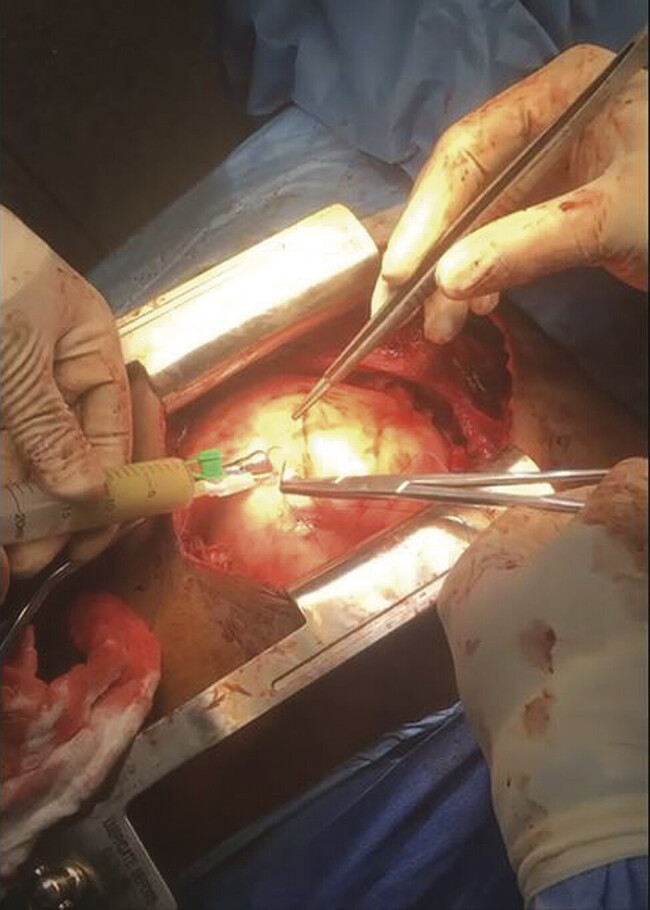 Figure 1
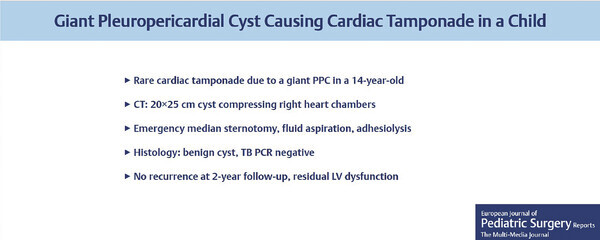 Figure 2
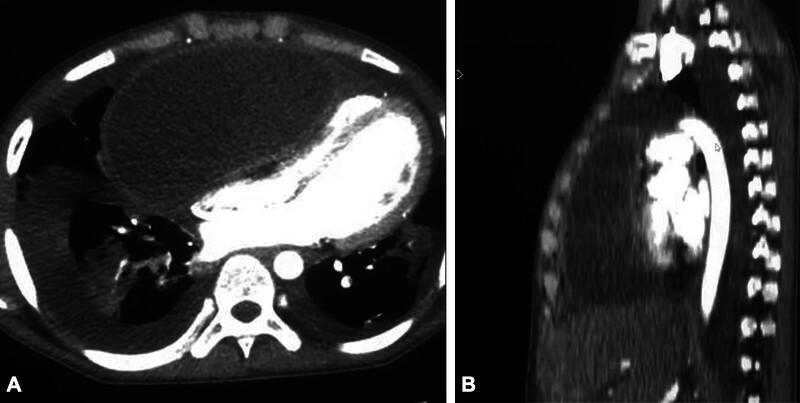 Figure 3
Peer Reviews
No public reviews on file for this paper yet. If you reviewed it on a platform where reviews are public (OpenReview, ICLR, NeurIPS, ICML), you can paste yours below so the community can read it here.
Videos
No videos yet. Explain this paper in a talk, walkthrough, or lecture? Add one.
Taxonomy
TopicsMyasthenia Gravis and Thymoma · Cardiac tumors and thrombi · Vascular Malformations and Hemangiomas