Correction to: Discovery of bifunctional diterpene cyclases/synthases in bacteria supports a bacterial origin for the plant terpene synthase gene family

Abstract
Genes, proteins, chemicals, diseases, species, mutations and cell lines named across the full text — each resolved to its canonical identifier and authoritative record.
Click any figure to enlarge with its caption.
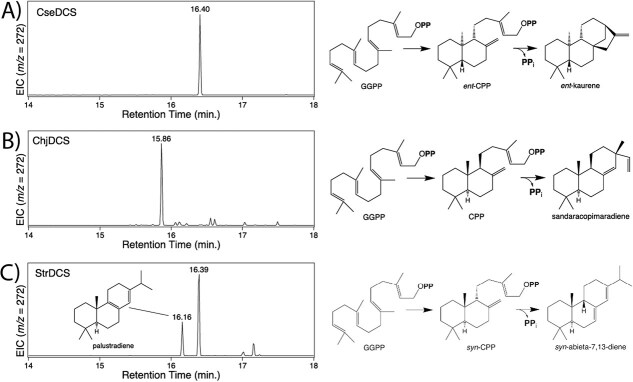 Figure 1
Peer Reviews
No public reviews on file for this paper yet. If you reviewed it on a platform where reviews are public (OpenReview, ICLR, NeurIPS, ICML), you can paste yours below so the community can read it here.
Videos
No videos yet. Explain this paper in a talk, walkthrough, or lecture? Add one.
Taxonomy
TopicsPlant biochemistry and biosynthesis · Plant and animal studies · Photosynthetic Processes and Mechanisms
This is a correction to: Xinlu Chen, Meimei Xu, Jin Han, Mark Schmidt-Dannert, Reuben J. Peters, Feng Chen, Discovery of bifunctional diterpene cyclases/synthases in bacteria supports a bacterial origin for the plant terpene synthase gene family, Horticulture Research, Volume 11, Issue 10, October 2024, uhae221, https://doi.org/10.1093/hr/uhae221.
In the originally published version of this manuscript, our assignment of the product for the fused diterpene cylase–synthase (DCS) from Streptomyces sp. GS7 (StrDCS) was incorrect. Rather than syn-abieta-11,13(15)-diene, this is actually syn-abieta-7,13-diene, as first indicated by personal communication from Prof. Jeffrey Rudolf (Univ. Florida), based up on his investigations of a very closely related DCS (1), and supported by computational NMR shift prediction (2). Specifically, using the CHESHIRE CCAT webtool (http://cheshirenmr.info/index.htm), which revealed substantially greater divergence between predicted and observed chemical shifts for the previous double-bond isomer of syn-abietadiene [i.e., 11,13(15)] versus current [i.e., 7,13]. As a consequence, Figure 3 in this publication should be replaced by that shown here immediately below.
Figure 3. Bacterial DCS activity. Genes were recombinantly expressed in E. coli also engineered to produce GGPP, and enzymatic products extracted from the resulting induced cultures for analysis by GC-MS. Shown here are chromatograms and schemes indicating the relevant reactions for A) CseDCS, B) ChjDCS, and C) StrDCS.
The reference list from the paper itself. Each links out to its DOI / PubMed record.
- 1Mc Cadden CA, Lomowska-Keehner DP, Qu T, Nafie J, Alsup TA, Rudolf JD. (in press) Discovery of a plant-like tridomain bifunctional syn-abieta-7,13-diene synthase in Streptomyces, Org Biomol Chem.10.1039/d 5ob 00724 k PMC 1216455240511979 · doi ↗ · pubmed ↗
- 2Lodewyk MW, Siebert MR, Tantillo DJ. et al. Computational prediction of 1H and 13C chemical shifts: a useful tool for natural product, mechanistic, and synthetic organic chemistry,. Chem Rev. 2012;112:1839–6222091891 10.1021/cr 200106 v · doi ↗ · pubmed ↗