A novel muscle-friendly technique with 90° dissection plane rotation in tunneling endoscopic submucosal dissection
Ahmad Madkour, Ahmad F. Aboelezz, Hassan Atalla, Osama Elnahas, Alaa Ismail, Hossam Ismail, Amr Elfouly

Abstract
Genes, proteins, chemicals, diseases, species, mutations and cell lines named across the full text — each resolved to its canonical identifier and authoritative record.
Click any figure to enlarge with its caption.
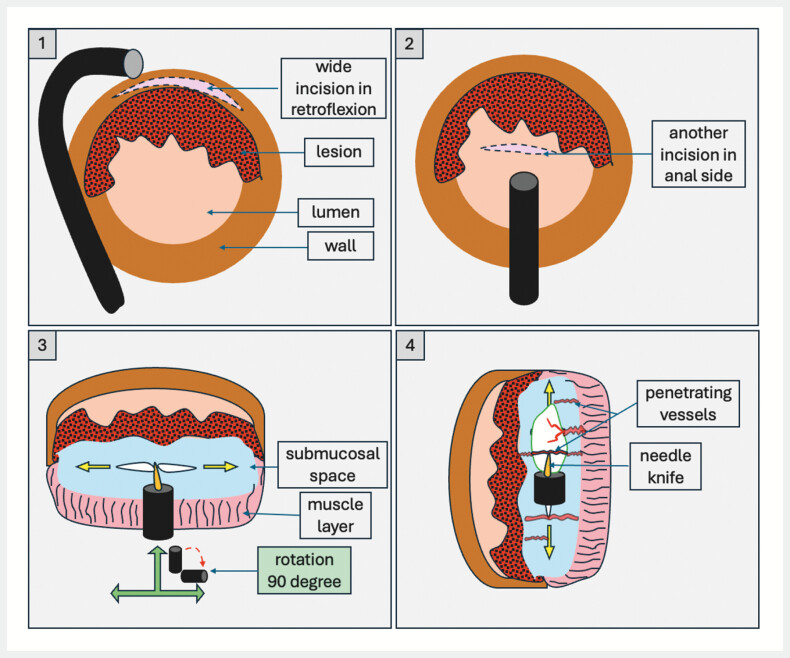 Fig. 1
Peer Reviews
No public reviews on file for this paper yet. If you reviewed it on a platform where reviews are public (OpenReview, ICLR, NeurIPS, ICML), you can paste yours below so the community can read it here.
Videos
No videos yet. Explain this paper in a talk, walkthrough, or lecture? Add one.
Taxonomy
TopicsGastric Cancer Management and Outcomes · Metastasis and carcinoma case studies · Gastrointestinal Tumor Research and Treatment
Endoscopic submucosal dissection (ESD) is a minimally invasive, organ-preserving maneuver that can be used to resect early gastrointestinal tumors, even larger ones. In recent years, different ESD strategies have been applied to facilitate resection of large lesions, like the tunneling technique and the pocket creation method 1 2 3 4 .
Despite the advantages provided through tunneling ESD, it carries technical challenges such as the narrow working space, looping of the scope inside the tunnel, and false orientation of the scope, resulting in injury to the muscle or the inner surface of the mucosal flap.
Here, we report the 90° dissection plane rotation via the scope, where the muscle bed and the mucosa became on the right and left sides, respectively, instead of the upper and lower planes. In this technique, a wide incision from the cecal side of the lesion through retroflexion of the scope was done at first. This is followed by another incision at the anal side where we start entering our tunnel ( Fig. 1 ). This novel muscle-friendly approach provides clear visualization of the dissection plane and good orientation of the scope throughout the procedure. Moreover, this helps in proper assessment and dealing with the penetrating vessels. To address, this technique was found to be beneficial in sigmoid colon lesions where the scope position is unstable, and the colon wall is redundant and floppy ( Video 1 ).
Schematic representation of the endoscopic view after 90° rotation with the muscularis propria and mucosal flap on both sides of the dissection plane.
The video demonstrates a novel muscle-friendly technique with 90° dissection plane rotation in tunneling ESD.Video 1
Patient 1 A 44-year-old female patient with a lateral spreading tumor, granular mixed type. Histological assessment confirmed R0 resection of a tubulovillous adenoma with high-grade dysplasia.
Patient 2 A 72-year-old man presented with a large circumferential anorectal lesion measuring about 32 cm. En-bloc resection was achieved, and histopathological examination revealed intramucosal carcinoma.
Patient 3 A 58-year-old female patient with a large sigmoid lesion, and histopathological examination revealed an intramucosal carcinoma that was removed en bloc.
Endoscopy_UCTN_Code_TTT_1AQ_2AD_3AZ
The reference list from the paper itself. Each links out to its DOI / PubMed record.
- 1Aslan F Akpinar Z Yurtlu DA Single tunneling method with endoscopic submucosal dissection for treatment of a rectal giant (18-cm) laterally spreading tumor Endoscopy 20174901 E 114E 11610.1055/s-0043-10021828226390 · doi ↗ · pubmed ↗
- 2Linghu E Feng X Wang X Endoscopic submucosal tunnel dissection for large esophageal neoplastic lesions Endoscopy 201345606210.1055/s-0032-132596523254407 · doi ↗ · pubmed ↗
- 3Hayashi Y Miura Y Yamamoto H Pocket-creation method for the safe, reliable, and efficient endoscopic submucosal dissection of colorectal lateral spreading tumors Dig Endosc 20152753453510.1111/den.1246525708068 · doi ↗ · pubmed ↗
- 4Hayashi Y Sunada K Takahashi H Pocket-creation method of endoscopic submucosal dissection to achieve en bloc resection of giant colorectal subpedunculated neoplastic lesions Endoscopy 20144601 E 421E 42225314173 10.1055/s-0034-1377438 · doi ↗ · pubmed ↗