High Rate of Postural Blindness in Patients With Idiopathic Parkinson's Disease: A Clinical Observation
Damiano D. Zemp, Daria Dinacci, Salvatore Galati

TL;DR
Some Parkinson's patients experience less postural sway when their eyes are closed, suggesting a unique role of vision in balance.
Contribution
This study reports a novel clinical observation of postural blindness in idiopathic Parkinson's disease patients.
Findings
30% of Parkinson's patients reduced postural sway with closed eyes on both firm and compliant surfaces.
The Romberg Quotient was used to assess the role of vision in postural control among these patients.
Abstract
Background: Patients affected by idiopathic Parkinson's disease (IPD) are known to have difficulties in sensorial integration. The ratio of the postural sway in the standing position with closed eyes to open eyes (Romberg Quotient) is a simple way to investigate the role of the visual channel in postural control in this category of patients. Objective: We aim to share our observation about the incidence in patients with IPD of postural blindness, namely the reduction of the postural sway by closing the eyes. Methods: Patients had to stay quiet on a force plate for 30 s in four conditions: eyes open and closed both on a firm and a compliant surface. Results: 30% of the 22 patients analyzed reduced their postural sway by closing their eyes on both firm and compliant surfaces. Conclusion: The role of vision for postural control in patients with IPD should be further investigated.
Genes, proteins, chemicals, diseases, species, mutations and cell lines named across the full text — each resolved to its canonical identifier and authoritative record.
Click any figure to enlarge with its caption.
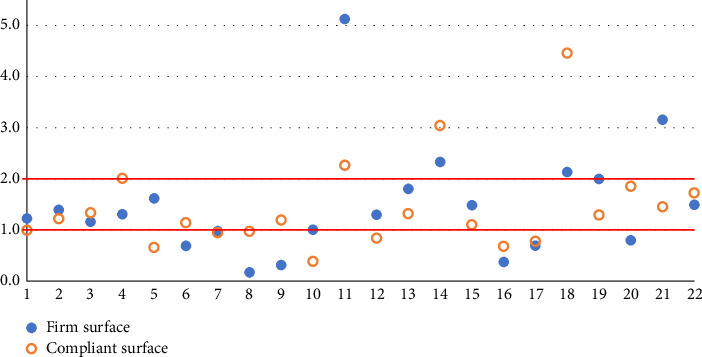 Figure 1
Peer Reviews
No public reviews on file for this paper yet. If you reviewed it on a platform where reviews are public (OpenReview, ICLR, NeurIPS, ICML), you can paste yours below so the community can read it here.
Videos
No videos yet. Explain this paper in a talk, walkthrough, or lecture? Add one.
Taxonomy
TopicsParkinson's Disease Mechanisms and Treatments · Balance, Gait, and Falls Prevention · Botulinum Toxin and Related Neurological Disorders