Peculiarities of Diagnostic Reliability—Nested PCR Versus SAT in the Identification of Helicobacter pylori
Barbora Šipková, Michaela Abrahamovská, Janka Klingová, Bianka Prokopová, Jana Krčmáriková, Iveta Cihová, Pavol Sulo

TL;DR
This study compares diagnostic methods for Helicobacter pylori and finds that a modified PCR test is more sensitive than the stool antigen test.
Contribution
A modified nested PCR assay using a shorter amplicon significantly improves detection sensitivity for Helicobacter pylori in stool samples.
Findings
The 148 bp nested PCR detected 51% positive samples compared to 27.9% with the stool antigen test.
Among asymptomatic volunteers, 66.6% were positive with the short amplicon PCR versus 35% with SAT.
DNA sequencing confirmed all PCR-positive samples were Helicobacter pylori.
Abstract
H. pylori detection via the stool antigen test (SAT) requires 100 times more cells than nested PCR (NPCR) for a 454 bp amplicon, but is significantly more sensitive in identifying positive stool samples. To understand this contradiction, we developed an NPCR assay to amplify a shorter 148 bp segment of the 16S rRNA gene. The assay was extremely sensitive and reliable when adhering to particular rules commonly used in forensic laboratories. The SAT and NPCR for long and short amplicons were compared using stool samples from 208 gastroenterological patients, of which 27.9% were identified as positive according to the SAT and only 6.25% according to the 454 bp NPCR amplicon, but 51.0% in the short 148 bp NPCR. Among 100 asymptomatic volunteers, the prevalence was 35% in the SAT assay and 22% in the long NPCR, but as much as 66.6% of positives were determined in the short 148 bp NPCR. The…
Genes, proteins, chemicals, diseases, species, mutations and cell lines named across the full text — each resolved to its canonical identifier and authoritative record.
Click any figure to enlarge with its caption.
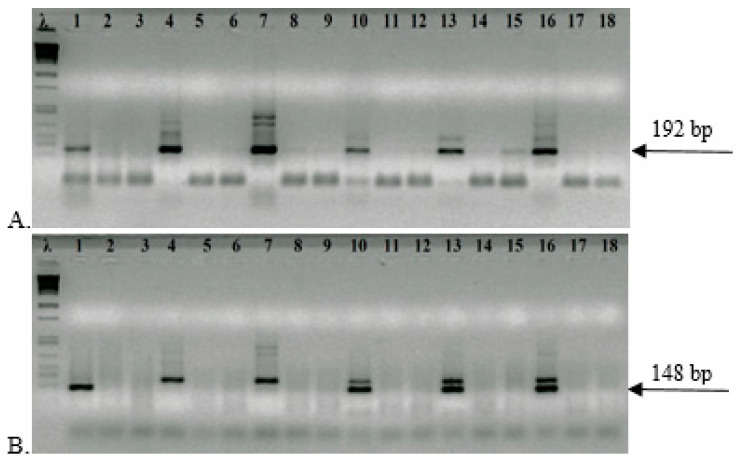 Figure 1
 Figure 2
Peer Reviews
No public reviews on file for this paper yet. If you reviewed it on a platform where reviews are public (OpenReview, ICLR, NeurIPS, ICML), you can paste yours below so the community can read it here.
Videos
No videos yet. Explain this paper in a talk, walkthrough, or lecture? Add one.
Taxonomy
TopicsHelicobacter pylori-related gastroenterology studies · Mycobacterium research and diagnosis · Veterinary medicine and infectious diseases