Quantification of the Role of Teupol® 25P and Graminex® G96 Compared to Hexanic Extract of Serenoa repens in Patients Affected by Lower Urinary Tract Symptoms During Treatment with Silodosin
Yazan Al Salhi, Damiano Graziani, Andrea Fuschi, Fabio Maria Valenzi, Manfredi Bruno Sequi, Paolo Pietro Suraci, Alice Antonioni, Onofrio Antonio Rera, Cosimo De Nunzio, Riccardo Lombardo, Paolo Benanti, Giuseppe Candita, Eleonora Rosato, Filippo Gianfrancesco, Giorgio Martino

TL;DR
This study compares two supplements combined with silodosin for treating urinary symptoms in men with prostate issues, finding one more effective.
Contribution
The study introduces Xipag® as a more effective combination therapy with silodosin compared to HESr for LUTS/BPH.
Findings
Xipag® combined with silodosin improved urinary flow more than HESr plus silodosin.
QoL and PSA levels improved significantly in the Xipag® group after six months.
Xipag® showed sustained benefits with no adverse effects compared to HESr.
Abstract
Background and Objectives: While α1-blockers like silodosin are the mainstay for treating lower urinary tract symptoms (LUTS) due to benign prostatic hyperplasia (BPH), combination therapy with phytotherapeutics may provide enhanced symptom control. Xipag® is a novel formulation containing Graminex® G96 (pollen extract) and Teupol® 25P (teupolioside), offering anti-inflammatory and antiandrogenic effects. This study aimed to evaluate the efficacy of Xipag® versus hexanic extract of Serenoa repens (HESr), both in combination with silodosin, in patients with LUTS/BPH. Materials and Methods: We conducted a single-center, prospective, observational, comparative study involving male patients with moderate-to-severe LUTSs undergoing treatment with silodosin. Patients were allocated to receive either Xipag® or HESr in addition to silodosin, with follow-up every 3 months for 12 months. Primary…
Genes, proteins, chemicals, diseases, species, mutations and cell lines named across the full text — each resolved to its canonical identifier and authoritative record.
Click any figure to enlarge with its caption.
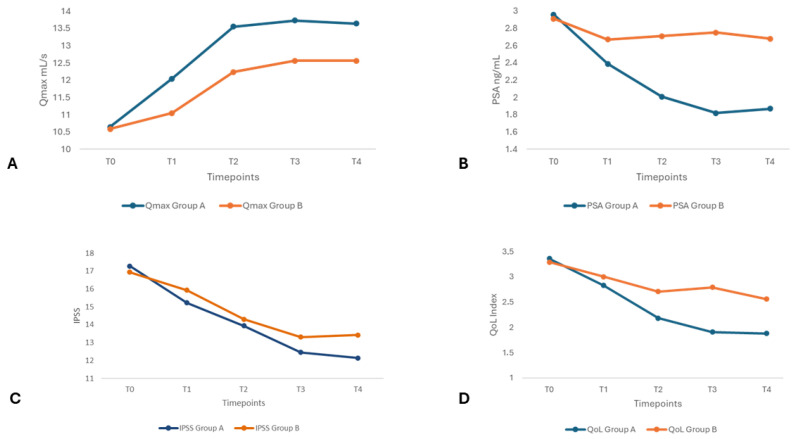 Figure 1
Peer Reviews
No public reviews on file for this paper yet. If you reviewed it on a platform where reviews are public (OpenReview, ICLR, NeurIPS, ICML), you can paste yours below so the community can read it here.
Videos
No videos yet. Explain this paper in a talk, walkthrough, or lecture? Add one.
Taxonomy
TopicsUrinary Bladder and Prostate Research · Hormonal and reproductive studies · Pharmacology and Obesity Treatment