The Insufficient Number of Informative SNPs in a Preclinical Karyomapping Test for PGT-M Depends on the Reference Selected
Min Jee Kim, Yeseul Hong, Gaeul Han, Hyoung-Song Lee, Eun A. Park, Kyung-Ah Lee, Eun Jeong Yu, Inn Soo Kang

TL;DR
This study shows that the choice of family member used as a reference in karyomapping affects the success rate of preimplantation genetic testing for monogenic disorders.
Contribution
The study is the first to analyze how the choice of reference family member impacts the availability of informative SNPs in karyomapping for PGT-M.
Findings
Using a child or parent as a reference resulted in fewer non-applicable karyomapping cases compared to using a sibling.
Neurofibromatosis type 1 and Kennedy disease had the highest rates of non-applicable karyomapping cases.
The success rate of karyomapping was 91.6% across 263 couples tested.
Abstract
Background/Objectives: Karyomapping, a genome-wide SNP analysis, has drastically changed the approach to preimplantation genetic testing for monogenic disorders (PGT-M). However, there are cases in which karyomapping cannot be applied due to an insufficient number of informative SNPs. In this study, we aimed to analyze for the first time whether an insufficient number of informative SNPs is related to the family member used as a reference. Methods: For the karyomapping pre-clinical test, in addition to the couple, one of the DNA samples from an additional family member (children, parent, sibling) is used as a reference for phasing the SNP allele. We analyzed 263 couples who underwent karyomapping for PGT-M at the CHA Fertility Center from May 2020 to December 2022. karyomapping data was scanned on an Illumina NextSeq and analyzed through the BlueFuse Multi software version 4.5. Results:…
Genes, proteins, chemicals, diseases, species, mutations and cell lines named across the full text — each resolved to its canonical identifier and authoritative record.
Click any figure to enlarge with its caption.
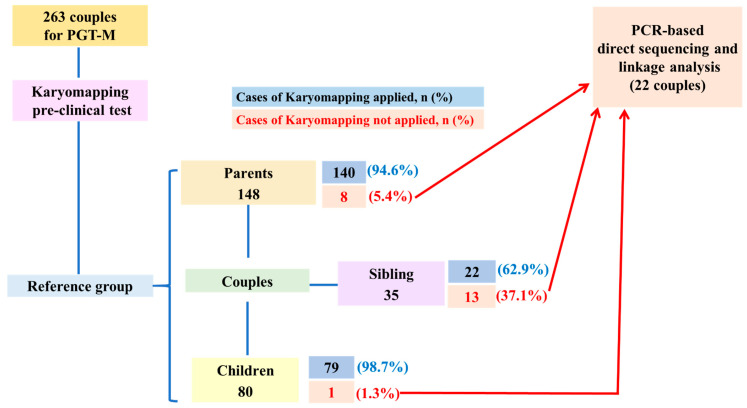 Figure 1
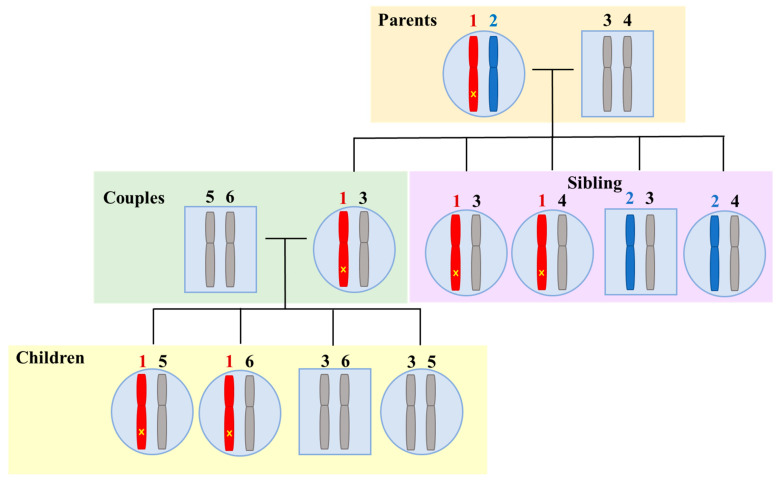 Figure 2
Peer Reviews
No public reviews on file for this paper yet. If you reviewed it on a platform where reviews are public (OpenReview, ICLR, NeurIPS, ICML), you can paste yours below so the community can read it here.
Videos
No videos yet. Explain this paper in a talk, walkthrough, or lecture? Add one.
Taxonomy
TopicsPrenatal Screening and Diagnostics · Genomic variations and chromosomal abnormalities · Genetic Syndromes and Imprinting