Quantification of Total and Unbound Selinexor Concentrations in Human Plasma by a Fully Validated Liquid Chromatography-Tandem Mass Spectrometry Method
Suhyun Lee, Seungwon Yang, Hyeonji Kim, Wang-Seob Shim, Eunseo Song, Seunghoon Han, Sung-Soo Park, Suein Choi, Sungpil Han, Sung Hwan Joo, Seok Jun Park, Beomjin Shin, Donghyun Kim, Hyeon Su Kim, Kyung-Tae Lee, Eun Kyoung Chung

TL;DR
This paper presents a new method to measure both total and unbound selinexor in human plasma, which is important for understanding drug behavior in patients.
Contribution
A fully validated LC-MS/MS method for simultaneous quantification of total and unbound selinexor in human plasma.
Findings
The method showed excellent linearity for total and unbound selinexor with high accuracy and precision.
The method successfully quantified selinexor in plasma samples from renally impaired patients, revealing inter-individual differences in unbound concentrations.
Abstract
Background/Objectives: Selinexor is a selective nuclear-export inhibitor approved for hematologic malignancies, characterized by extensive plasma protein binding (>95%). However, a validated analytical method to accurately measure the clinically relevant unbound fraction of selinexor in human plasma has not yet been established. This study aimed to develop a fully validated bioanalytical assay for simultaneous quantification of total and unbound selinexor concentrations in human plasma. Methods: We established and fully validated an analytical method based on liquid chromatography–tandem mass spectrometry (LC-MS/MS) capable of quantifying total and unbound selinexor concentrations in human plasma. Unbound selinexor was separated using ultrafiltration, and selinexor was efficiently extracted from 50 μL of plasma by liquid–liquid extraction. Chromatographic separation was achieved on a…
Genes, proteins, chemicals, diseases, species, mutations and cell lines named across the full text — each resolved to its canonical identifier and authoritative record.
Click any figure to enlarge with its caption.
 Figure 1
 Figure 2
 Figure 3
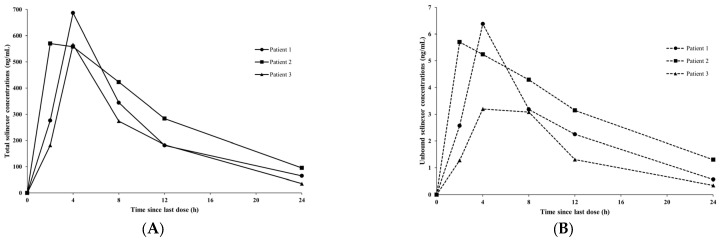 Figure 4
Peer Reviews
No public reviews on file for this paper yet. If you reviewed it on a platform where reviews are public (OpenReview, ICLR, NeurIPS, ICML), you can paste yours below so the community can read it here.
Videos
No videos yet. Explain this paper in a talk, walkthrough, or lecture? Add one.
Taxonomy
TopicsDrug Transport and Resistance Mechanisms · Bone health and treatments · Pharmacological Effects and Toxicity Studies