Insights from the Absorption Coefficient for the Development of Polarizable (Multipole) Force Fields
Marion Sappl, András Szabadi, Philipp Honegger, Franziska König, Othmar Steinhauser, Christian Schröder

TL;DR
This paper studies how different water models affect THz absorption, focusing on the role of dipole moments in spectral features.
Contribution
The study provides new insights into the influence of polarizable and multipole water models on THz absorption coefficients.
Findings
Induced dipoles strongly contribute to the peak at 200 cm−1 but do not improve experimental agreement when increased.
Intermolecular interactions dominate the low-frequency peak, while intramolecular interactions explain the 600 cm−1 peak.
Dissecting THz spectra reveals distinct contributions from inter- and intramolecular interactions in water models.
Abstract
We present a detailed examination of the absorption coefficients in the THz region for different water models using different types of potentials: the non-polarizable SPC/E, the Drude-polarizable SWM4-NDP and OPC3-pol, IPOL-0.13 and the multipole AMOEBA14 water. The primary focus is on understanding the interplay between permanent and induced dipole moments and their influence on the THz spectrum. Although the induced dipoles strongly contribute to the peak at 200 cm−1, merely increasing the induced dipole moments does not improve the agreement with experiments. We aim to investigate the behavior of the intensity at 200 cm−1 depending on the water model. Furthermore, we dissect the THz spectra of the water models into distinct contributions to gain more insight into the inter- and intramolecular interactions. Intermolecular interactions significantly contribute to the low-frequency…
Genes, proteins, chemicals, diseases, species, mutations and cell lines named across the full text — each resolved to its canonical identifier and authoritative record.
Click any figure to enlarge with its caption.
 Figure 1
 Figure 2
 Figure 3
 Figure 4
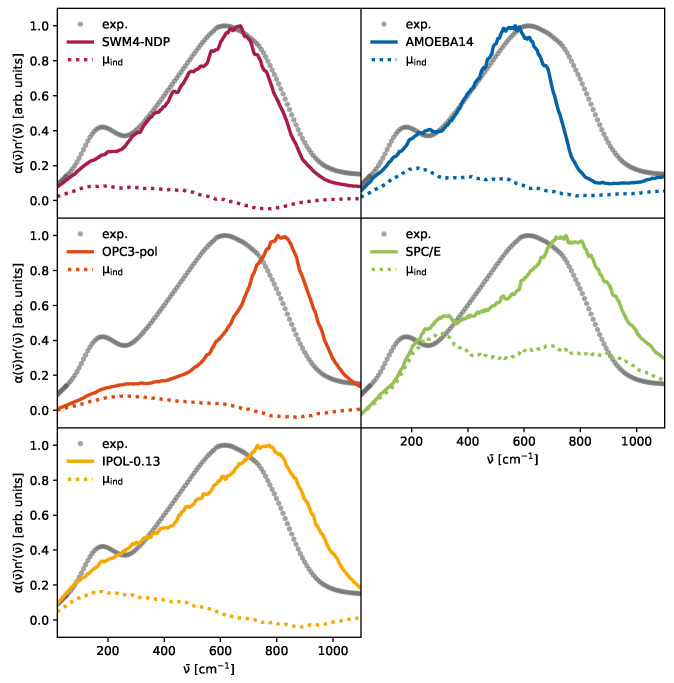 Figure 5
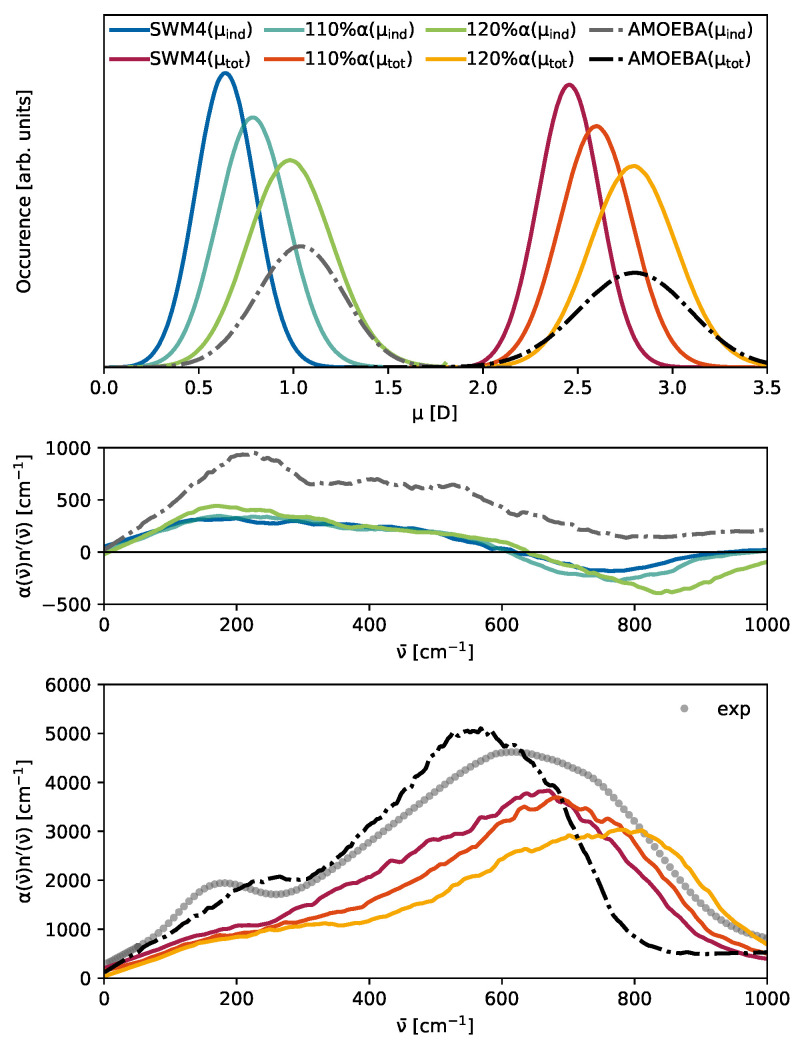 Figure 6
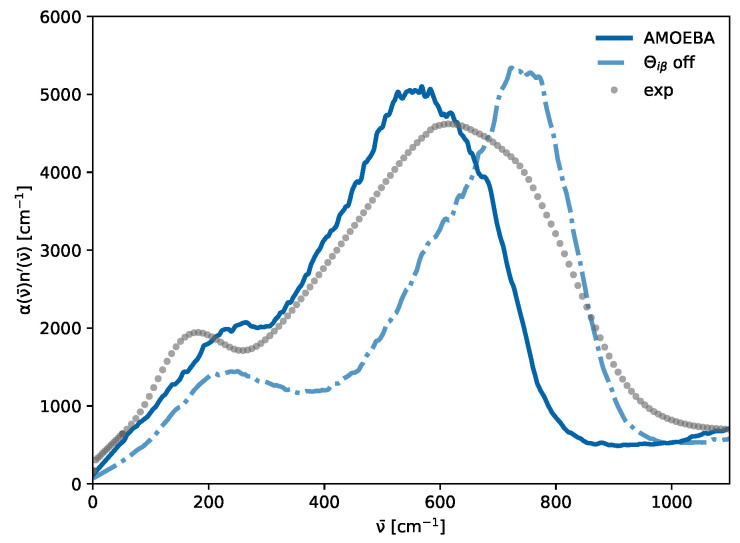 Figure 7
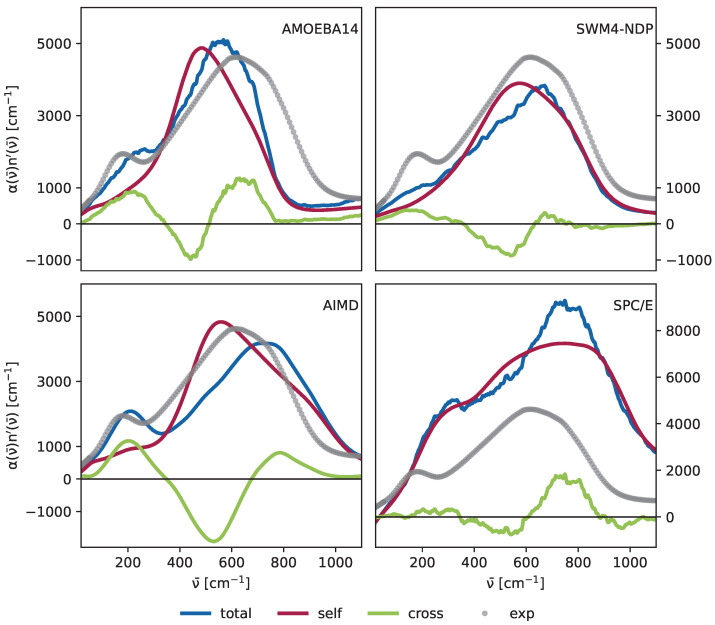 Figure 8
Peer Reviews
No public reviews on file for this paper yet. If you reviewed it on a platform where reviews are public (OpenReview, ICLR, NeurIPS, ICML), you can paste yours below so the community can read it here.
Videos
No videos yet. Explain this paper in a talk, walkthrough, or lecture? Add one.
Taxonomy
TopicsOrbital Angular Momentum in Optics · Mechanical and Optical Resonators · Particle accelerators and beam dynamics