Gastrointestinal Cancers with Consideration of DPD and UGT1A1 Plasma Levels: Chemotherapy-Related Toxicity
Velko Minchev, Hristo Tsankov, Bozil Robev, Martin Takov, Stefan Federchev, Kalina Kamenova, Lozan Todorov, Liliya Atanasova, Nadya Hristova-Avakumova, Rumen Nikolov, Pavlina Gateva, Vanyo Mitev

TL;DR
This study explores how DPD and UGT1A1 plasma levels relate to chemotherapy toxicity and cancer progression in gastrointestinal cancer patients.
Contribution
The study introduces a potential use of DPD and UGT1A1 plasma levels to assess chemotherapy response and toxicity in gastrointestinal cancer.
Findings
FOLFIRI caused a greater reduction in granulocyte counts compared to FOLFOX.
DPD levels were significantly lower in FOLFOX-treated patients.
DPD levels were associated with cancer progression in a regression model.
Abstract
Unpredictable, dose-limiting toxicity remains a challenge in cancer treatment. We evaluated dihydropyrimidine dehydrogenase (DPD) and UDP-glucuronosyltransferase 1A1 (UGT1A1) plasma levels in the context of chemotherapy-induced toxicity and disease progression. Seventy gastrointestinal cancer patients (30 FOLFOX; 40 FOLFIRI) were enrolled. DPD and UGT1A1 plasma levels were determined using ELISA. Univariable and bivariable analyses and a general linear model (GLM) framework were used. Post-infusional reductions in white blood cell and granulocyte counts were observed. For FOLFOX, the granulocyte counts decreased by 17% (r = 0.54; p = 0.0030), while FOLFIRI caused a 41% reduction (r = 0.43; p = 0.0063). DPD levels were lower in FOLFOX than in FOLFIRI (2.543 vs. 3.579; p = 0.0363; Cohen’s d = 0.52). The multiple linear regression models associated DPD levels with cancer progression (b* =…
Genes, proteins, chemicals, diseases, species, mutations and cell lines named across the full text — each resolved to its canonical identifier and authoritative record.
Click any figure to enlarge with its caption.
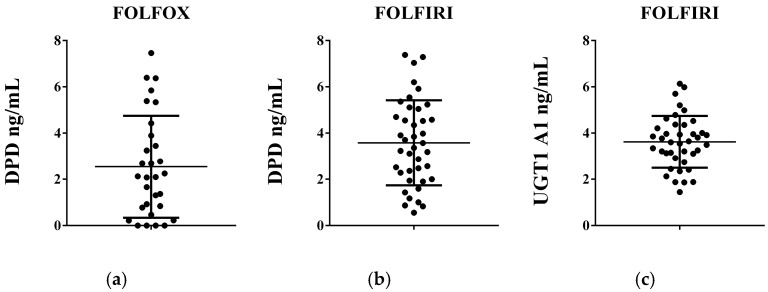 Figure 1
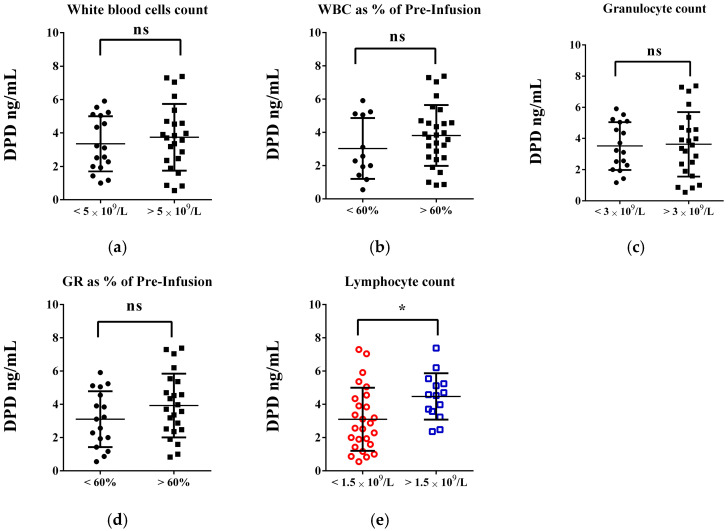 Figure 2
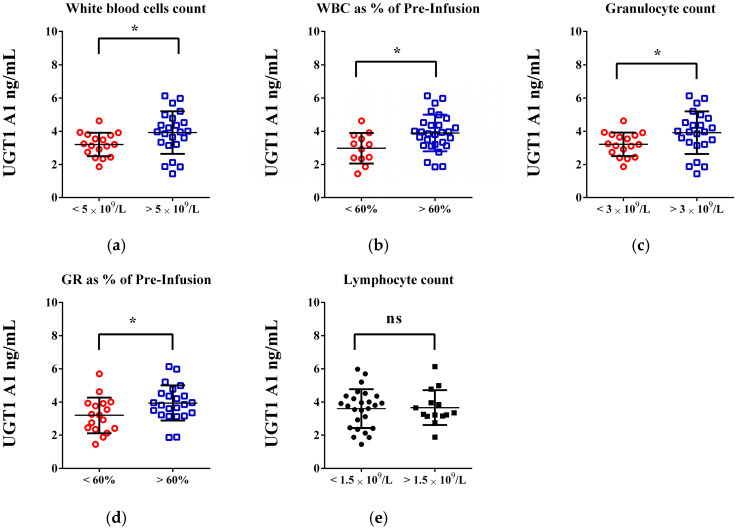 Figure 3
 Figure 4
Peer Reviews
No public reviews on file for this paper yet. If you reviewed it on a platform where reviews are public (OpenReview, ICLR, NeurIPS, ICML), you can paste yours below so the community can read it here.
Videos
No videos yet. Explain this paper in a talk, walkthrough, or lecture? Add one.
Taxonomy
TopicsGastric Cancer Management and Outcomes · Pancreatic and Hepatic Oncology Research · Colorectal Cancer Treatments and Studies