Relating Anthropometric Profile to Countermovement Jump Performance and External Match Load in Mexican National Team Soccer Players: An Exploratory Study
Israel Rios-Limas, Carlos Abraham Herrera-Amante, Wiliam Carvajal-Veitía, Rodrigo Yáñez-Sepúlveda, César Iván Ayala-Guzmán, Luis Ortiz-Hernández, Andrés López-Sagarra, Pol Lorente-Solá, José Francisco López-Gil

TL;DR
This study explores how body composition affects soccer performance in Mexican national team players, finding that lower body fat and higher muscle mass improve jump and sprint performance.
Contribution
The study provides new insights into how specific anthropometric traits relate to performance metrics in elite soccer players.
Findings
Higher body fat percentage is linked to slower sprint speed and shorter distance covered during matches.
Greater thigh and calf girth is associated with improved countermovement jump performance.
Optimizing body composition is crucial for enhancing explosive movements in professional soccer.
Abstract
Background/Objectives: The role of body composition in sports performance has been widely studied, particularly in soccer. Understanding how anthropometric characteristics impact movement efficiency and neuromuscular performance is crucial for optimizing player performance. This study examined the relationship between body composition and locomotor performance in elite soccer players. Methods: Thirty-six male soccer players from the Mexican National Team participated in the study, where body composition was assessed using surface anthropometry. Players underwent tests to measure countermovement jump (CMJ) performance, sprinting speed, maximum acceleration, and distance covered during two games of the CONCACAF Nations League quarterfinals. Correlation matrices were created to identify the most significant associations, followed by generalized linear models (GLMs) to associate body…
Genes, proteins, chemicals, diseases, species, mutations and cell lines named across the full text — each resolved to its canonical identifier and authoritative record.
Click any figure to enlarge with its caption.
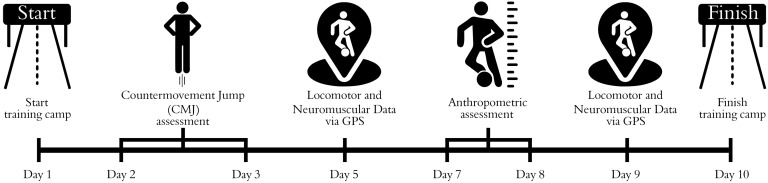 Figure 1
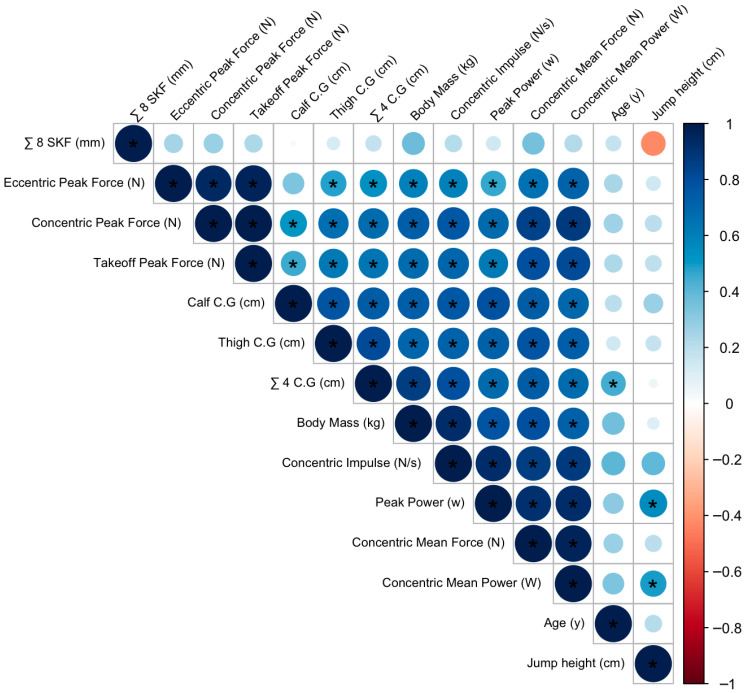 Figure 2
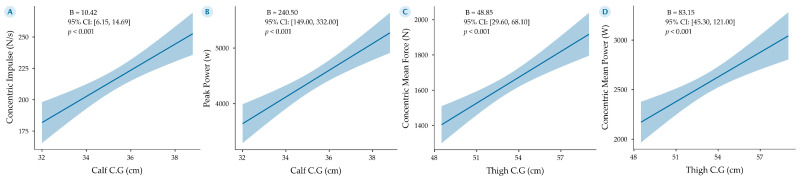 Figure 3
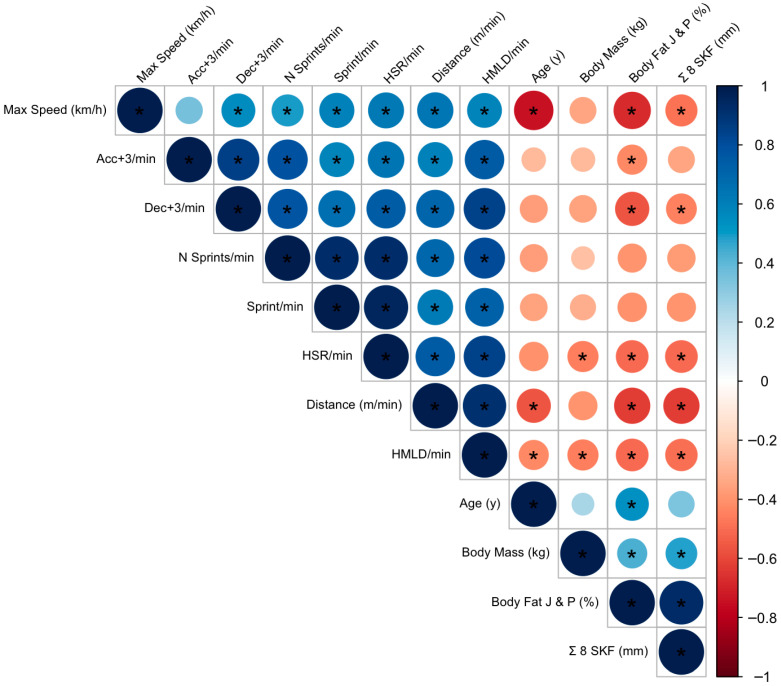 Figure 4
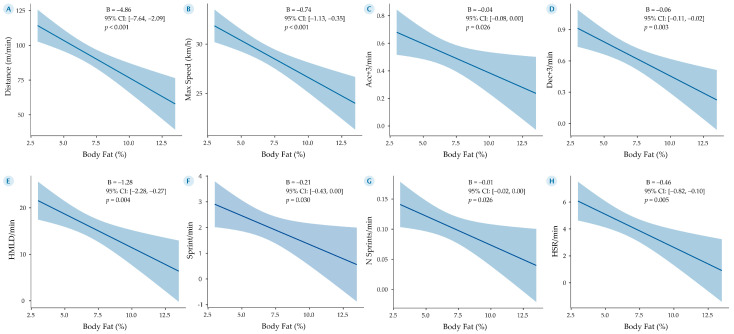 Figure 5
Peer Reviews
No public reviews on file for this paper yet. If you reviewed it on a platform where reviews are public (OpenReview, ICLR, NeurIPS, ICML), you can paste yours below so the community can read it here.
Videos
No videos yet. Explain this paper in a talk, walkthrough, or lecture? Add one.
Taxonomy
TopicsSports Performance and Training · Sports injuries and prevention · Body Composition Measurement Techniques