Susceptibility Weighted Imaging in Migraine with and Without Aura: A Case–Control Study
Adrian Scutelnic, Tomas Klail, Diego Moor, Nedelina Slavova, Valentina Petroulia, Simon Jung, Mattia Branca, Urs Fischer, Franz Riederer, Roland Wiest, Christoph J. Schankin

TL;DR
This study found that MRI scans of migraine patients show different vein patterns depending on whether they experience aura, suggesting different biological processes.
Contribution
The study is the first to show that SWI asymmetry is specific to migraine with aura, indicating no role for cortical spreading depression in migraine without aura.
Findings
Migraine with aura showed 26% SWI asymmetry compared to 3% in migraine without aura.
SWI asymmetry was significantly higher in migraine with aura than in controls.
Migraine without aura showed no significant difference from controls in SWI asymmetry.
Abstract
Background: The asymmetry of cortical veins in susceptibility weighted imaging (SWI) in MRI might be a biomarker for migraine aura and cortical spreading depression (CSD). The aim of this study was to assess in humans if SWI asymmetry can be found in patients who have migraine attacks without aura. Methods: We included patients (n = 100 per group) from the emergency room setting when they (i) presented with an acute neurological deficit or headache; (ii) had a discharge diagnosis of a migraine aura, a migraine without an aura, or neither (controls without stroke or epilepsy); and (iii) had a brain MRI with SWI in the acute setting. Results: In the migraine with aura group, SWI asymmetry was found in 26% (95% CI 18–35) compared to patients with migraine without aura (3%, [95% CI 1–8], p < 0.001) and controls 7% [95% CI 3–14], p < 0.001). There was no difference between patients with…
Genes, proteins, chemicals, diseases, species, mutations and cell lines named across the full text — each resolved to its canonical identifier and authoritative record.
Click any figure to enlarge with its caption.
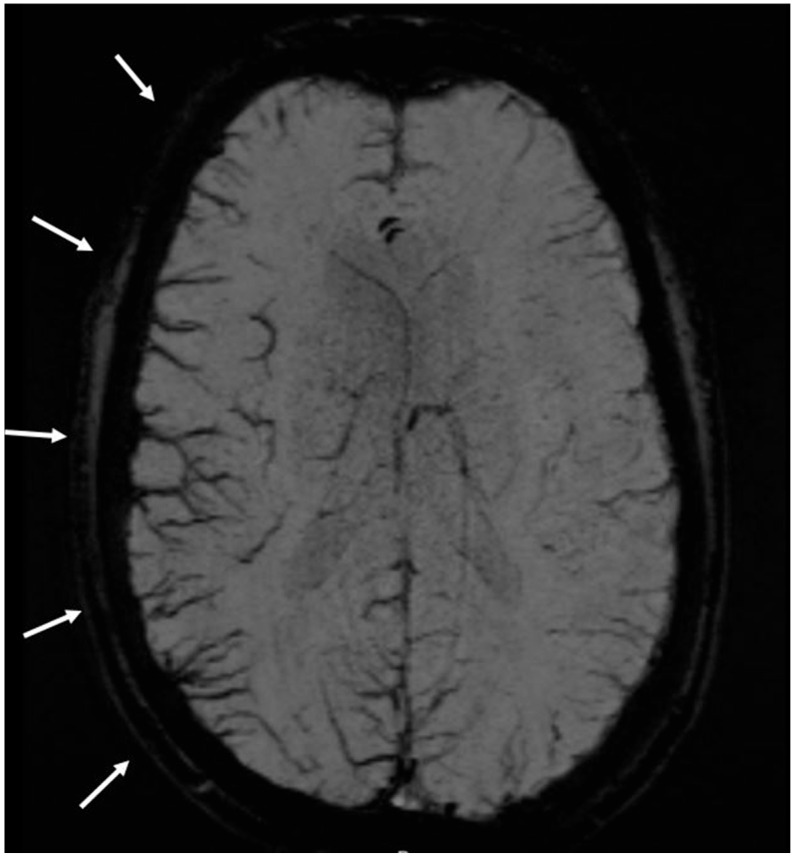 Figure 1
Peer Reviews
No public reviews on file for this paper yet. If you reviewed it on a platform where reviews are public (OpenReview, ICLR, NeurIPS, ICML), you can paste yours below so the community can read it here.
Videos
No videos yet. Explain this paper in a talk, walkthrough, or lecture? Add one.
Taxonomy
TopicsMigraine and Headache Studies · Trigeminal Neuralgia and Treatments · Functional Brain Connectivity Studies