Minimum Inhibitory Concentration Increase in Clostridioides difficile Isolates from Patients with Recurrence: Results from a Retrospective Single-Centre Cohort Study
Pietro Valsecchi, Erika Asperges, Marta Corbella, Greta Banfi, Marcello Maffezzoni, Nicolò Amarasinghe, Riccardo Drago, Flavia Virga, Filippo Costanzo, Francesca Calabretta, Paolo Sacchi, Patrizia Cambieri, Antonio Di Sabatino, Fausto Baldanti, Raffaele Bruno

TL;DR
This study found increased minimum inhibitory concentrations for some antibiotics in Clostridioides difficile isolates from patients with recurring infections, which may impact treatment outcomes.
Contribution
The study reports MIC increases in C. difficile isolates from recurrent infections and links higher MIC to increased mortality.
Findings
No resistance to vancomycin, metronidazole, and tigecycline was found, but all isolates showed ciprofloxacin resistance.
Recurrent isolates showed 2- to 4-fold MIC increases for vancomycin, metronidazole, and tigecycline.
Higher vancomycin MIC was associated with increased 28-day mortality in patients.
Abstract
Antimicrobial susceptibility testing (AST) is not routinely performed for C. difficile infection (CDI); however, reports of antimicrobial resistance to various antibiotics have increased. This study aimed to assess the rate of antimicrobial resistance to four antimicrobials (vancomycin, metronidazole, tigecycline, and ciprofloxacin) to assess risk factors for antimicrobial resistance and evaluate MIC variation in patients with recurrence. Data from consecutive patients with CDI admitted to our institution between 1 January 2022 and 30 April 2023 were collected. We performed AST with gradient diffusion and NAAT to evaluate the presumptive presence of R027/NAP1 and toxin production genes. Antimicrobial susceptibility testing was performed on 108 available isolates. We did not find any resistance to vancomycin (median MIC 0.5 μg/mL), metronidazole (median MIC 1 μg/mL), and tigecycline…
Genes, proteins, chemicals, diseases, species, mutations and cell lines named across the full text — each resolved to its canonical identifier and authoritative record.
Click any figure to enlarge with its caption.
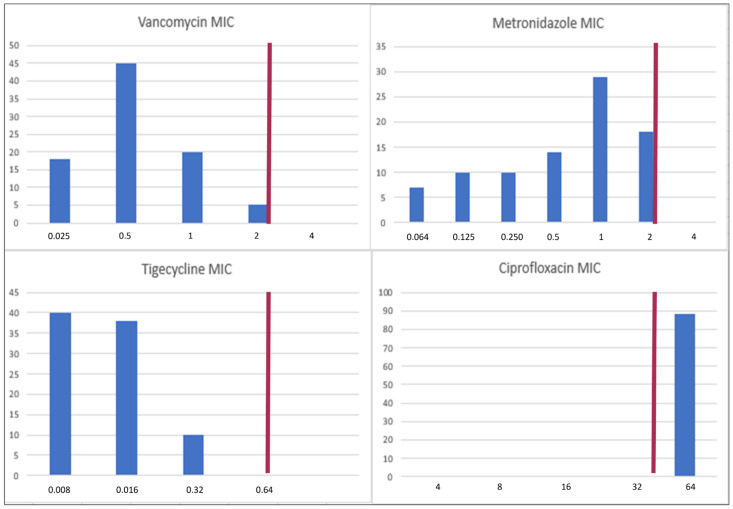 Figure 1
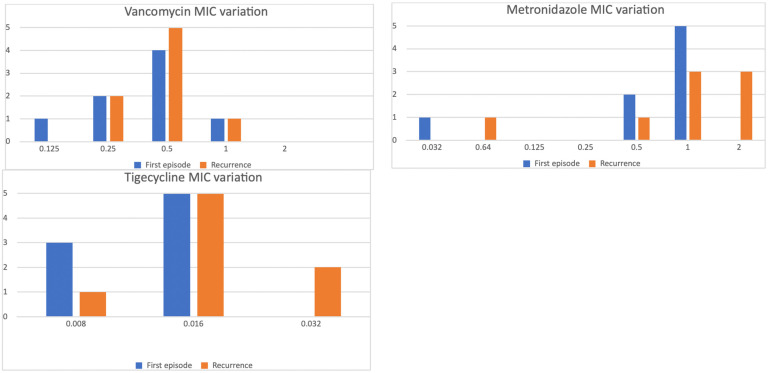 Figure 2
Peer Reviews
No public reviews on file for this paper yet. If you reviewed it on a platform where reviews are public (OpenReview, ICLR, NeurIPS, ICML), you can paste yours below so the community can read it here.
Videos
No videos yet. Explain this paper in a talk, walkthrough, or lecture? Add one.
Taxonomy
TopicsClostridium difficile and Clostridium perfringens research · Microscopic Colitis · Antimicrobial Resistance in Staphylococcus