Assessing Gross Motor and Gait Function Using Hip–Knee Cyclograms in Ambulatory Children with Spastic Cerebral Palsy
Jehyun Yoo, Juntaek Hong, Jeuhee Lee, Yebin Cho, Taekyung Lee, Dong-wook Rha

TL;DR
This study shows that hip–knee cyclogram metrics can serve as digital biomarkers to assess motor and gait function in children with cerebral palsy, offering a simpler alternative to traditional hospital-based evaluations.
Contribution
The study introduces hip–knee cyclogram parameters as accessible digital biomarkers for evaluating motor and gait function in children with spastic CP.
Findings
Hip–knee cyclogram parameters showed moderately strong correlations with GMFM-66, gait speed, GDI, and GPS subscores.
Swing phase area was the strongest correlate and used to estimate GMFM-66 and gait speed with R² values of 0.301 and 0.484, respectively.
The PC1/PC2 ratio correlated with selective motor control as measured by the SCALE (R² = 0.320).
Abstract
Children with cerebral palsy (CP) often experience weakness, spasticity, and muscle shortening, leading to deficits in gross motor, gait, and selective motor functions. GMFM-66, gait analysis, and the SCALE are commonly used in this regard, but are limited by time and space constraints in hospital settings. This study aims to identify digital biomarkers to assess gross motor, gait, and selective motor functions in children with CP, using simple kinematic data for hip–knee cyclogram-based analysis. What are the main findings? The parameters of the hip–knee cyclogram showed moderately strong correlations with GMFM-66, gait speed, GDI, and the sagittal plane subscore of the GPS for the hip and knee, while the principal component ratio correlated with the SCALE.In particular, the swing phase area showed the strongest correlation and was used to build regression models to estimate the…
Genes, proteins, chemicals, diseases, species, mutations and cell lines named across the full text — each resolved to its canonical identifier and authoritative record.
Click any figure to enlarge with its caption.
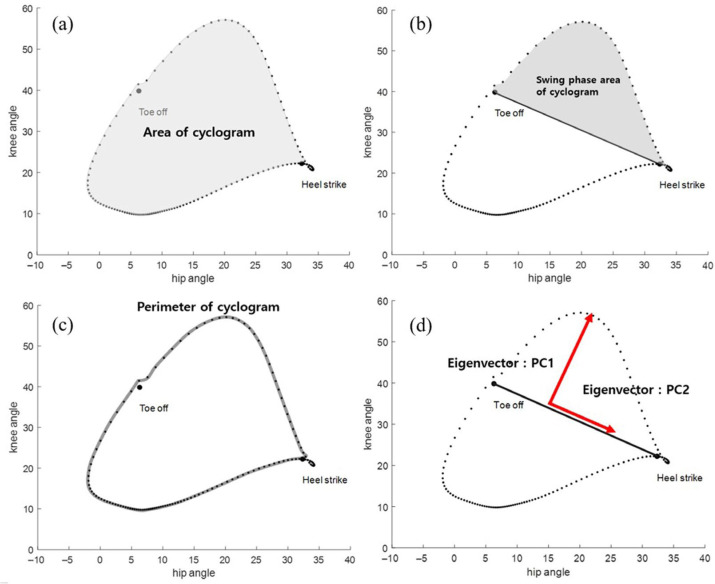 Figure 1
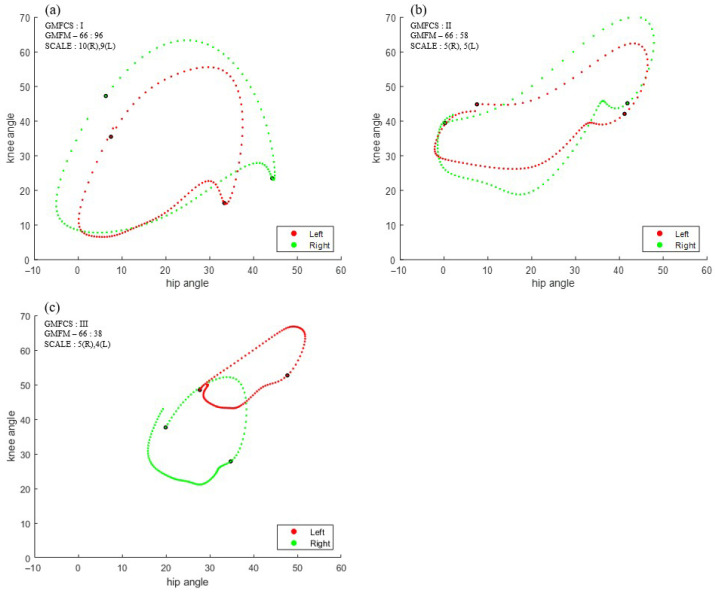 Figure 2
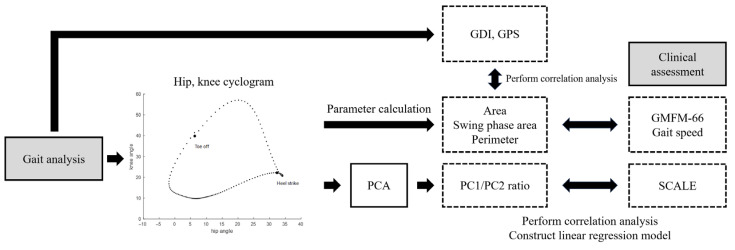 Figure 3
Peer Reviews
No public reviews on file for this paper yet. If you reviewed it on a platform where reviews are public (OpenReview, ICLR, NeurIPS, ICML), you can paste yours below so the community can read it here.
Videos
No videos yet. Explain this paper in a talk, walkthrough, or lecture? Add one.
Taxonomy
TopicsCerebral Palsy and Movement Disorders · Botulinum Toxin and Related Neurological Disorders · Stroke Rehabilitation and Recovery