The Anti-Nucleocapsid IgG Antibody as a Marker of SARS-CoV-2 Infection for Hemodialysis Patients
Akemi Hara, Shun Watanabe, Toyoaki Sawano, Yuki Sonoda, Hiroaki Saito, Akihiko Ozaki, Masatoshi Wakui, Tianchen Zhao, Chika Yamamoto, Yurie Kobashi, Toshiki Abe, Takeshi Kawamura, Akira Sugiyama, Aya Nakayama, Yudai Kaneko, Hiroaki Shimmura, Masaharu Tsubokura

TL;DR
This study shows that anti-nucleocapsid IgG antibodies can detect prior SARS-CoV-2 infection in hemodialysis patients, but their effectiveness decreases over time.
Contribution
Demonstrates the diagnostic accuracy of anti-IgG N antibodies in hemodialysis patients, a population with unique immune challenges.
Findings
Anti-IgG N antibodies showed high diagnostic accuracy (AUC: 0.973–0.865) in detecting prior SARS-CoV-2 infection.
Optimal cutoff for anti-IgG N was 0.01 AU/mL with sensitivity 1.00 and specificity 0.94.
Diagnostic accuracy declined over time, indicating a need for tailored strategies in hemodialysis patients.
Abstract
Background: Hemodialysis patients, due to impaired kidney function and compromised immune responses, face increased risks from SARS-CoV-2. Anti-nucleocapsid IgG (anti-IgG N) antibodies are a commonly used marker to assess prior infection in the general population; however, their efficacy for hemodialysis patients remains unclear. Methods: A retrospective study of 361 hemodialysis patients evaluated anti-IgG N antibodies for detecting prior SARS-CoV-2 infection. Antibody levels were measured using a chemiluminescence immunoassay (CLIA) over the four time points. Boxplots illustrated antibody distribution across sampling stages and infection status. Logistic regression and receiver operating characteristic (ROC) curve analysis determined diagnostic accuracy, sensitivity, specificity, and optimal cutoff values. Results: Among the 361 hemodialysis patients, 36 (10.0%) had SARS-CoV-2…
Genes, proteins, chemicals, diseases, species, mutations and cell lines named across the full text — each resolved to its canonical identifier and authoritative record.
Click any figure to enlarge with its caption.
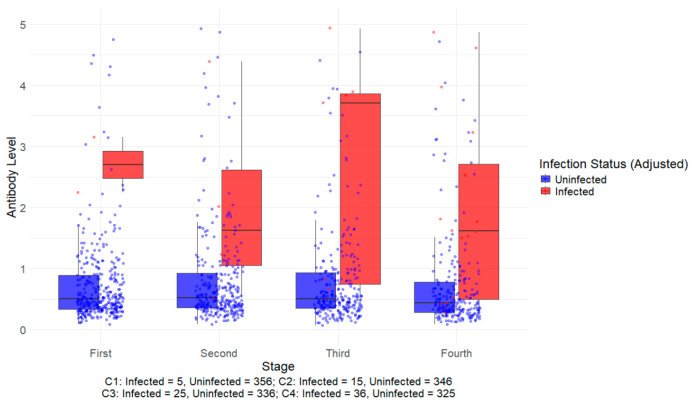 Figure 1
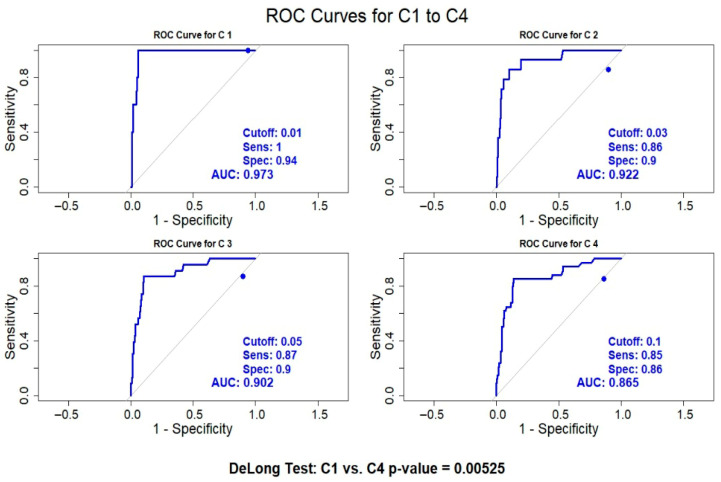 Figure 2
Peer Reviews
No public reviews on file for this paper yet. If you reviewed it on a platform where reviews are public (OpenReview, ICLR, NeurIPS, ICML), you can paste yours below so the community can read it here.
Videos
No videos yet. Explain this paper in a talk, walkthrough, or lecture? Add one.
Taxonomy
TopicsSARS-CoV-2 and COVID-19 Research · COVID-19 Clinical Research Studies · SARS-CoV-2 detection and testing