Dientamoeba fragilis in Ulcerative Colitis: Analysis of Clinical Findings and Biochemical Parameters
Ismail Taskiran, Erdogan Malatyali, Ibrahim Yildiz, Levent Durmus Guler, Evren Tileklioglu, Hatice Ertabaklar, Sema Ertug

TL;DR
This study found that Dientamoeba fragilis is present in some ulcerative colitis patients but does not significantly affect disease stage or symptoms.
Contribution
The study provides new insights into the clinical relevance of D. fragilis in adult ulcerative colitis patients.
Findings
D. fragilis was detected in 10.9% of ulcerative colitis patients.
No significant associations were found between D. fragilis and disease stage or symptoms.
All D. fragilis isolates were classified as genotype 1.
Abstract
Although Dientamoeba fragilis is a common protozoan in humans, its pathogenicity and clinical significance in human diseases remain poorly understood. This study aimed to determine the frequency of D. fragilis in adult ulcerative colitis patients and to assess its relationship with clinical findings, disease characteristics, and biochemical parameters. Patient data were analysed in a prospective, single-centre, cross-sectional design. Faecal samples were consecutively collected from June to December 2024 and screened for D. fragilis positivity using polymerase chain reaction. Of the 110 patients, 33 (30%) were in the active stage of the disease, while 77 (70%) were in remission. The overall frequency of D. fragilis was 10.9% (n = 12), with all isolates classified as genotype 1 according to SSU rRNA sequence analysis. Other protozoa identified were Blastocystis sp. (n = 5, 4.5%),…
Genes, proteins, chemicals, diseases, species, mutations and cell lines named across the full text — each resolved to its canonical identifier and authoritative record.
Click any figure to enlarge with its caption.
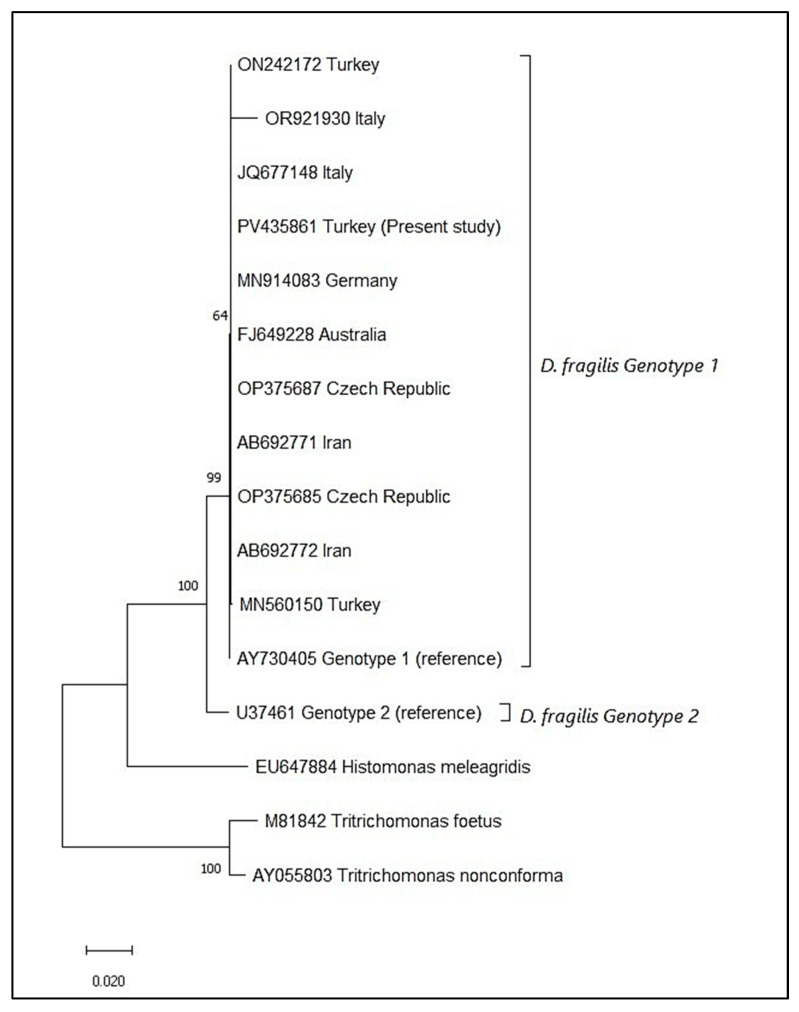 Figure 1
Peer Reviews
No public reviews on file for this paper yet. If you reviewed it on a platform where reviews are public (OpenReview, ICLR, NeurIPS, ICML), you can paste yours below so the community can read it here.
Videos
No videos yet. Explain this paper in a talk, walkthrough, or lecture? Add one.
Taxonomy
TopicsParasitic Infections and Diagnostics · Amoebic Infections and Treatments · Parasites and Host Interactions