Pathogen Enzyme-Mediated Alkoxyamine Homolysis as a Killing Mechanism of Aspergillus fumigatus
Marion Filliâtre, Pierre Voisin, Seda Seren, Ines Kelkoul, Olivier Glehen, Philippe Mellet, Sophie Thétiot-Laurent, Jean Menotti, Sylvain R. A. Marque, Gérard Audran, Abderrazzak Bentaher

TL;DR
This paper introduces a new antifungal strategy that uses a pathogen's own enzyme to generate toxic radicals, effectively killing drug-resistant Aspergillus fumigatus.
Contribution
A novel prodrug design that leverages pathogen enzyme activity to produce toxic radicals for antifungal action.
Findings
The alkoxyamine prodrug inhibits A. fumigatus growth in a concentration-dependent manner.
The strategy works against both voriconazole-susceptible and resistant A. fumigatus strains.
Reactive alkyl radicals are essential for antifungal activity, as non-radical substitutions failed to inhibit growth.
Abstract
The emergence of antifungal-resistant Aspergillus fumigatus (A. fumigatus) became a serious public health concern, underscoring the need for new effective antifungal agents. Here, we present a strategy based on the in situ generation of radical species that are toxic to the pathogen. The synthesis of an alkoxyamine linked to a peptide substrate recognized by A. fumigatus-secreted dipeptidyl peptidase is described. Kinetic experiments show a stable prodrug prior to enzymatic activation. Ensuing peptide cleavage and spontaneous homolysis resulted in the generation of a stable nitroxide and a reactive alkyl radical moiety. Next, the exposure of A. fumigatus spores to the prodrug lead to pathogen growth inhibition in a compound concentration-dependent fashion (e.g., 42% inhibition at 10 µg/L). Importantly, the designed alkoxyamine inhibited not only the growth of a clinical…
Genes, proteins, chemicals, diseases, species, mutations and cell lines named across the full text — each resolved to its canonical identifier and authoritative record.
Click any figure to enlarge with its caption.
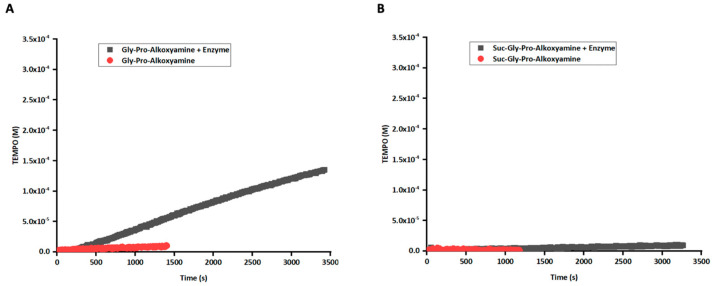 Figure 1
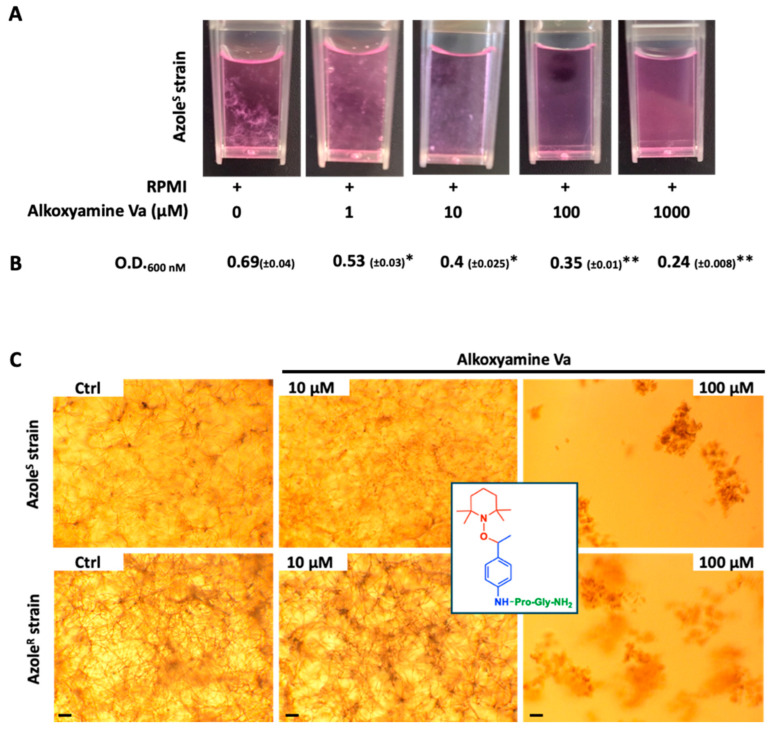 Figure 2
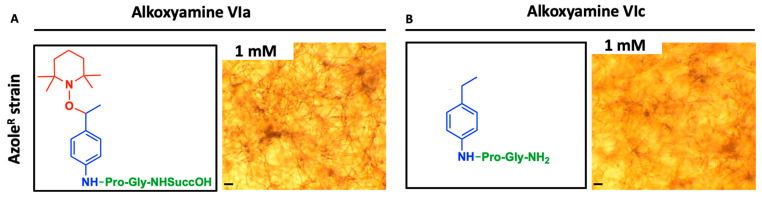 Figure 3
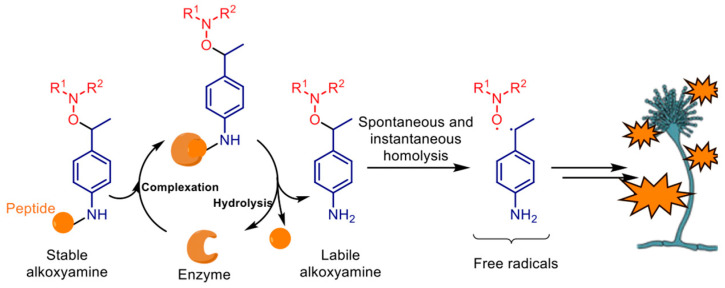 Figure 4
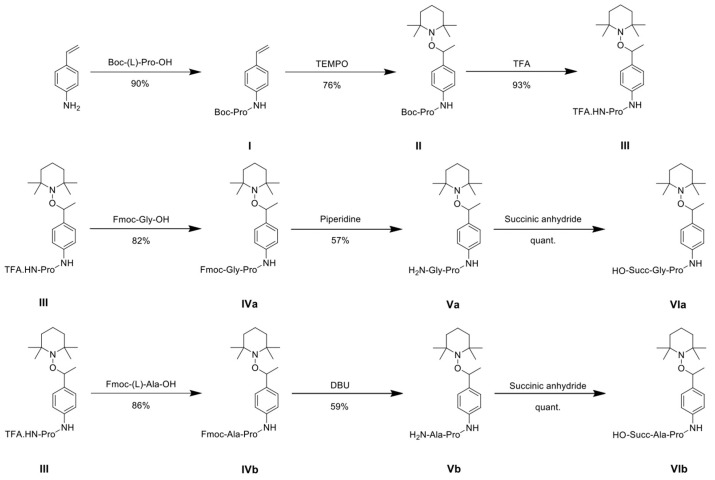 Figure 5
Peer Reviews
No public reviews on file for this paper yet. If you reviewed it on a platform where reviews are public (OpenReview, ICLR, NeurIPS, ICML), you can paste yours below so the community can read it here.
Videos
No videos yet. Explain this paper in a talk, walkthrough, or lecture? Add one.
Taxonomy
TopicsAntifungal resistance and susceptibility · Peptidase Inhibition and Analysis · Synthesis and Biological Evaluation