First Molecular Identification of Cotylophoron cotylophorum in Ecuador and Its Phylogenetic Relationship with Fasciola hepatica
Geanella Barragán-López, Fausto Bedoya-Páez, María Lugo-Almarza, Carolina Fonseca-Restrepo, Francisco Angulo-Cubillán, Edison J. Romero, Jacobus H. de Waard, Armando Reyna-Bello

TL;DR
This study identifies a new parasite species in Ecuador and explores its genetic relationship with another liver fluke affecting livestock.
Contribution
First molecular identification of Cotylophoron cotylophorum in Ecuador and its phylogenetic analysis with Fasciola hepatica.
Findings
Cotylophoron cotylophorum was identified in Ecuador with high genetic similarity to an Indian strain.
The bile-duct fluke showed strong genetic similarity to Fasciola hepatica isolates from Australia and Nigeria.
Distinct SNPs in ITS2 suggest a diploid genome structure in both trematode species.
Abstract
Trematode infections caused by Fasciolidae and Paramphistomidae remain widespread in livestock, resulting in substantial economic losses. The two distinct fluke families are difficult to distinguish morphologically, and molecular identification provides the most reliable means of accurate diagnosis. In Ecuador, however, molecular data on these parasites are scarce. In this study, we collected trematodes from cattle rumen and bile ducts, molecularly identified them, and assessed their phylogenetic relationship to Fasciola hepatica to determine their introduction pathways into South America. Genomic DNA was extracted, and PCR was used to amplify the ITS2 (~500 bp) and COXI (~266 bp) regions; all amplicons were Sanger-sequenced. Phylogenetic trees for both markers were constructed using a Maximum Likelihood approach with 1000 bootstrap replicates in CIPRES v3.3. The rumen fluke exhibited…
Genes, proteins, chemicals, diseases, species, mutations and cell lines named across the full text — each resolved to its canonical identifier and authoritative record.
Click any figure to enlarge with its caption.
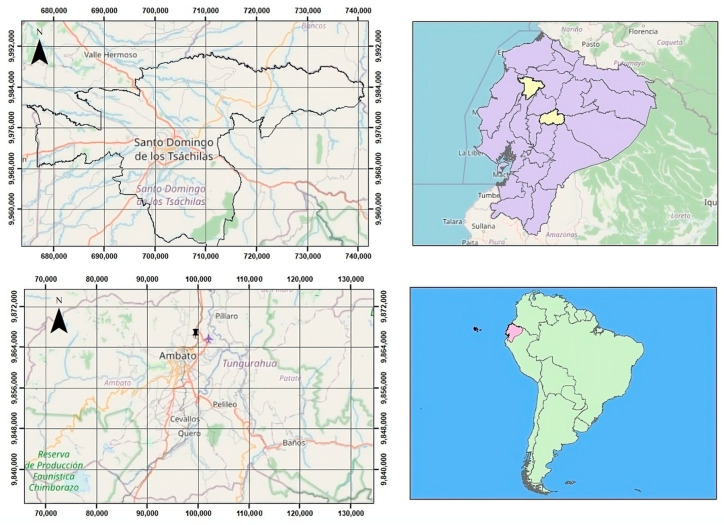 Figure 1
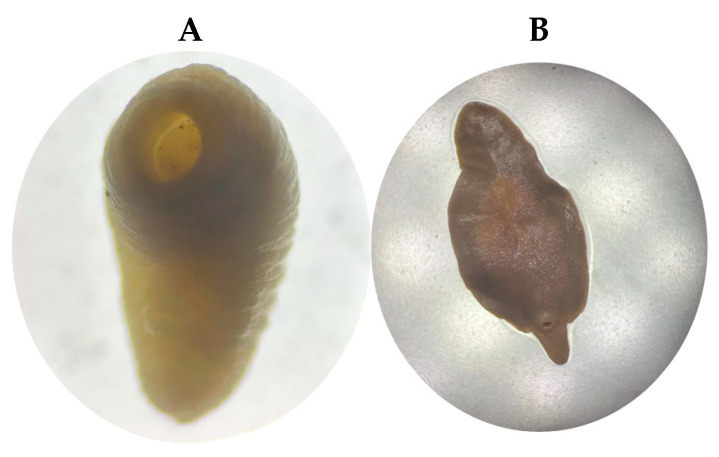 Figure 2
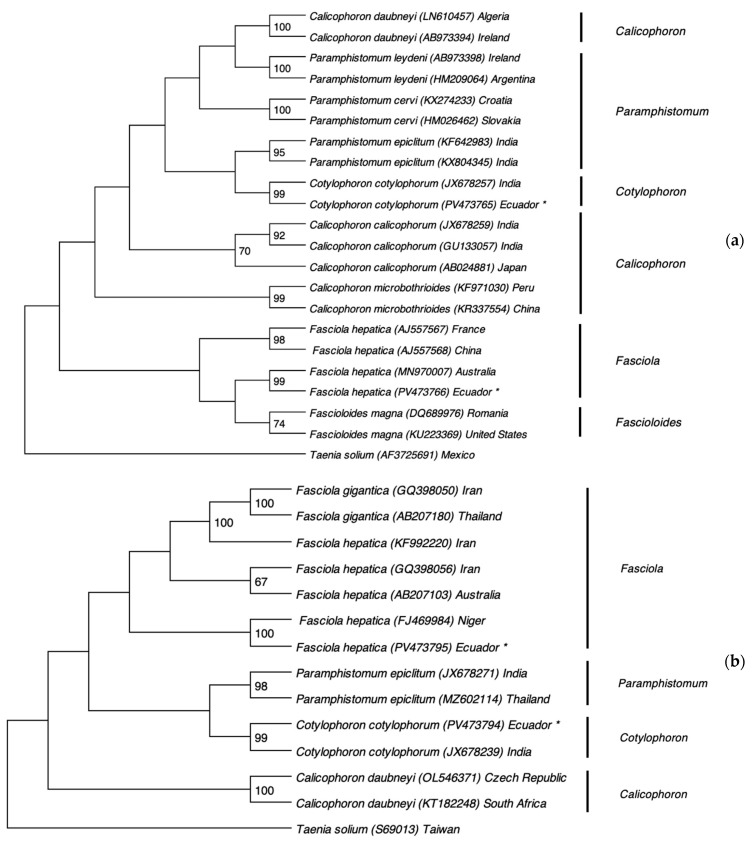 Figure 3
Peer Reviews
No public reviews on file for this paper yet. If you reviewed it on a platform where reviews are public (OpenReview, ICLR, NeurIPS, ICML), you can paste yours below so the community can read it here.
Videos
No videos yet. Explain this paper in a talk, walkthrough, or lecture? Add one.
Taxonomy
TopicsHelminth infection and control · Parasite Biology and Host Interactions · Coccidia and coccidiosis research