Genes linked to schistosome resistance identified in a genome-wide association study of African snail vectors
Tom Pennance, Jacob A. Tennessen, Johannie M. Spaan, Tammie J. McQuistan, George Ogara, Fredrick Rawago, Kennedy Andiego, Boaz Mulonga, Meredith Odhiambo, Martin W. Mutuku, Gerald M. Mkoji, Eric S. Loker, Maurice R. Odiere, Michelle L. Steinauer

TL;DR
Researchers identified genes in African snails that help them resist a parasite causing schistosomiasis, a tropical disease.
Contribution
The study discovered novel genomic regions in African snails linked to resistance against Schistosoma mansoni, distinct from those in neotropical snails.
Findings
Two genomic regions, SudRes1 and SudRes2, are associated with snail resistance to Schistosoma mansoni.
Resistant and susceptible snail haplotypes show coding differences, including presence/absence of entire genes.
Snail ancestry is strongly correlated with parasite compatibility, suggesting genetic influence on resistance.
Abstract
Schistosomiasis, a neglected tropical disease, is transmitted by freshwater snails. Interruption of transmission will require novel vector-focused interventions. We performed a genome-wide association study of African snails, Biomphalaria sudanica, exposed to Schistosoma mansoni in an endemic area of high transmission in Kenya. Two snail genomic regions, SudRes1 and SudRes2, were significantly associated with snail resistance to schistosomes. SudRes1 includes receptor-like protein tyrosine phosphatases while SudRes2 includes a class of leucine-rich repeat-containing G-protein coupled receptors, both comprising diverse extracellular binding domains suggestive of host-pathogen interaction. Resistant and susceptible haplotypes show numerous coding differences including presence/absence of entire genes. No loci previously tied to schistosome resistance in a neotropical snail species showed…
Genes, proteins, chemicals, diseases, species, mutations and cell lines named across the full text — each resolved to its canonical identifier and authoritative record.
Click any figure to enlarge with its caption.
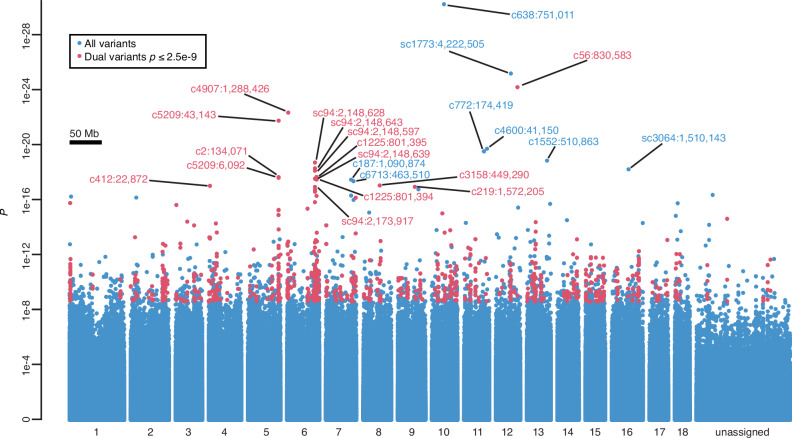 Figure 1
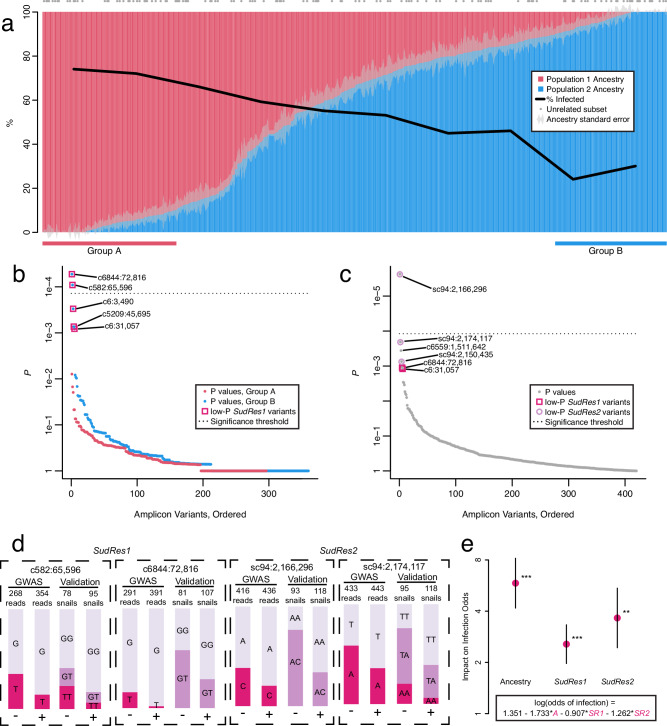 Figure 2
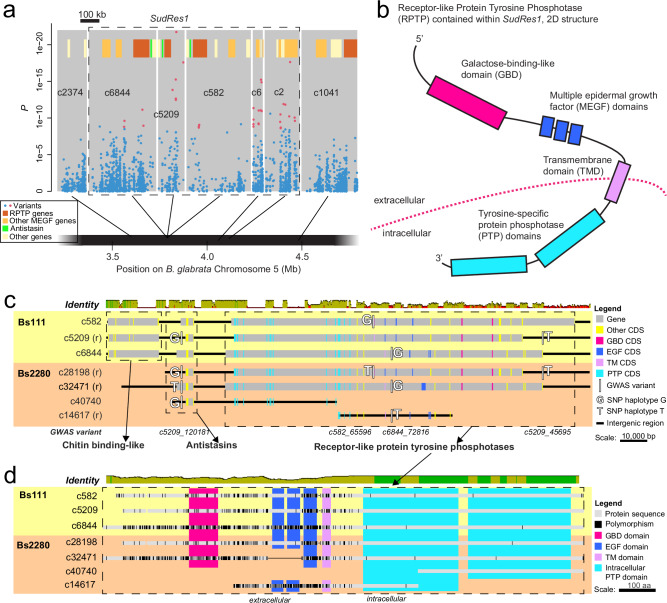 Figure 3
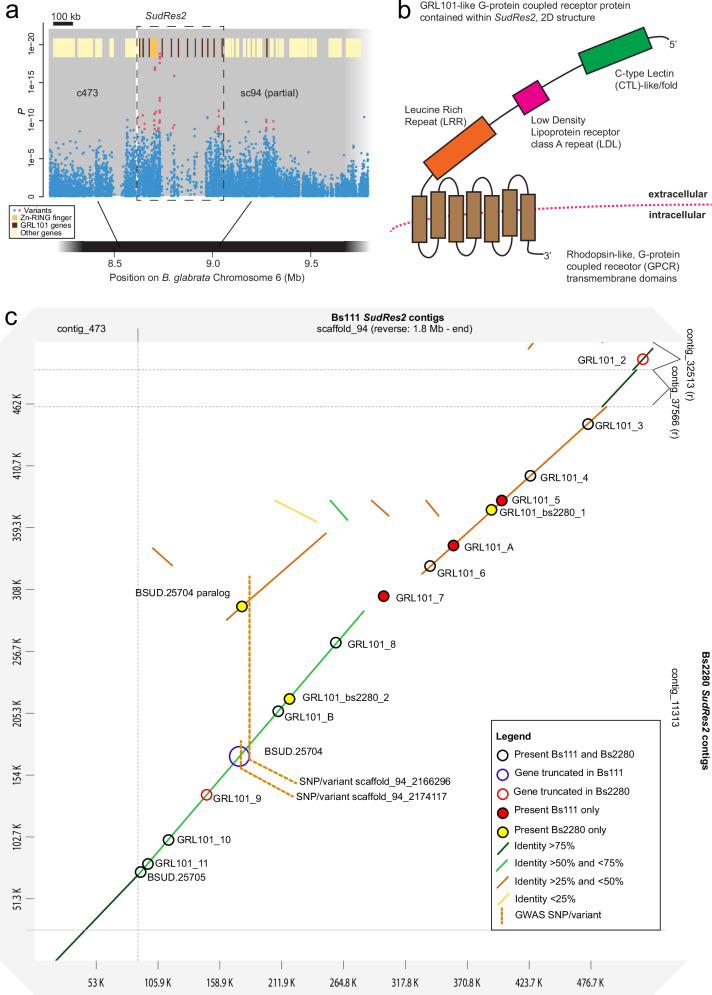 Figure 4
Peer Reviews
No public reviews on file for this paper yet. If you reviewed it on a platform where reviews are public (OpenReview, ICLR, NeurIPS, ICML), you can paste yours below so the community can read it here.
Videos
No videos yet. Explain this paper in a talk, walkthrough, or lecture? Add one.
Taxonomy
TopicsParasites and Host Interactions · Parasite Biology and Host Interactions · Research on Leishmaniasis Studies