125Te and 57Fe nuclear resonance vibrational spectroscopic characterization of intermediate spin state mixed-valent dimers
Aleksa Radović, Justin T. Henthorn, Hongxin Wang, Deepak Prajapat, Ilya Sergeev, Nobumoto Nagasawa, Yoshitaka Yoda, Stephen P. Cramer, George E. Cutsail

TL;DR
This paper explores how replacing sulfur with heavier elements in iron-sulfur clusters affects their spin states and vibrational properties.
Contribution
The study reveals that heavier chalcogens reduce vibronic coupling, enabling intermediate spin states in mixed-valent iron complexes.
Findings
Heavier chalcogens like Te decrease vibronic coupling in [2Fe-2S]+ clusters.
Intermediate S = 3/2 spin states are unattainable with lighter Fe2Q2 cores.
NRVS and DFT show the role of vibronic coupling in modulating electronic structures.
Abstract
Iron-sulfur clusters fulfill numerous roles throughout biology. The reduced [2Fe-2S]+ cluster offers unique electronic and magnetic properties due to its mixed-valent nature and can serve as an essential model for understanding electron transfer, electron delocalization, and accessible spin states not only in mixed-valent dimers, but potentially larger iron sulfur clusters. Recently a series of mixed-valent diiron dichalcogenide complexes [L2Fe2Q2]− (Q = S (1), Se (2), Te (3), L = 2,6-diisopropylphenyl β-diketiminate ligand) were synthesized and characterized, where complex 1 showed a typical S = 1/2 spin state, while complexes 2 and 3 exhibited intermediate S = 3/2 spin states, potentially enabled by the minimization of vibronic coupling. Here we studied the vibrational dynamics of the Fe and Te centers in these complexes using 57Fe and 125Te nuclear resonance vibrational spectroscopy…
Genes, proteins, chemicals, diseases, species, mutations and cell lines named across the full text — each resolved to its canonical identifier and authoritative record.
Click any figure to enlarge with its caption.
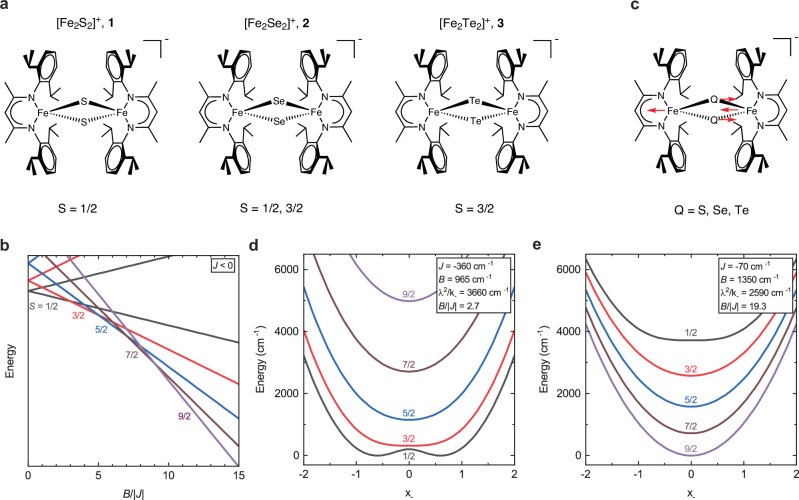 Figure 1
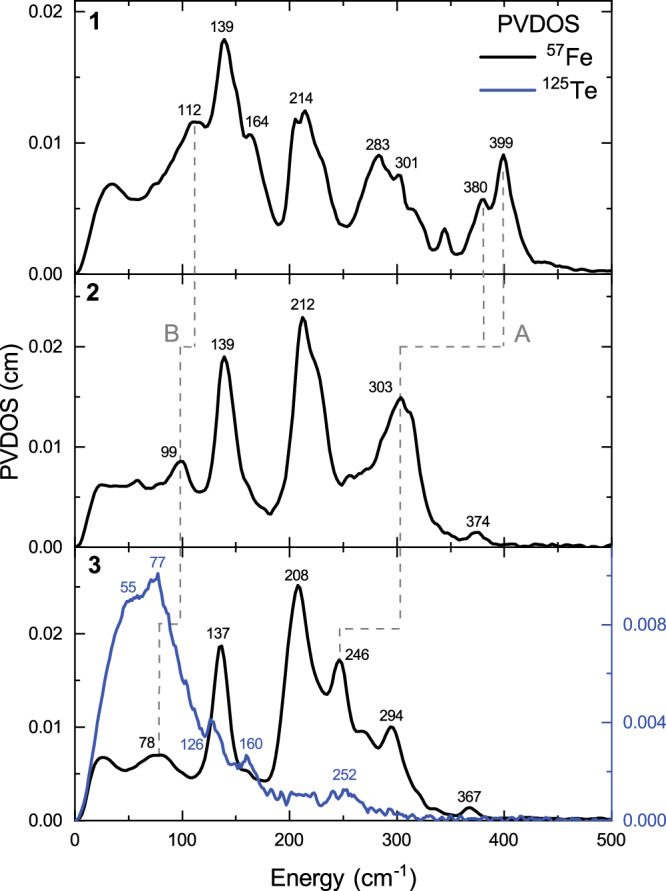 Figure 2
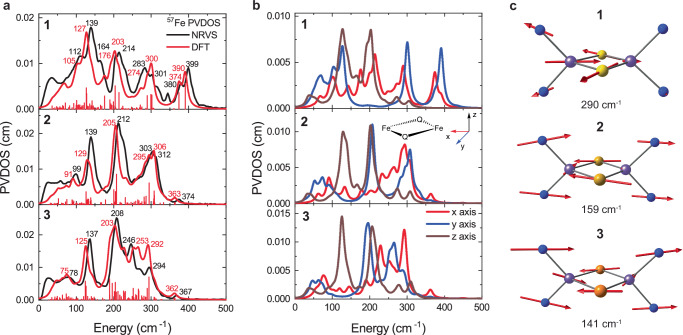 Figure 3
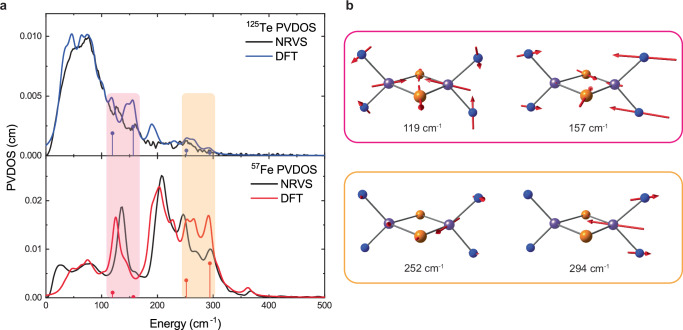 Figure 4
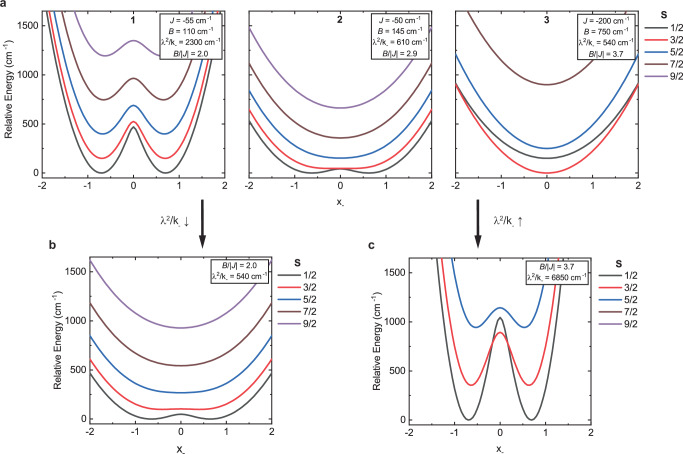 Figure 5
Peer Reviews
No public reviews on file for this paper yet. If you reviewed it on a platform where reviews are public (OpenReview, ICLR, NeurIPS, ICML), you can paste yours below so the community can read it here.
Videos
No videos yet. Explain this paper in a talk, walkthrough, or lecture? Add one.
Taxonomy
TopicsMetalloenzymes and iron-sulfur proteins · Magnetism in coordination complexes · Inorganic Chemistry and Materials