Sex-differences in Mountain Ultra-trail Performance: Look at the Scenery
Grégoire P. Millet, Alexa Callovini, Antoine Raberin

TL;DR
This paper explores why sex differences in ultra-trail running performance are larger in mountainous terrain due to factors like uphill running, altitude, and temperature changes.
Contribution
The paper identifies three mountain-specific factors that amplify sex differences in ultra-distance running compared to flat terrain.
Findings
Sex differences in uphill endurance performance are about twice as large as on flat terrain.
Females show greater hypoxemia at altitude due to sex-sensitive ventilatory responses.
Females face thermoregulatory challenges in cold mountain environments due to lower muscle mass and higher surface area-to-mass ratio.
Abstract
There is a growing body of literature on sex-differences in human performance, particularly in the context of endurance sports. However, several mechanisms (e.g., higher type 1 fibres proportion; lesser neuromuscular fatigue; higher metabolic flexibility etc) have been previously proposed and suggest an advantage to females over ultra-endurance competitions on flat terrain. However, in mountain ultramarathon, the percent sex difference between male and female records appears to be larger than on various road/track running distances on flat terrain, suggesting that additional factors related to the specific mountainous conditions may be at play. In this Current Opinion, we point to three specific factors that are likely to influence and widen sex differences in ultra-distance running events performed in the mountains (i.e., uphill– downhill locomotion, altitude, and changes in extreme…
Genes, proteins, chemicals, diseases, species, mutations and cell lines named across the full text — each resolved to its canonical identifier and authoritative record.
Click any figure to enlarge with its caption.
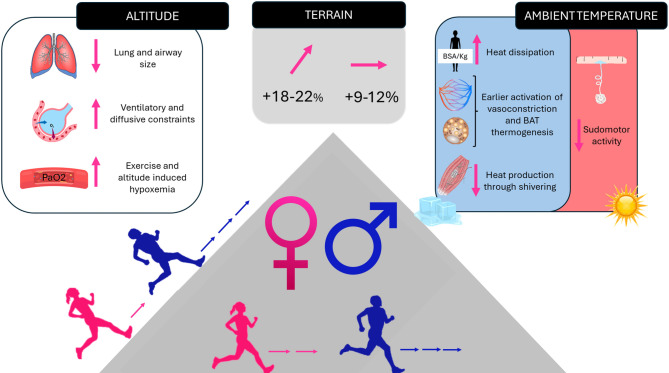 Figure 1
Peer Reviews
No public reviews on file for this paper yet. If you reviewed it on a platform where reviews are public (OpenReview, ICLR, NeurIPS, ICML), you can paste yours below so the community can read it here.
Videos
No videos yet. Explain this paper in a talk, walkthrough, or lecture? Add one.
Taxonomy
TopicsHigh Altitude and Hypoxia · Exercise and Physiological Responses · Muscle metabolism and nutrition