Understanding the Utility of Automation for Diagnosing Spontaneous Bacterial Peritonitis and Its Variants
Yasha Mukim, C Ganesh Pai, Chaitanya Tellapragada, Vandana K.E

TL;DR
This study shows that automated culture methods are much better than traditional methods for diagnosing bacterial infections in the abdominal fluid of cirrhotic patients.
Contribution
The study demonstrates that automated culture systems significantly improve pathogen detection in ascitic fluid, especially for rare and fastidious organisms.
Findings
Automated culture detected pathogens in 40% of cases, compared to 9.8% with conventional methods.
Rare organisms like Campylobacter spp. and Aeromonas spp. were only isolated using automated culture.
Automated systems identified four times more infections, making them a preferred diagnostic tool for SBP.
Abstract
Background: Spontaneous bacterial peritonitis (SBP) is the most frequent bacterial infection in cirrhotic patients with ascites, marking early hepatic decompensation. Variants of SBP are classified based on ascitic fluid polymorphonuclear neutrophil count and culture positivity. Methods: A prospective cross-sectional study was conducted from 2014 to 2016 at a tertiary care hospital in South India. The study compared the diagnostic yield of conventional versus automated culture methods for detecting SBP and its variants. Ascitic fluid samples were cultured using conventional culture and/or automated culture methods, based on the clinician’s preference. Results: Among 190 patients with ascites, automated culture was performed in 175 patients (92%) and conventional in 82 patients (43%). An automated blood culture system detected pathogens in 70 patients (40%), whereas conventional…
Genes, proteins, chemicals, diseases, species, mutations and cell lines named across the full text — each resolved to its canonical identifier and authoritative record.
Click any figure to enlarge with its caption.
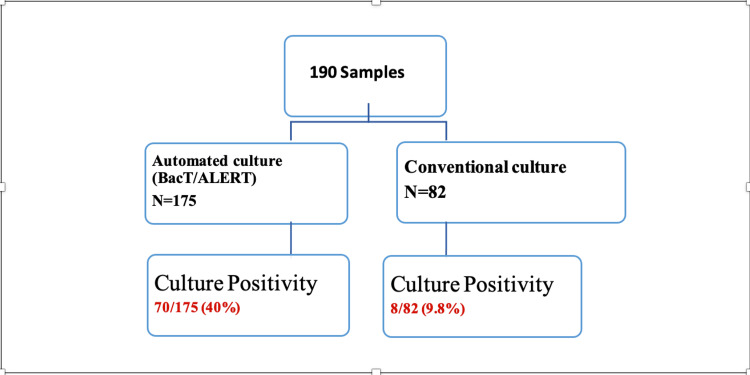 Figure 1
 Figure 2
 Figure 3
 Figure 4
Peer Reviews
No public reviews on file for this paper yet. If you reviewed it on a platform where reviews are public (OpenReview, ICLR, NeurIPS, ICML), you can paste yours below so the community can read it here.
Videos
No videos yet. Explain this paper in a talk, walkthrough, or lecture? Add one.
Taxonomy
TopicsLiver Disease and Transplantation · Liver Disease Diagnosis and Treatment · Abdominal vascular conditions and treatments