Physical activity and cancer biology: a narrative review of molecular mechanisms and introduction of the SCRUM-MONSTAR LIFELOG study
Shugo Yajima, Shin Kobayashi, Tadayoshi Hashimoto, Yoshiaki Nakamura, Riu Yamashita, Toshihiro Misumi, Yasutoshi Sakamoto, Satoshi Horasawa, Takao Fujisawa, Mitsuho Imai, Taro Shibuki, Yuichiro Tsukada, Hideaki Bando, Hitoshi Masuda, Takayuki Yoshino

TL;DR
This paper reviews how physical activity affects cancer biology and introduces a new study that combines wearable activity tracking with molecular profiling to uncover the mechanisms behind these effects.
Contribution
The study introduces the first comprehensive integration of continuous physical activity monitoring with multi-omics profiling in cancer patients.
Findings
Physical activity is linked to improved cancer outcomes, but the molecular mechanisms are not well understood.
The LIFELOG study will investigate associations between physical activity and molecular profiles, including MRD, transcriptome, proteome, and microbiome data.
Preliminary results from the feasibility phase show good device compliance and data quality.
Abstract
Physical activity (PA) has been consistently associated with improved cancer outcomes across multiple epidemiological studies. While the evidence for clinical benefits is strong, the underlying molecular mechanisms remain poorly understood. Recent technological advances now enable both continuous monitoring of PA through wearable devices and comprehensive molecular profiling through multi-omics approaches, including whole-genome sequencing (WGS)-based molecular residual disease (MRD) detection. This review examines current evidence regarding PA’s effects on cancer biology and introduces the LIFELOG study, which aims to address critical knowledge gaps in this field. We review the current literature on PA and cancer with emphasis on molecular mechanisms, and present the design of the LIFELOG study, an ancillary study to MONSTAR-SCREEN-3. The LIFELOG study will enroll 170 post-surgical…
Genes, proteins, chemicals, diseases, species, mutations and cell lines named across the full text — each resolved to its canonical identifier and authoritative record.
Click any figure to enlarge with its caption.
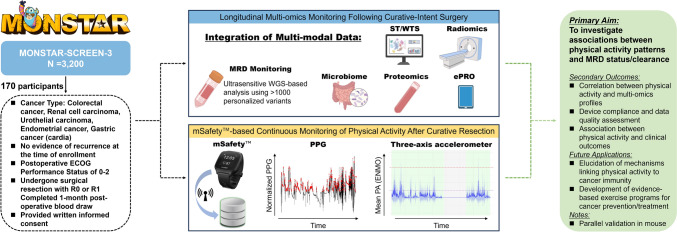 Figure 1
Peer Reviews
No public reviews on file for this paper yet. If you reviewed it on a platform where reviews are public (OpenReview, ICLR, NeurIPS, ICML), you can paste yours below so the community can read it here.
Videos
No videos yet. Explain this paper in a talk, walkthrough, or lecture? Add one.
Taxonomy
TopicsPhysical Activity and Health · Cardiovascular and exercise physiology · Adipose Tissue and Metabolism