Risks and benefits of ChatGPT in informing patients and families with rare kidney diseases: an explorative assessment by the European Rare Kidney Disease Reference Network (ERKNet)
Albertien M. van Eerde, Ana Teixeira, Flavia Galletti, Michal Maternik, Valentina Capone, Rik Westland, Jaap Mulder, Jan Halbritter, Thomas Osterholt, Valentina Neukel, Lutz T. Weber, Max C. Liebau, Franz Schaefer, Stefan Kohl

TL;DR
This study explores how ChatGPT can help patients and families with rare kidney diseases by providing accurate and helpful information.
Contribution
The study is the first to assess ChatGPT's potential in informing patients about rare kidney diseases through expert and patient advocacy group evaluations.
Findings
ChatGPT provided accurate and helpful information on 28 rare kidney diseases.
Participants expressed neutral views on ChatGPT's recommendations for alternative treatments and second opinions.
ChatGPT showed potential in real-world patient inquiries but requires human oversight for safety.
Abstract
Rare diseases affect fewer than 1 in 2000 individuals, but approximately 150 rare kidney diseases account for about 10% of the chronic kidney disease (CKD) population, impacting millions across Europe and globally. The scarcity of medical experts for these conditions results in an unmet need for accurate and helpful patient information. Large language models like ChatGPT may offer a technological solution to assist medical professionals in educating patients and improving doctor-patient communication. We hypothesized that ChatGPT could provide accurate responses to frequently asked basic questions from patients with rare kidney diseases. Medical professionals and members of European Patient Advocacy Groups (ePAGs) affiliated with the European Rare Kidney Disease Reference Network (ERKNet) simulated patient-ChatGPT interactions using a Microsoft forms questionnaire and ChatGPT 3.5 and…
Genes, proteins, chemicals, diseases, species, mutations and cell lines named across the full text — each resolved to its canonical identifier and authoritative record.
Click any figure to enlarge with its caption.
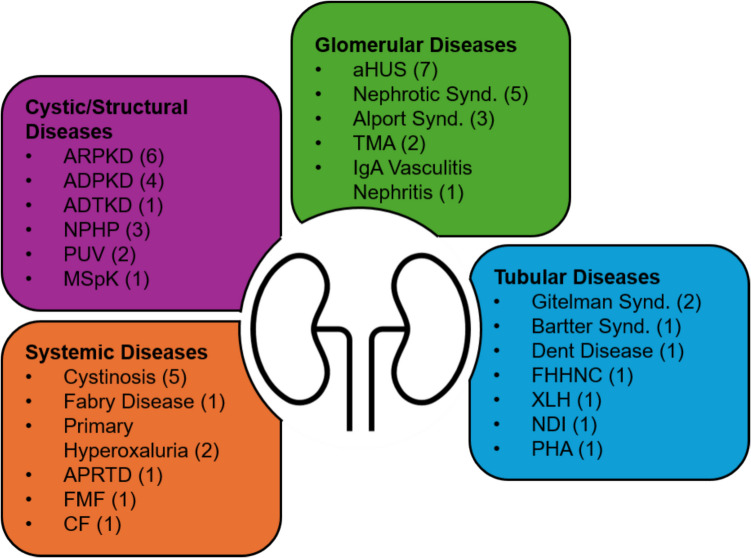 Figure 1
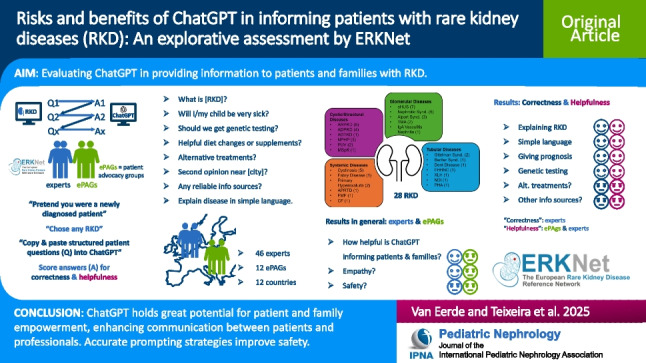 Figure 2
Peer Reviews
No public reviews on file for this paper yet. If you reviewed it on a platform where reviews are public (OpenReview, ICLR, NeurIPS, ICML), you can paste yours below so the community can read it here.
Videos
No videos yet. Explain this paper in a talk, walkthrough, or lecture? Add one.
Taxonomy
TopicsArtificial Intelligence in Healthcare and Education · Renal and related cancers · Renal Diseases and Glomerulopathies